
BOI eyes Philippines as Southeast Asia's EV training hub
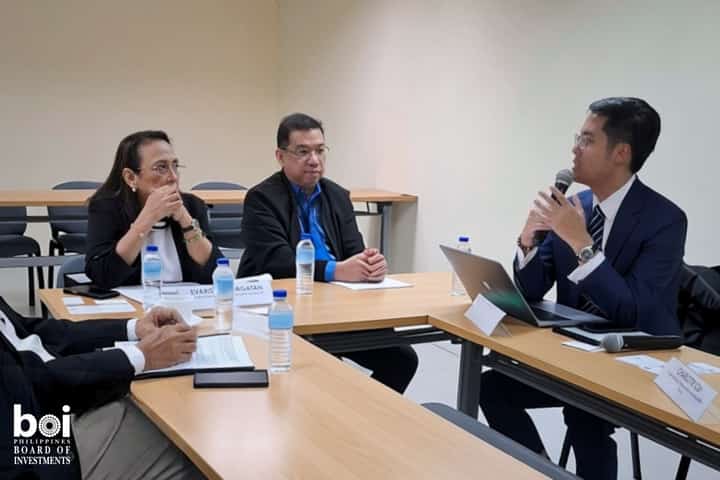
(L-R) BOI Investments Promotion Service Executive Director Evariste Cagatan, BOI Managing Head Ceferino Rodolfo, and Beifang General Manager of its International Department and Director for its Americas Market Zhang Zhihao.
BOI
The Board of Investments (BOI) is exploring a partnership with China's Beifang Automotive Education Group to position the Philippines as a regional hub for electric vehicle (EV) talent development and technical training.
Trade Undersecretary and BOI Managing Head Ceferino Rodolfo, together with BOI Executive Director for Investments Promotion Evariste Cagatan, recently met with Beifang officials led by International Department General Manager Zhang Zhihao and Project Manager Cui Yumeng.
Also present were representatives from the Electric Vehicle Association of the Philippines, the Chamber of Automotive Manufacturers of the Philippines Inc., the Truck Manufacturers Association and the Motor Vehicle Parts Manufacturers Association of the Philippines.
The meeting focused on possible cooperation in skills development, certification programs and EV training facilities to support the country's growing automotive industry.
Stakeholders also discussed workforce requirements across the automotive manufacturing value chain, highlighting the importance of targeted technical training and school-industry partnerships to strengthen the Philippines' competitiveness as an investment destination.
Rodolfo said developing a skilled workforce is critical as the country's EV industry continues to expand.
While the local EV sector is growing rapidly, he noted that the shortage of skilled technical professionals remains a major challenge to attracting high-value investments and scaling the industry.
He also raised the possibility of establishing a flagship EV training center that could position the Philippines as a regional training hub for new energy vehicle technologies in Southeast Asia.
Both sides identified potential areas of collaboration in automotive education and workforce development to enhance the country's participation in the global EV value chain.
Beifang also invited BOI officials and Philippine industry stakeholders to visit its headquarters in Beijing to gain firsthand experience with its automotive training platforms and education systems.
Founded in 1993, Beifang Automotive Education Group is China's largest automotive vocational education institution and a manufacturer of automotive training equipment. It offers programs covering internal combustion engine, hybrid, electric and hydrogen vehicle technologies, supporting workforce development for major global automakers, including Volkswagen, Mercedes-Benz, BMW, Audi, Toyota, BYD, Tesla and NIO.
The BOI said the initiative supports its goal of making the Philippines a premier destination for smart and sustainable manufacturing and services in Southeast Asia.
The announcement came a day after Malacañang said President Ferdinand Marcos Jr. signed Executive Order No. 121, or the Electric Vehicle Incentive Strategy, which aims to attract EV investments, strengthen local manufacturing and create more jobs for engineers, technicians, factory workers and logistics personnel.
Under the program, qualified companies may receive incentives, including tax payment certificates, to encourage investments in EV manufacturing.
"The EVIS Program is hereby adopted to promote local manufacturing of EVs, including their parts and components, attract investments to expand domestic EV manufacturing operations, and develop the Philippines as a regional automotive manufacturing hub," the executive order states.