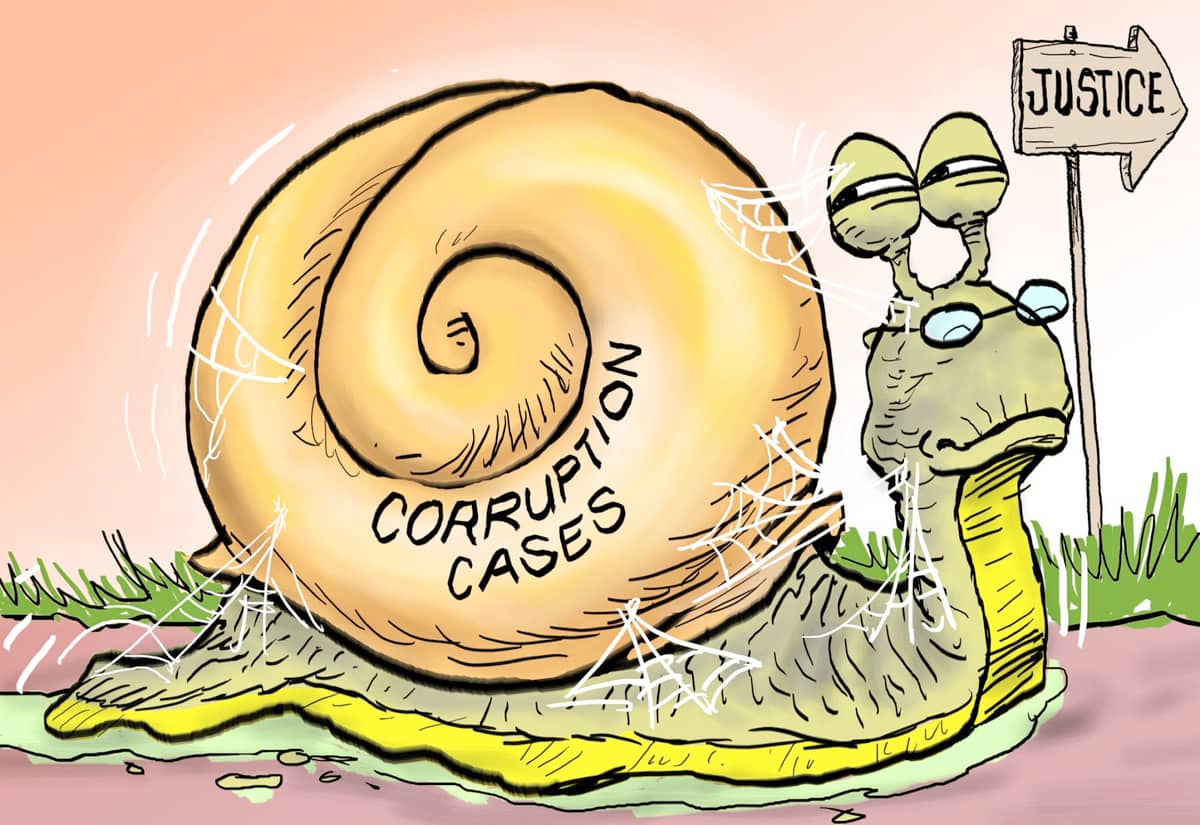
Why is probe moving at snail’s pace?

Nosy Tarsee has found one reason the probe into corruption cases in ghost flood control projects seemed to move at a snail’s pace after sources in a key anti-graft body revealed that “another system is operating behind the scenes.” No wonder that body has earned the tag of a court of selective justice.
The scheme is restitution, short for “for the boys,” according to a Tarsier source in the court.
On paper, restitution is straightforward. If public money was stolen, it should be recovered and returned to the Filipino people. No reasonable person disputes that principle.
But restitution derives its legitimacy from transparency. Once discussions about repayment begin before prosecutions are completed, once reports emerge that restitution is being discussed alongside witness cooperation, and once the process itself becomes opaque, the issue is no longer simply about recovering public funds.
It becomes an issue of public trust. That is why the growing public discussion surrounding individuals allegedly involved in restitution negotiations cannot simply be ignored.
Names have surfaced in public conversations. One of them is a figure known only by the nickname “Nanang.”
Who — or what — is this figure? Is it a person? A nickname? A code name? An intermediary? A private facilitator? Or nothing more than rumor?
Another name repeatedly mentioned in public discussions is that of a businessman.
There is no publicly established evidence proving that this businessman acted as an intermediary or negotiated restitution arrangements. That is precisely why the relevant body should resolve the issue — not with silence, but with facts.
If he had no role whatsoever, a formal statement supported by a credible inquiry would put the speculation to rest. If he had a lawful role, the public deserves to know exactly what that role was, who authorized it and what limits governed it.
The same standard applies to the other names repeatedly associated with the restitution issue.
A senior official in the body has publicly defended restitution as an accountability measure. That public position inevitably raises legitimate questions about the scope of his participation. Was his role confined to explaining government policy, or did it extend to the operational implementation of restitution discussions?
Likewise, questions have been raised publicly regarding two other individuals. Those questions deserve answers grounded on documents, not speculation.
This is not about convicting people in the court of public opinion. It is about protecting the integrity of public institutions. The simplest way to protect innocent people from rumors is complete transparency.
If restitution is lawful, there should be nothing mysterious about it. There should be no need for whispered conversations, unnamed intermediaries, or closed-door negotiations.
Without that transparency, restitution begins to resemble something else entirely — probably a “bribe,” “parking fee,” or simply put, something “for the boys.”
Then comes the second and perhaps more troubling chapter of the story. The extraordinary disparity in prosecutorial speed. For months, the Filipino people were told that the country’s most powerful political personalities would soon face the courts.
Specific deadlines were announced. Specific dates were repeated. Specific assurances were given. Christmas came and went. The promised warrants did not. The promised wave of prosecutions never materialized.
Yet when the prosecutorial machinery finally moved at full speed, it moved with remarkable urgency against two sitting senators publicly identified with one political bloc.
One senator’s case moved from complaint to detention in remarkably short order, while the other’s prosecution advanced with similar urgency. No one argues that either should have been immune from prosecution. If the evidence supports criminal charges, the law should take its course.
The question is why the same urgency appears to be absent elsewhere.
Why were cases repeatedly described as “almost ready for filing” still awaiting prosecution months later? Why did some investigations appear to accelerate while others seemed trapped in procedural limbo?
Complex corruption cases naturally move at different speeds. But when prosecutors themselves publicly describe certain cases as nearly complete, only to leave them unresolved while others move rapidly from investigation to detention, the burden shifts to the institution.
The relevant body must explain the difference. Otherwise, the appearance of unequal justice becomes impossible to ignore.
That is where restitution returns to the center of the discussion. The public is entitled to know whether restitution had any bearing whatsoever on prosecutorial decisions.
The body still has an opportunity to answer that perception with evidence rather than assurances. Until it does, the most damaging question confronting the institution will not concern restitution itself.