
Court subpoenas VP’s bank, tax records
‘So we need to examine the extent of her wealth and compare it against her legitimate income.’
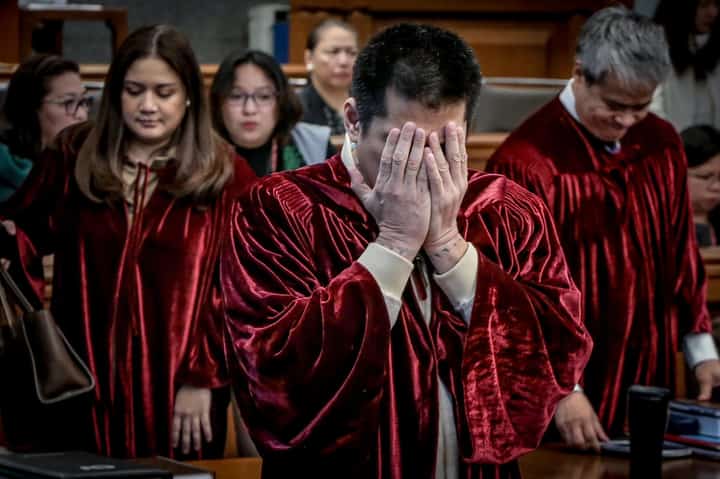
SENATOR Robinhood Padilla covers his face with both hands in a quiet moment of reflection before the start of Day 7 of the impeachment trial of Vice President Sara Duterte on Monday, perhaps underscoring the weight of the proceedings ahead. Also in the frame are fellow senator-judges Camille Villar and Joel Villanueva before the day's session began.
PHOTOGRAPH by aram lascano for DAILY TRIBUNE
The Senate impeachment court on Monday granted the prosecution’s request to subpoena the bank and tax records of Vice President Sara Duterte and her husband, Atty. Manases Carpio, over strong defense objections that the move violates due process and statutory confidentiality laws.
After almost four grueling hours of intense debate, impeachment court presiding officer Sen. Francis “Chiz” Escudero declared that the prosecution’s request to subpoena Duterte’s financial records “meets the requirements” set forth by the court.
“They are reasonably described, readily identifiable, and prima facie relevant and material to the allegations under Article II,” said Escudero during the seventh day of the impeachment trial.
Article II of the Articles of Impeachment focuses on allegations that Duterte acquired unexplained wealth and that she deliberately failed to truthfully disclose this in her Statements of Assets, Liabilities and Net Worth (SALNs), as well as for her failure to comply with the mandatory divestment in business interests.
Senators challenge ruling
Meanwhile, four senator-judges — Alan Peter Cayetano, Loren Legarda, Camille Villar and Imee Marcos — are set to challenge the Senate court’s ruling through separate written manifestations.
Senator Christopher “Bong” Go said he would file his own manifestation.
The prosecutors have argued that the subpoenaed documents are necessary to support the allegations of unexplained wealth under the impeachment complaint.
Produce records, banks told
On Monday, Escudero announced that the impeachment court granted the prosecution’s request and ordered the banking institutions concerned to produce the records pertaining to the separate and joint accounts of Duterte and Carpio, as well as those of their law firm and 19 companies allegedly linked to them.
Escudero pointed out that these financial records are relevant because spouses are mandated to disclose their joint assets under the Code of Conduct and Ethical Standards for Public Officials and Employees (RA 6713).
“The banks are ordered to submit to the Clerk of Court the documents on 30 July 2026, at 9 a.m. with the attendance of the parties’ counsels,” Escudero said.
As a result, Duterte’s financial records from 2007 to 2021 will be submitted to the court.
The House prosecutors had sought to compel the disclosure of Duterte’s and Carpio’s financial history to support allegations that she amassed unexplained wealth, a charge contained under Article II.
House prosecutor Chel Diokno had argued that even existing jurisprudence allowed the disclosure of the records in question as they were necessary to provide a clear picture of the Duterte’s total wealth and to ascertain whether her income was acquired through legitimate and not unlawful dealings.
“So we need to examine the extent of her wealth and compare it against her legitimate income. That could only be determined by looking at the records that we are requesting from this honorable court,” Diokno told the senator-judges on Monday.
Defense panel member Atty. Michael Poa countered, however, that the prosecution’s thesis failed to meet the two key requirements to justify the issuance of a subpoena — which are the definiteness and the relevance of the financial records to the impeachment case.
Poa contended that the prosecution’s request was “fatally overboard” as it sought to unseal Duterte’s financial records from as far back as 2007, or almost two decades ago. At that time Duterte was Davao City vice mayor, which Poa said was not an impeachable office.
He argued that this was tantamount to an “unlimited search” through Duterte’s financial history, which he argued was not permitted by tax and privacy laws.
“The documents they are asking for, Your Honors, while specified, if you look really carefully, they are asking for all bank records without any assertions as to why all of these are relevant to prove whatever allegations they have stated in the Articles of Impeachment,” Poa told the impeachment court.
Citing the Anti-Money Laundering Act (RA 9160), Poa said the law did not include impeachment as an exception to the prohibition on disclosure; thus, the court could not compel the production of the records in question.
He stressed that demanding the production of these documents overrode the legal protections, such as the absolute confidentiality of bank deposits under the Bank Secrecy Law and the Tax Code.
“While the impeachment court is a constitutional creation, it cannot go over and above the Constitution itself,” Poa said.
Diokno, meanwhile, argued that the ruling on the subpoena did not necessarily mean that the financial records would be automatically admissible as evidence in the court.
He averred that the Senate impeachment court was confronted with a similar issue during the impeachment trial of the late Supreme Court chief justice Renato Corona in 2012, during which the court accepted the same requested documents as evidence.
He also disputed Poa’s assertion regarding the Bank Secrecy Law, saying that the law, although it generally provides that all bank deposits are absolutely confidential, does not prohibit disclosure in impeachment proceedings.