
Gov't expands salt farms to cut imports
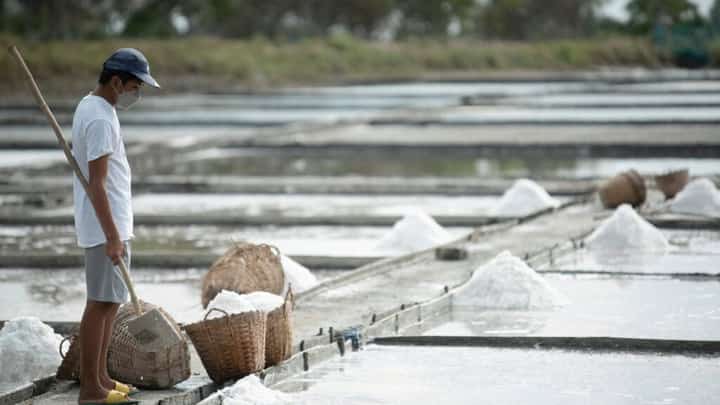
The government is expanding its salt farm development program to more coastal communities to boost domestic production and gradually reduce the country's reliance on imported salt.
The Bureau of Fisheries and Aquatic Resources (BFAR) said Monday it will continue rolling out its Development of Salt Industry Project (DSIP) nationwide after local salt production posted gains in the first half of the year, signaling early progress in reviving the industry.
Domestic production of artisanal, solar, and cooking salt reached more than 199,000 metric tons (MT) from January to June, according to BFAR.
"We are pleased with the improvement in salt output from January to June this year, reflecting gains of the DSIP.
BFAR will continue to provide unwavering support to the Philippine salt industry as we work toward unlocking its full potential," BFAR National Director Elizer Salilig said.
The DSIP targets to rehabilitate salt farms, improve local production capacity, and provide alternative livelihood opportunities for coastal communities while strengthening the country's salt supply.
One community benefiting from the program is Barangay Tawagan Sur in Pagadian City, where a 19-member fisherfolk association, most of them women, shifted from seaweed farming to salt production with BFAR's assistance.
Before production began, the bureau conducted site assessments and salinity tests to determine the area's suitability for salt farming. It also provided key infrastructure, including solar beds, greenhouse tunnel-type salt dryers, elevated solar dryers, storage facilities, and production equipment.
The association produced nearly 7 MT of high-quality salt in 2025 and now operates 12 ground-level solar beds, four greenhouse dryers, 19 elevated solar dryers, and two storage facilities.
To further expand production, BFAR Region IX is set to provide an iodizing machine this year, while the Department of Science and Technology is extending technical assistance on iodization and the development of value-added salt products.
Pagadian City Agriculturist Engr. Ramon Rodrigo said the project demonstrates how government support can help revive the local salt industry while creating sustainable livelihoods.
"Revitalizing the salt industry is essential to strengthening our local production. What we are seeing in Tawagan Sur is proof that with the right support, technical guidance, and community determination, we can produce high-quality salt and secure sustainable livelihoods," Rodrigo said.