
Rio Tuba sets mine rehabilitation benchmark

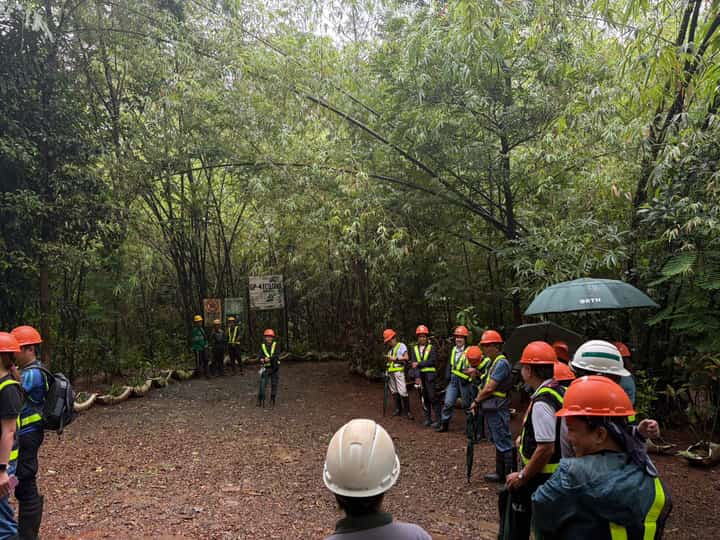
Rio Tuba Nickel Mining Corporation (RTNMC) has emerged as a benchmark in mine rehabilitation, demonstrating how decades of environmental experience, research and restoration practices can transform mined-out areas into recovering ecosystems.
Located in Bataraza, Palawan, RTNMC, the country’s oldest and one of the largest operating nickel mine, has integrated progressive rehabilitation into its mining operations, restoring disturbed areas while continuously improving techniques that are now being recognized as models for responsible mining.
Forester Banjo V. Carorocan of RTNMC said the company’s rehabilitation practices were developed through years of field experience, particularly during a period when formal mine rehabilitation guidelines were still being established.
“Before, there were no guidelines. Even the government did not yet have specific guidelines for rehabilitation. The lessons learned by our foresters and former foresters are what we continue to apply in our reforestation efforts,” Carorocan said.
One of RTNMC’s key rehabilitation approaches is rebuilding the soil foundation of mined-out areas to allow vegetation to recover. Carorocan explained that the company restores topsoil and enhances it with organic materials, including chicken manure, to improve soil conditions.
“The benefit is that it helps our plants grow faster because the foundation underneath is rock. It is difficult to grow vegetation when the underlying layer is bedrock,” he said.
RTNMC Mine Environmental Protection & Enhancement (MEPE) Manager Janice M. Tupas said rehabilitation starts immediately after mining activities are completed in an area through a combination of engineering and ecological restoration strategies.
“Immediately, we rehabilitate it. We have different strategies. We have conditioning or soil area stabilization, then afterwards we put topsoil, then we plant native trees and seedlings,” Tupas said.
She added that while land disturbance is unavoidable because mineral deposits are located beneath the surface, the company implements mitigation programs to restore the land after extraction.
“Land disturbance is inevitable because mineral deposits are located in those areas. However, it does not end there. We have land management and mitigation programs, including the rehabilitation of mined-out areas,” Tupas said.
Through these methods, RTNMC has been able to restore areas affected by mining by studying the original forest ecosystem and replicating native vegetation patterns.
Coral Bay Nickel Corporation (CBNC), RTNMC’s processing partner, also applies ecological restoration measures in its rehabilitation programs. Engr. Jeb Badlon, manager of CBNC’s Environment Management and Quality Control Section, said successful restoration requires understanding the natural environment before mining activities.
“We studied the native trees that were growing in the area and replicated their composition and distribution. So for those who ask if we can restore the land to its previous condition, we can. In fact, it is even more challenging because it is a mined-out area,” Badlon said.
RTNMC has expanded its rehabilitation capacity through its central nursery, which can accommodate up to one million seedlings. The facility currently houses around 459,000 seedlings to support continuing reforestation and ecosystem restoration programs.
Catadman also said future mining technologies could reduce dependence on extensive excavation by allowing valuable metals to be recovered through vegetation-based approaches.
For RTNMC and CBNC, rehabilitation goes beyond meeting regulatory requirements. Their programs highlight a long-term approach where mining operations are paired with environmental restoration, biodiversity protection and the recovery of ecosystems.
Through decades of experience in reforestation and land restoration, the Palawan-based companies continue to serve as examples of how responsible mining can create value beyond mineral production.