
Sampaloc’s son, Manila’s shield
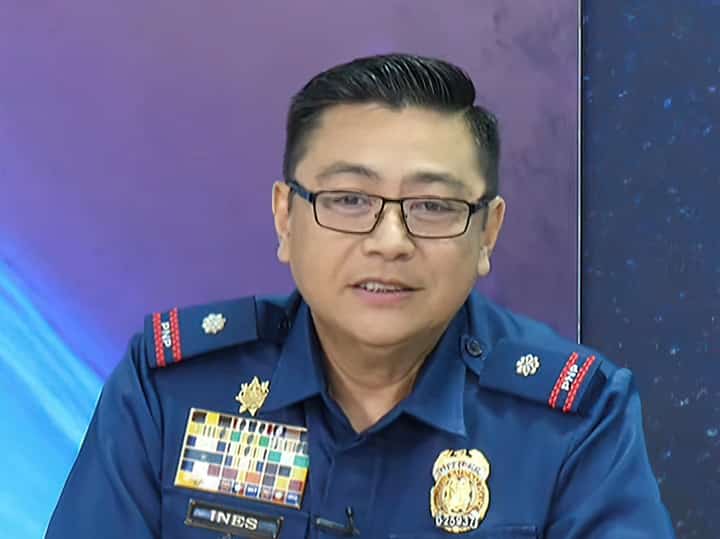
Reason for double P Fuse his given and family names, Manila Police District spokesperson Major Philipp Ines reveals where his heart lies.
Photograph courtesy of MPD
He grew up in the most populous district in Manila, Sampaloc, “Batang Sampaloc,” he calls himself, in the shadow of the University Belt, where he would later be assigned to oversee as a member of the police force.
Before he became the spokesperson for the Manila Police District (MPD), Major Philipp Ines commanded the University Belt Area, the dense corridor along Recto and España where most Manila colleges and universities sit almost wall-to-wall.
It is a formative detail he returns to more than once, when asked why the area sees so many incidents, his answer is pragmatic. “Where the fish are thickest, that’s where the fisherman goes.”
Students, he said, are often the ones caught in the net, and the job is less about waiting for trouble than about being visibly and constantly present so that trouble looks elsewhere.
That instinct for visibility as prevention shapes almost everything he describes about MPD’s current approach to campus security, a subject given new urgency by recent violent incidents involving students in Tacloban and Cavite cities.
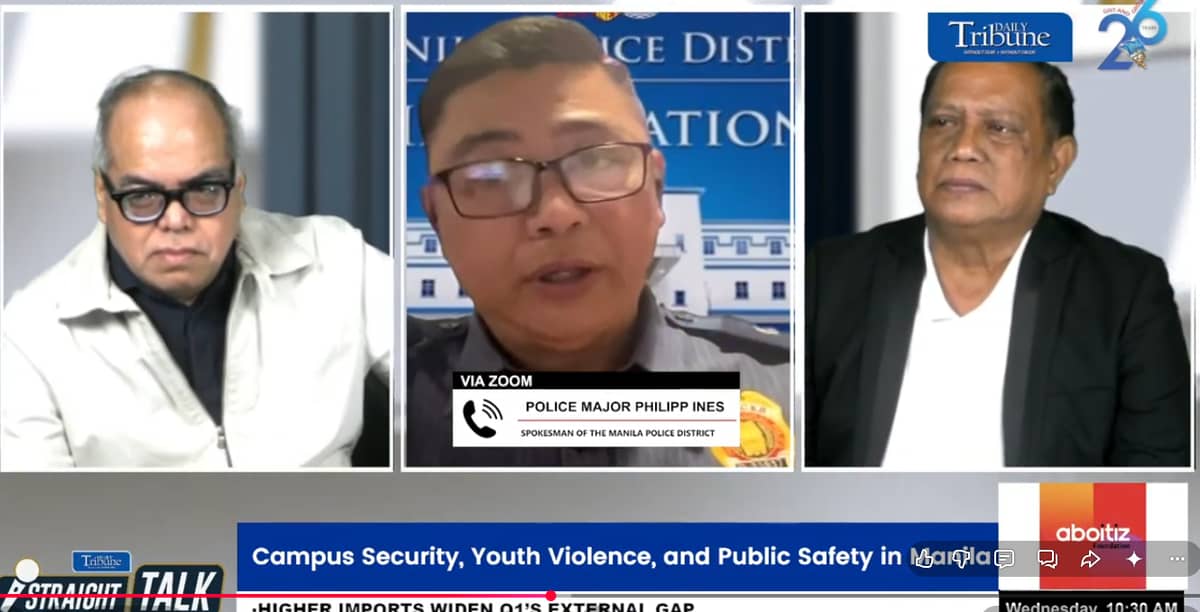
Unique to the capital city The Manila Police District manages protest actions. Major Philipp Ines (center) explains to ‘Straight Talk’ hosts Chito Lozada (left) and Pat Santos (right) that the Humanitarian Engagement Team, unique to Manila and built from years of experience handling sprawling, high-tension rallies, is key to this.
Screengrab from ‘Straight Talk’ video
Manila has 204 schools, public and private, and Ines says roughly 1,600 personnel have been dedicated to covering them, officers stationed at gates during arrival and dismissal, deliberately visible so students and teachers feel, in his words, a sense of security rather than mere enforcement.
But presence alone isn’t the whole strategy. Security personnel undergo regular seminars and training on how to respond to incidents on campus, and each school is linked to its local police community precinct (PCP) through a Viber-based communication channel that connects principals, section commanders, and station leadership. Video and information can move in seconds, he says, rather than waiting for formal reports.
He’s careful to consider this as something already built rather than assembled in reaction to headlines. The system, he notes, predates the Tacloban shooting and the Cavite stabbing incidents that have pushed campus violence back into the national conversation.
Its legal basis is Executive Order 29 of 2026, which formalized what the city calls the Manila School and Community Safety Initiative, explicitly framed not as a police program but as a shared responsibility among police, school administrators, parents, barangay officials, and city government.
Asked whether MPD’s manpower can realistically stretch across every public and private school in the city, Ines stated that it is a matter of deployment of personnel where it matters most and trusting the wider network, Parent-Teacher Association (PTA) groups, teachers, tricycle drivers, transport groups, even street vendors he says he has personally recruited as informal lookouts, as force multiplier to fill the gaps a finite police force cannot.
On youth involvement in violence specifically, Ines pivots quickly to parental accountability. He cited Manila’s Child Endangerment Ordinance 8243, which holds parents or guardians legally responsible when a minor is repeatedly involved in violent incidents, with younger children carrying steeper penalties for the adults responsible for them, including fines and possible imprisonment.
He pushes back, gently but firmly, against a habit he says he encounters constantly: parents surrendering discipline entirely to barangay officials or police because a child has become unmanageable. Discipline, he insists, has to start inside the home; law enforcement can be the last resort, not a substitute for parenting.
The conversation shifts to the recent sudden road closures around an INC rally, which snarled Metro Manila traffic, including through Recto, Quiapo, España and the Ayala Bridge with little advance warning.
Ines doesn’t dispute the inconvenience. He asks for public understanding, since road closures were necessary given the rally’s proximity to Malacañang, and he pointed to a standing traffic advisory system as the only real safeguard against the unpredictability of large, often short-notice demonstrations.
He’s blunt that this has simply become routine in the city: mass actions near the Palace happen often enough that “rally” has become part of MPD’s daily operational vocabulary rather than an emergency.
That routine, he says, hasn’t come at the cost of civil liberties, a point of evident pride. Manila maintains four freedom parks, Liwasang Bonifacio, Plaza Miranda, Plaza Dilao and Plaza Moraza — where citizens may assemble without a permit, monitored only for peace and traffic management, never obstructed. He cites this as proof that rights are respected even amid heavy security. But he pairs it with a familiar caveat: freedom carries responsibility, and one person’s right to assemble cannot come at the expense of commuters, workers and residents whose own movement gets caught in the closures.
Rally response squad
Central to how MPD now manages these events, Ines explains, is a Humanitarian Engagement Team he personally supervises, a structure he says is unique to Manila, built from years of experience in handling sprawling, high-tension rallies.
The team includes trained negotiators, in-house lawyers, a human rights officer, and dedicated documentation staff, supported by drone pilots and ground-level 360-degree cameras.
The footage, he says, cuts both ways: it protects protesters from false narratives of police provocation, while also building evidence, sometimes leading to administrative complaints and prosecutor referrals, against instigators.
A companion city ordinance banning face coverings during assemblies, he adds, has meaningfully reduced anonymous troublemaking within otherwise peaceful crowds.
Digitally, MPD runs a parallel cyber patrol unit alongside conventional foot patrols, watching for scams and coordinated online activity tied to unrest, the online equivalent, he jokes, of the old foot-patrol grind he remembers from his Sampaloc days.
Asked directly whether Manila is truly ready for a scenario in which a rally escalates or a new mass mobilization catches the city off guard, Ines avoids overconfidence. Intelligence indicated the recent rally’s permit ran only until the afternoon; what might follow, he admits, remains uncertain.
His closing message to would-be troublemakers and to the public alike returns to the same refrain he has repeated throughout the interview, more corporate philosophy than talking point: presence deters, cooperation multiplies limited manpower, and Manila’s police will keep their guard up, kalasag nakaangat, tabak nakaumang (shield up, sword drawn), regardless of what any given day brings.