
Group leads Samar megaforest revival
The initiative, backed by a 25-year partnership between government and private actors, is being positioned as one of Southeast Asia’s most ambitious ecosystem restoration projects.

Sustaining the nation In explaining the motivation behind the ecological initiative, Green Samar BioSPV and CEO of Samar Bamboo Corp. Ruben Diego Picardo said the country ‘needed a healthy and dense forest to sustain our water supply.’
Photographs by Yuko Shimomura for Daily Tribune
In Samar’s vast protected landscapes, where degraded forests are now being reimagined as carbon sinks, biodiversity corridors, and livelihood zones, one name has emerged at the center of a bold restoration experiment — Ruben Diego Q. Picardo.
As president of Green Samar BioSPV and CEO of Samar Bamboo Corporation, Picardo is helping steer a 120,000-hectare reforestation effort inside the Samar Island Natural Park, one of the Philippines’ largest terrestrial protected areas and a UNESCO candidate site.
The initiative, backed by a 25-year partnership between government and private actors, is being positioned as one of Southeast Asia’s most ambitious ecosystem restoration projects.
For Picardo, the project is not framed as a conventional conservation program but as a long-term structural shift in how degraded landscapes are revived and managed.
At its core is a model that links environmental recovery with rural development, job creation, and climate-linked financing mechanisms.
“We needed a healthy and dense forest to sustain our water supply,” Picardo said in explaining the deeper motivation behind the initiative. “Restoring degraded forests is essential because this is where our watershed is located.”
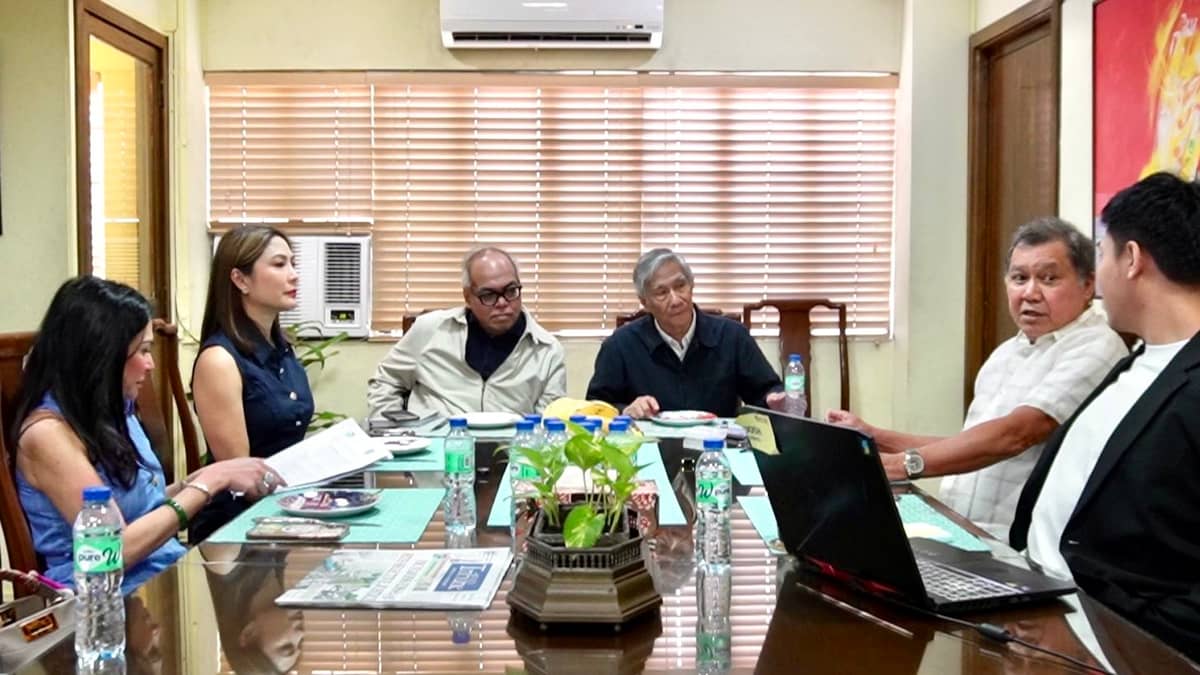
Green blueprint Personalities behind the Green Samar Project discuss the landmark, large-scale nature restoration and carbon-funded conservation initiative during a roundtable at the Daily Tribune. Pictured (from left) are Allana Montelibano, Audax Global project convenor and strategic partner; Karen Gimeno, chief legal counsel of SofCap Partners and Audax Global project convenor and strategic partner; Daily Tribune executive editor Chito Lozada; Daily Tribune Business editor Teddy Montelibano, Benjamin Picardo, president of Samar Bamboo Corp. and Business reporter Mico Virata.
Many characters of forest restoration
The statement reflects a recurring theme among project proponents: that forest restoration is not only ecological but also economic and infrastructural.
In Samar, watershed systems underpin hydropower operations and local water security, making forest recovery directly tied to energy stability and community resilience.
Beyond environmental goals, the project is expected to generate thousands of jobs in forest protection, native tree planting, and assisted regeneration work.
More than 20,000 residents living inside and around the protected area are also set to benefit from livelihood programs, agricultural support systems, and long-term benefit-sharing arrangements.
Picardo has described the undertaking as a “legacy investment,” one that seeks to move communities away from extractive dependence on forest degradation and toward sustainable participation in restoration economies.
The approach aligns with broader plans to use internationally certified carbon credits to finance long-term forest maintenance and protection.
“We are proud to be part of a project that reflects the aspirations of our communities and the extraordinary natural heritage of our island,” he added.
“As a Philippine citizen originating from Samar, I am delighted to participate in the Green Samar Project, which will have a transformational impact on the province and its local communities. And I am confident that our partnership with aDryada will be powerful enough to achieve our ambitious goals,” Picardo said.
Lawyer Karen Jimeno earlier underscored the unprecedented scale of the initiative, noting that the 120,000-hectare restoration footprint is nearly twice the size of Metro Manila and is being pursued without direct public funding. For Picardo and his partners, however, the emphasis is not on scale alone but on sustainability and execution over decades.
Gauge for green projects
Project proponents say the Samar model is designed to function as a test case for climate-linked natural capital investments, blending ecological rehabilitation with private capital discipline and state oversight. It also aims to strengthen forest protection systems, expand ranger capacity, and reduce illegal logging pressures in one of the country’s most ecologically sensitive regions.
As implementation moves forward, Picardo stands at the intersection of environmental ambition and economic restructuring — helping shape a project that its supporters hope will redefine how the Philippines restores its forests while building livelihoods around them.
In Samar, the forest is no longer just a resource to be protected. Under this model, it becomes infrastructure to be rebuilt, managed, and sustained across generations.