
Farewell to a place we called home
The present ABS-CBN compound was inaugurated in 1968. It was the largest broadcast network in the entire Far East.

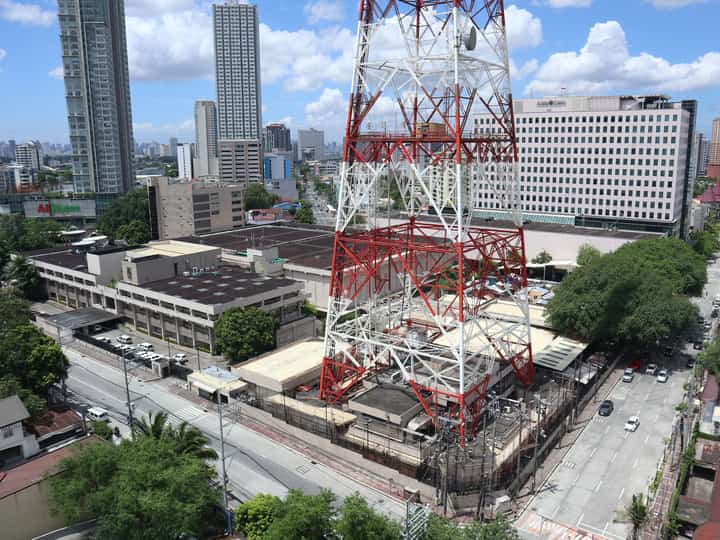
THE ABS-CBN Broadcasting Center, located at Sgt. Esguerra Avenue corner Mother Ignacia Street in Quezon City, is slated for demolition. The iconic complex served as the longtime headquarters of the country’s prominent media and entertainment company.
Photo courtesy of ABS-CBN
The ABS-CBN transmission tower was the Eiffel Tower of the Philippines in my young mind. I was always fascinated by that Quezon City landmark, especially when a condominium boom was not yet in the metropolis. Later called the millennium transmitter, it was visible from most points of Diliman and beyond.
The transmission tower and the entire ABS-CBN compound used Bohol Avenue as its address in the old days. Bohol Avenue, however, had since been renamed Sgt. Esguerra.
The street name change happened after the 28 August 1987 coup attempt against the administration of the late President Cory Aquino. The rebel soldiers, upon the orders of Gregorio Honasan, had seized the government station, PTV-4, that was still located at the ABS-CBN compound.
A police staff sergeant by the name of Eduardo A. Esguerra was part of a government force led by Alfredo Lim, who was tasked with making the rebel soldiers leave the premises. The government station was eventually taken back by the police team, but Sgt. Esguerra died in the process. He deserved to have a street named after him.
But why was that road named Bohol Avenue in the first place? When Quezon City was created in 1939, what is now Sgt. Esguerra Avenue was originally called South 6th Street. It became Bohol Avenue because President Carlos P. Garcia built a home there after he left Malacañang in 1961. He had hoped to get reelected and continue staying at the Palace, but was defeated by Diosdado Macapagal, the father of Gloria Arroyo.
After his presidency, Garcia decided to retire in his hometown province of Bohol. But he and his wife, the former Leonila de la Serna Dimataga, fondly called Inday, needed a place to stay in Manila. They chose a property in South 6th Street that was then still being developed. The area was very remote that time.
To honor the former President, the Quezon City Council changed the name of South 6th Street to Bohol Avenue. That long stretch of road from Timog to Quezon Avenue couldn’t be named after Garcia because he was still alive. Naming the street where he lived after his birthplace was sufficient enough. Today, there are so many streets in the country called C.P. Garcia.
Ghosts of a past
Bohol Avenue was no stranger to me. My family used it as a shortcut whenever we traveled north. Along the way, we passed by the ABS-CBN compound with its magnificent transmitter. I was always in awe looking at that tower. Little did I know that I would be an ABS-CBN on-cam talent years later.
When I signed up to do a show for ABS-CBN in 1992, the first thing I did once inside the compound was to admire the tower up close. To me, it was the 8th Wonder of the world. But when I got to the ABS-CBN offices, my jaw dropped.
This it? For a TV studio? The whole workplace looked like a cottage industry. ABS-CBN always had some of the most visually polished productions. But outside of the camera range, it was a dump.
The present ABS-CBN compound was inaugurated in 1968. It was the largest broadcast network in the entire Far East. Unfortunately, martial law shut down ABS-CBN and other media outlets in 1972.
In 1973, the KBS studio that became RPN-9 was gutted by fire. It was the previous site of ABS-CBN prior to moving to its present location. The place was sold by the Lopez family to Roberto Benedicto, who would later own BBC-2, RPN-9 and IBC-13. When Broadcast City was constructed in 1978, all the Benedicto stations moved to that huge complex in Balara, Quezon City.
The year after, the government station, PTV-4, occupied the ABS-CBN compound. When the Lopezes reclaimed the ABS-CBN property after EDSA I, they had to share it with Channel 4. The members of the Lopez family must have fainted when they saw what became of their building. I can imagine how beautiful its interiors were when the structure was new. The restroom tiles were specially commissioned because those bore the ABS-CBN logo. But some of the toilets no longer flushed by the time the Lopezes got back their old compound.
I remember a nasty rumor that circulated back then: That Jim Paredes was caught making it out with a sexy star in one of the studio’s bathrooms. When asked about this issue, his answer was terse: “Given the state of the comfort rooms in ABS-CBN, who would be in the mood to do anything like that?” With that one statement, the gossip stopped.
When ABS-CBN became the carrying network for the 1994 Miss Universe pageant held in Manila, I wanted to die of embarrassment when the contestants visited the studio. By then, the main building was already being renovated and so, some of the shows had to be moved to Studio 9 (facing Mother Ignacia) and it looked even more decrepit.
There were some benefits though about being an ABS-CBN talent then: assigned parking. Those slots were ours 24/7. Since the distribution of parking spaces were done alphabetically, I was sandwiched between Mark Anthony Fernandez and Eric Fructuoso, two of the Guwapings! That made me feel like the third guwaping, Jomari Ylanna, but on a really bad day.
It was also in that compound where I experienced the luckiest day of my life. That was where I won a brand-new car in a bingo!
But there were supernatural stories, too, in that building. Charo Santos’ original office on the ground floor was believed to have an elemental inside. When she was moved to another wing, her old space was inherited by Arlene de Castro, the late wife of Noli de Castro.
As soon as Arlene noticed the presence in her room, she immediately talked to Charo to ask: “May naiwan ka sa opisina mo, ‘no (You left something behind in your office, didn’t you)?” Charo didn’t even have to ask what Arlene meant. All that Charo said was: “So, you feel it, too?”
A last salute
By the time I left the network to study abroad, construction had already started on the Eugenio Lopez, Jr. Bldg. or ELJ. We had to make sacrifices. For one, we lost our designated parking spaces. As a matter of fact, there was hardly any place to park. And park at your own risk. One day, a piece of hollow block just fell on the car of executive producer Judith Bauer.
I wasn’t inconvenienced much by the improvements done within ABS-CBN because I was already out of there by 1998 when the construction of the ELJ and the renovations of old structures were in full swing. But I can never forget my last day in the compound — the early hours of 14 February 1998. Yes, Valentine’s Day.
Before I hopped into my car, I went to the transmitter to say goodbye. There were already cellphones that time, but without cameras — so don’t expect me to be able to produce right this minute a selfie with the tower. I actually shed tears as I talked to the transmitter. Like a Douglas MacArthur gone mad, I told the transmitter that I would someday return.
On my second year of studies abroad, I had to stop school. I was told by my accountant that I lost everything I earned working for ABS-CBN in a bank run. I hurriedly returned to the country — and straight to television. But not on ABS-CBN. Boy Abunda had taken my old slot. But what do you know, I filled the vacuum he left behind in GMA. We always have a good laugh recalling that musical chair we played in the past.
As for the MacArthur promise I made to the transmitter, I did not renege on my word. I did return to ABS-CBN, but only after 25 years. In 2023, I did another talk show for ABS-CBN called Best 10 Bets, which proved to be popular among Filipinos abroad via TFC.
While I stayed longer on GMA — 16 years! — I can’t help but say that I’ve always considered ABS-CBN to be my real home. In fact, even when I was already with GMA, I would still do hosting jobs for ABS-CBN’s cable channels. I hoped against hope I wouldn’t get caught by the GMA bosses. They eventually did and I had to stop. ABS-CBN will always be home to me because that was where I started.
This month, the ABS-CBN compound, except for ELJ, will be turned over to its new owner, Ayala Land. My beloved transmitter may be dismantled. That will break my heart. That will break many hearts. It is not just an engineering marvel, but a symbol of excellence — for the countless outstanding works on TV transmitted over the decades through that tower.