
PRAGUE’S FILIPINO PRAYER

PRAGUE'S Santo Niño Shrine has added a Filipino translation of its prayer, recognizing the many Filipino pilgrims who visit the Church of Lady Victorious each year.
PHOTOGRAPH COURTESY OF CZECH REPUBLIC AMBASSADOR TO THE PHILIPPINES KAREL HEJČ
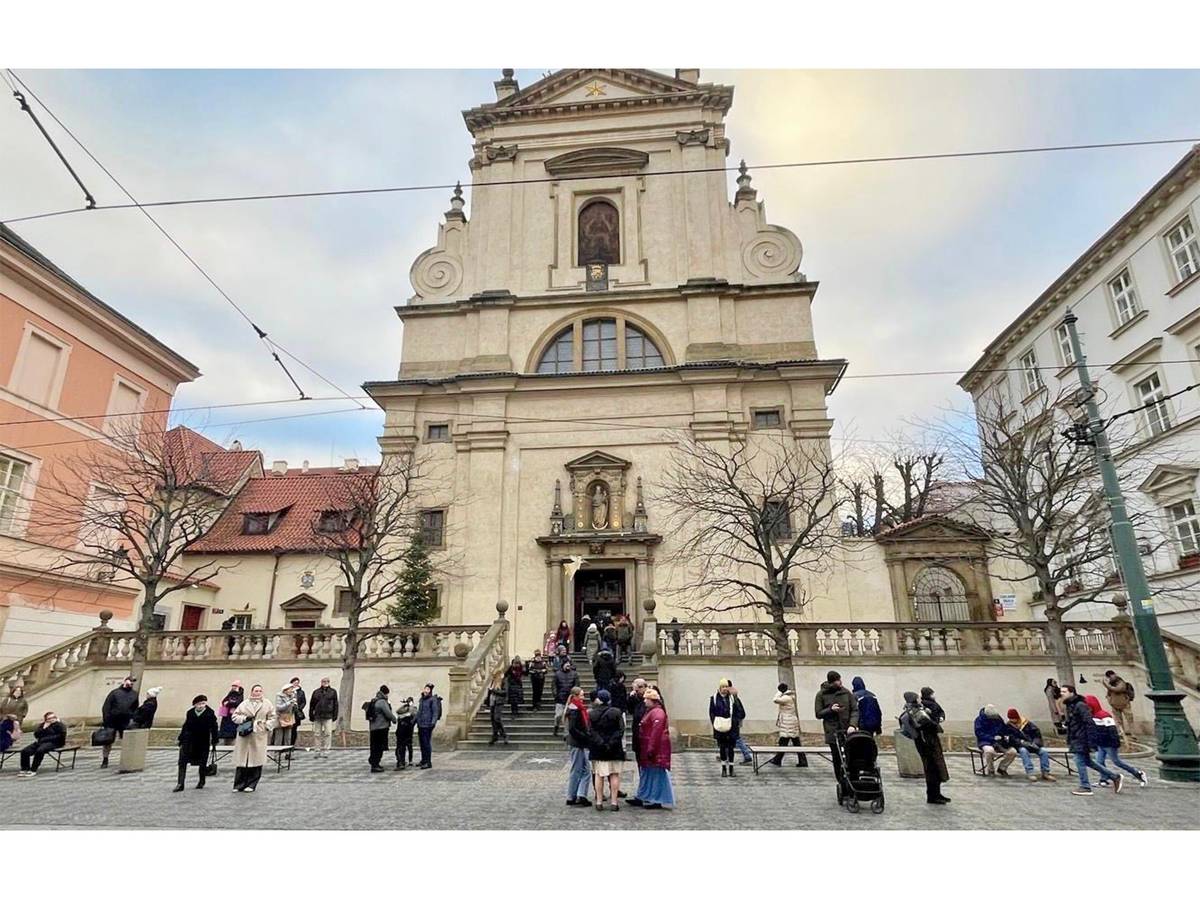
Right in the heart of Europe, in Prague, the capital of the Czech Republic, the Church of Our Lady Victorious can be found, open to everyone 365 days a year.
Already on its own, it is a valuable baroque monument built on renaissance foundations.
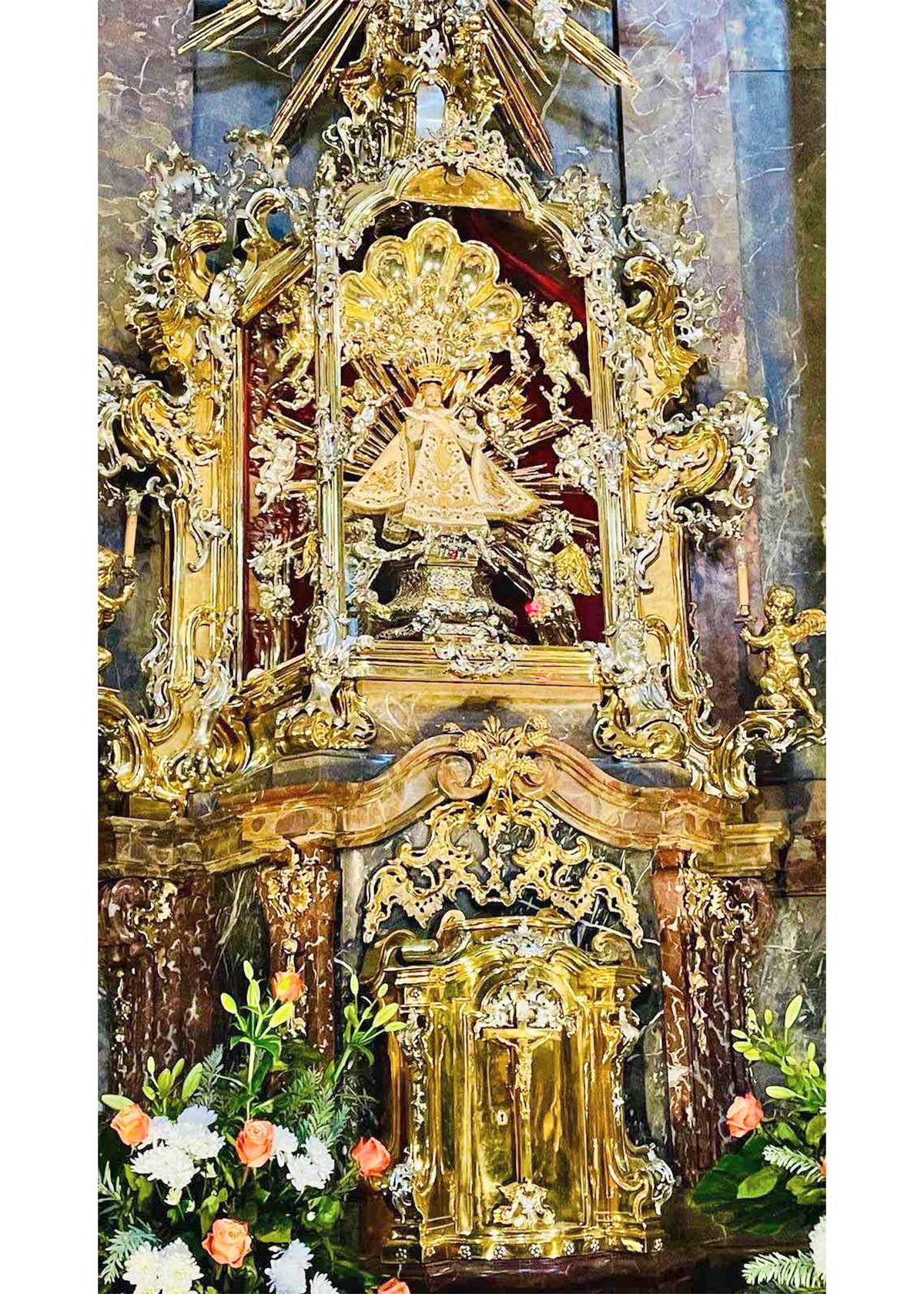
However, for many, it is more important as a pilgrimage site known worldwide, thanks to the statue of the Infant Jesus of Prague.
It, therefore, comes as no surprise that regular services and interesting public events are held here in five different languages.
And visitors and pilgrims travel to see the Santo Niño de Praga with their own eyes from all around the world. And also, from the Philippines.
Located within the main dome, the Holy Family of Jesus is placed in the center of the right side of the nave, with the statue of the Infant Jesus of Prague surrounded by statues of Our Lady and St. Joseph.
God the Father, allegorically depicted as an old man, sends his Son to earth in the upper part of the altar, and at the very top, the Holy Spirit is depicted in the form of a dove.
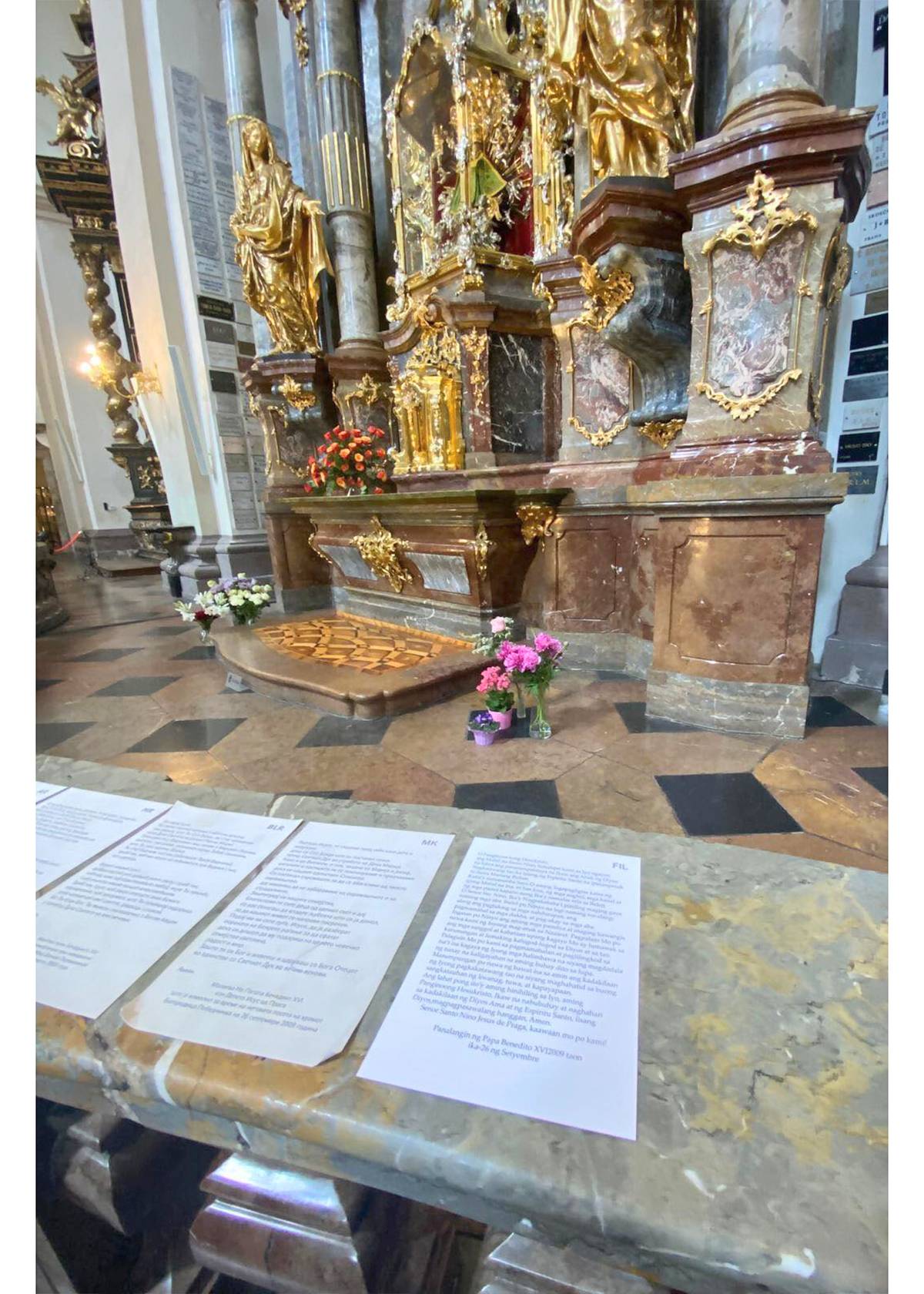
On the balustrade surrounding the shrine of the baby Jesus, prayers are placed in several world languages.
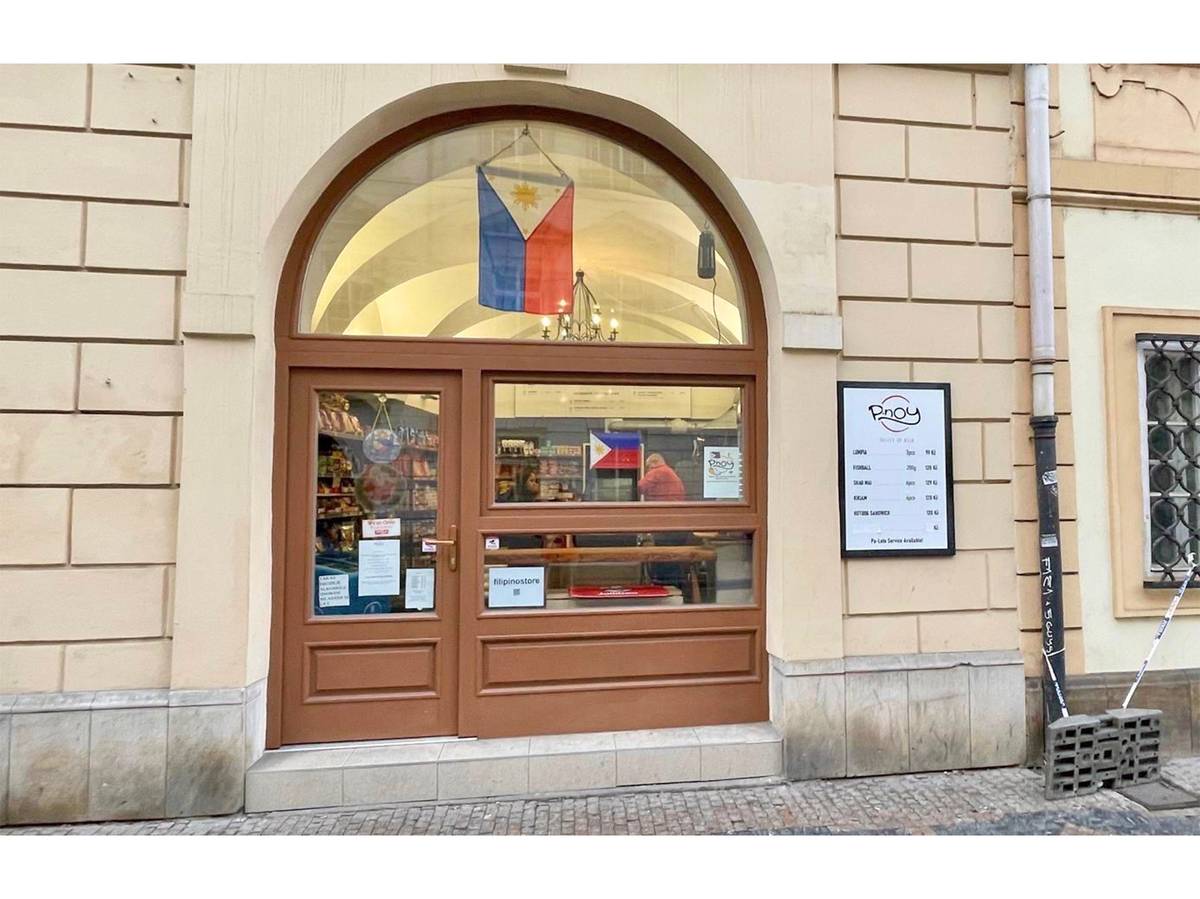
Surprisingly, despite the numbers of Filipino pilgrims visiting the site every year, which is clearly demonstrated by the Pinoy store found right across the street from the church, the Filipino language was missing. Well, until now, anyway.
But let us go back in time first to see what is behind the popularity of the Santo Niño in the Philippines.
The roots of all Infant Jesus devotions in the Philippines go back to 1521, when Ferdinand Magellan gave an image of the Santo Niño to Queen Juana of Cebu during the first mass baptisms, a moment recognized as the introduction of Christianity in the Philippines.
By the Spanish colonial period, Filipinos already had a deep emotional and religious attachment to the Infant Jesus, making later forms—like the Santo Niño de Praga—easy to adopt.
Santo Niño de Praga
More than a hundred years later, in 1628 to be specific, a Spanish-origin statue was brought to Prague.
The Prague image of the Infant Jesus, known as the Santo Niño de Praga, became famous worldwide through the Carmelites, who were missionaries and promoters of devotion spread after reports of miracles such as saving the city from plague or protecting it from the horrors of war during the Swedish siege in 1639.
It was brought to the Philippines by Benedictine monks in early 20th century.
The Confraternity of the Infant Jesus founded in 1903 and later, in 1926, the San Beda Abbey Church (known today as the Benedictine Abbey of Our Lady of Montserrat) in Manila was officially the first church in the Philippines dedicated to the Holy Infant of Prague.
It was the first but certainly not the last. Shrines dedicated to the Infant Jesus of Prague were established across the country.
Besides the main two, namely the one in San Beda, Mendiola, in Manila and the one in the Shrine Hills in Davao, there are many devoted parishes in other places, including Antipolo (Rizal), Cordon (Isabela), Angeles (Pampanga) or Dingalan (Aurora), showing how geographically widespread the immense popularity of the Infant Jesus of Prague in the Philippines is, symbolizing hope, protection, and childlike faith, for which it was already loved by Filipinos.
Praying to the Santo Niño
As the number of miracles and answered prayers continued to rise, the popularity of the Santo Niño grew exponentially.
In 1655 the statue was crowned by an auxiliary Bishop of Prague acting in the name of Cardinal Ernst Adalbert of Harrach.
In 1741 the statue was relocated from a smaller chapel to its present, much bigger place. In 1776 a worthy altar was built for the statue.
By the turn of the 19th and 20th century, the veneration of the Infant Jesus had spread all over the world in a miraculous way.
Thanks to missionaries and European immigrants, the Infant Jesus is also known in India, China, Korea, North America. And in the Philippines.
Due to Nazi and communist dictatorships from 1939 to 1989, veneration was silenced for 50 years. After the Czech Republic regained its freedom and democracy in 1993, the Discalced Carmelites returned to the church and the veneration of the Infant Jesus was brought back to life.
The most important event so far has been the visit of Pope Benedict XVI in 2009. In his speech, the Pope stated that the Infant Jesus demonstrated God’s closeness and love through his childlike tenderness.
The Pope prayed for children who are victims of violence and different forms of abuse and for broken and unfaithful families.
His prayer is now available to all pilgrims in 23 different languages online, with some of them displayed on the balustrade surrounding the Santo Niño.
Thanks to joint efforts of the Czech Embassy in Manila, the Church of Our Lady Victorious in Prague and the San Juan Nepomuceno Parish in Pasay, the last translation of the prayer added to the balustrade in June 2026 is Filipino.
Diplomacy has many faces, some traditional, some less so. Religious diplomacy is probably not one of the traditional ones, but it certainly contributes significantly to understanding between people and between nations.
Knowing how many Filipino pilgrims visit the church every day, we believed that adding a Filipino translation of the prayer to the balustrade is a must, thus allowing them to pray to the Santo Niño in their own language.
We therefore contacted San Juan Nepomuceno Parish in Malibay, Pasay, which is dedicated to Saint John Nepomucene (Sv. Jan Nepomucký in the Czech language), a saint born in town of Nepomuk in the Czech Republic and buried in St. Vitus Cathedral at the Prague Castle.
Since the parish has long-standing relations with the embassy, Brother Mark Brian B. Espino of the parish very kindly translated the prayer into Filipino and made sure that the translation has been adapted to best reflect Filipino terminology, the content and meaning of the prayer, and the practice of local worship.
We then requested the Church of Our Lady Victorious to consider including the Filipino language among those displayed in front of the Santo Niño.
It did not take long and we have received a positive and encouraging response.
Reverend Father Pavel Pola, Rector of the Church, welcomed our initiative with very kind words: “… It is a great joy to hear and see how reverence for God is an integral part of the experience for many visitors to our church from around the world.
Filipino pilgrims are truly among the most frequent visitors to our church, and we are very grateful for the feedback you have provided us and, above all, for your invaluable help in preparing a prayer text directly in the Filipino language, Tagalog”.
And so, after a short time, the prayer in Filipino was added to the balustrade of the Santo Niño shrine in the Church of Our Lady Victorious in Prague and to its official website.
And it makes us very happy that we could bring Santo Niño one step closer to Filipino pilgrims.