




Insights from the Philippine Trust Study

Text size
TRUST? BIG WORD. OKAY, LET’S TALK ABOUT TRUST.
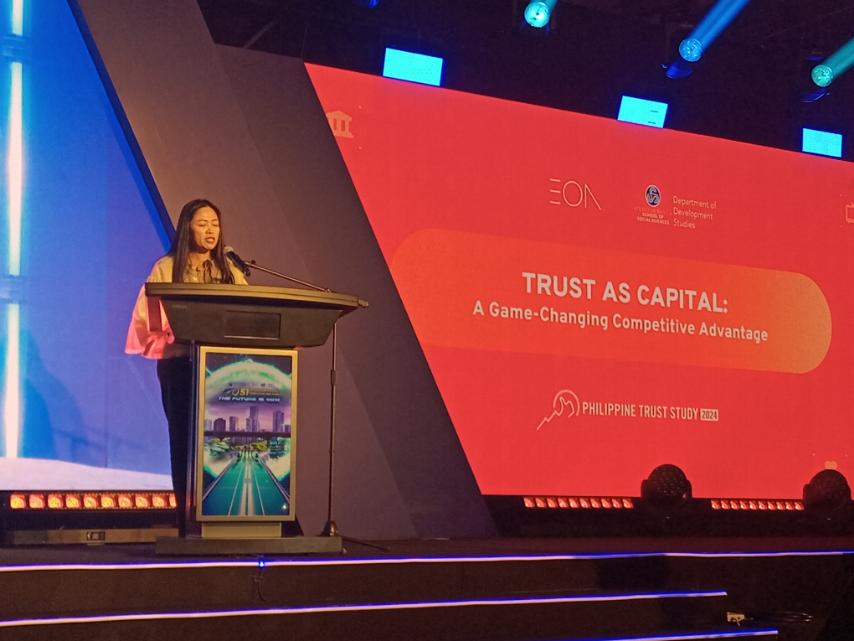
Ms. Malyn Molina, President and Chief Operating Officer (COO) of the EON Group, dissects what trust means in the Filipino context in her special session titled “Trust in the Age of Digital Transformation: Insights from the Philippine Trust Study.”
The session took place at the 51st Philippine Business Conference and Expo (PBC&E) at the SMX Convention Center on 21 October.
When institutions such as businesses or government agencies carry out trust rating surveys, Molina asserts the importance of understanding how Filipinos view trust—how and why they give it, or not—so that institutions can adapt their approach to providing better products and services.
Firstly, Molina explains how Filipinos view trust. In the Philippines, society has an awareness of their kapwa and places importance on community. Trust is the expectation that others will do their part. It is linked with feelings of satisfaction and confidence.
Trust is also rooted in history and familiarity, which is why the phrase “mayroong pinagsamahan” bears weight in the Filipino context. It is not given lightly and is very fragile, as this protects Filipinos from the pain of betrayal.
Secondly, it is important to understand that Filipinos do not give out trust indiscriminately. Molina says that while Filipinos may express trust in surveys, it is neither whole nor unconditional.
Rather, what they are really saying is, “I trust you now, but I am watching you.” Trust ratings have to be considered with this in mind, as Filipino trust is fragile and not given lightly. Ratings do not necessarily reflect a positive attitude toward an institution or individual.
More often than not, when Filipinos do express trust in institutions, Molina observes that it results from having no other choice. Trust comes with skepticism based on years of disappointment, and many Filipinos have remarked, “Malaki na ang nawala at ilang beses na kami nabigo.”
On a psychological level, Molina states that Filipinos are in survival mode. They have no other choice but to lend their trust to institutions tasked with providing them services.
This survival mode severely affects their decision-making processes, as they have internalized that they can’t “have it all.” Furthermore, long-term decision-making is hindered by the realization that what they have at present may not be enough.
Therefore, Filipinos often resort to “trusting” (now a loose word, after the context provided by the study) whatever and whoever is readily available. Trust being rooted in family also affects this decision-making process, as Filipinos are forced to think about their own family’s welfare and neglect the bigger picture, because survival mode leaves no room for anything else.
Molino gives advice to businesses and institutions on how to achieve and maintain Filipino trust. She asserts that familiarity helps build trust, as continuous presence establishes history and a sense of kinship.
However, she maintains that simply being present is not enough. Filipinos trust reliability and consistency. She also notes that they do not appreciate being talked down to or treated as though they are not intelligent enough to make their own decisions based on the information provided. It is also important that institutions give reliable information, as any deception will be met with disappointment and negativity.
Finally, Molina states that trust is negatively impacted by any perceived slight or prejudice against the underdog. When institutions abuse or take advantage of the “maliliit na tao,” such as the elderly, children, or the impoverished, Filipino trust ratings decline rapidly.
In conclusion, Malyn Molina calls for a nuanced perception of Filipino trust, considering the Philippines’ long history, which has resulted in cognitive, societal, and economic issues that affect how the country operates on a fundamental level.
Buddies, associates? One happy family?
A traditional dish called zongzi is served during China’s Dragon Boat Festival, which falls in June. It is a rice…
Divina credited the firm’s achievements to its members, thanking them for their ‘hard work, dedication, teamwork, and…
‘Sec. Vince Dizon, please explain how this finding of your own team should not be flagged as a ghost project in Taguig.’
