
Philippine experiences and imagination promised at world’s largest book fair
The Philippines is making history as Guest of Honor at the Frankfurt Book Fair, showcasing its stories, creativity and cultural identity.


In a history-making turn, the Philippine literary sector and publishing industry are stepping into the spotlight of international literary and publishing stage in Frankfurt, Germany, as the country serves as Guest of Honor at the world’s largest and oldest book trade event, the Frankfurter Buchmesse (Frankfurt Book Fair), which runs from 15 to 19 October.
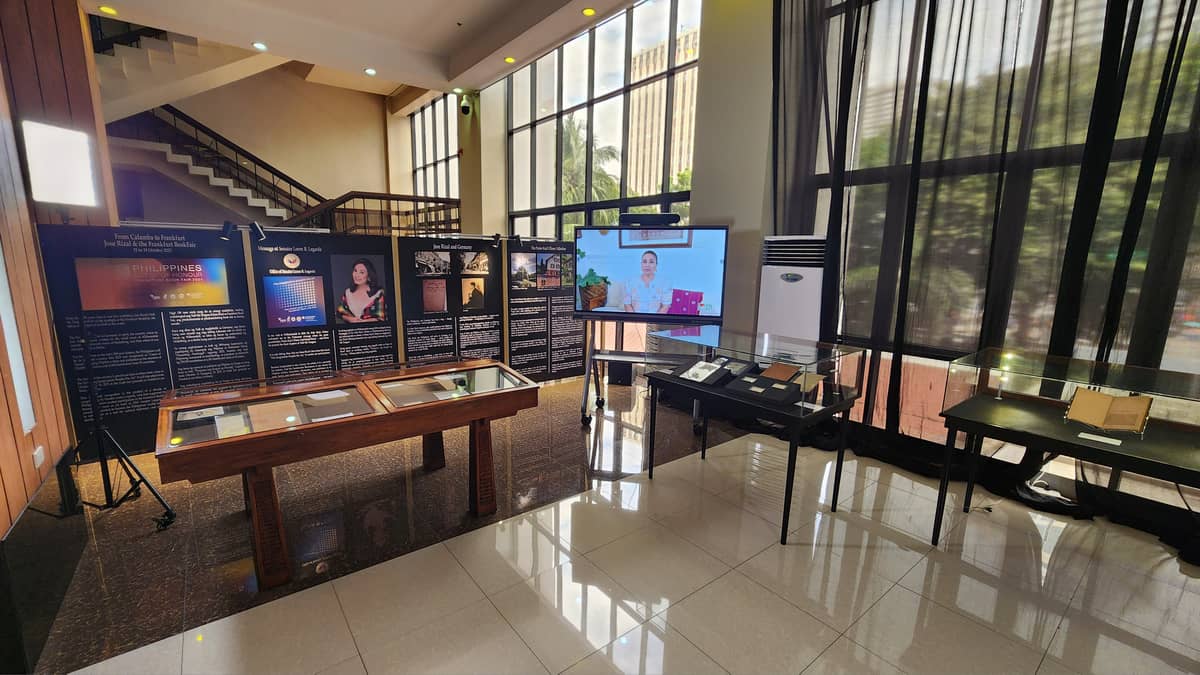
The exhibit 'From Calamba to Frankfurt: Jose Rizal and the Frankfurt Book Fair' at the National Library of the Philippines.
Photographs by Roel Hoang Manipon for DAILY TRIBUNE
Led by the National Book Development Board (NBDB) and the Office of Senator Loren Legarda (OSLL), with support from different agencies, the Philippines will be bringing in over 400 delegates — authors, illustrators, artists, creatives, publishers, performers, and cultural workers — and about 500 book titles to fill the halls of the world’s most important book fair with Philippine perspectives pregnant with stories and imagination.
Bannering the theme “The imagination peoples the air,” the 2,000-square-meter Philippine Guest of Honor Pavilion (PHL GOH) is intended to be not merely an exhibition space but as a living, breathing stage of Filipino creativity and pride.
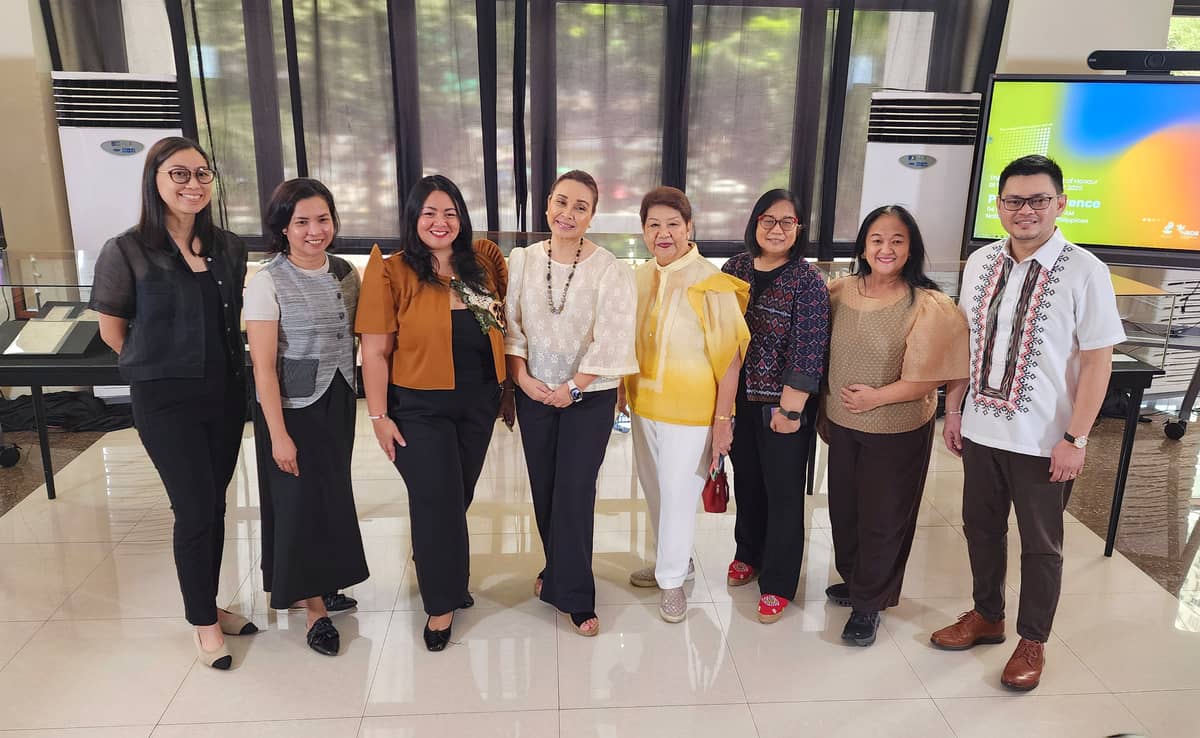
Senator Loren Legarda (middle) with some members of the PHL GOH team.
Journey to Frankfurt
Senator Loren Legarda, whose vision and persistence made this milestone possible, recalled how it began as an improbable dream.
“When I first envisioned the Philippines as the Guest of Honor at the Frankfurter Buchmesse, some felt that it was far too ambitious — that we were too diverse and too complex for the world’s largest book fair to embrace,” she said. “But I believed then, as I believe now, that our diversity is our greatest advantage, a gift and never a hurdle.”
The Philippines has been participating at the Frankfurt Book Fair (FBM) for many years now. The first NBDB participation in the FBM was in 1998 with 302 book titles from 45 publishers. More participation followed in 1999 and 2000, but the country was absent for many years until 2015. Karina Bolasco, then manager of Anvil Publishing, sought Legarda’s help for a modest 60-square-meter booth. Legarda saw beyond the booth, envisioning a future where Philippine literature would command global attention.
Legarda emphasized that “we need to boost support for publishers. For so long, our publishers felt they were not supported by the government. That’s what Karina told me 10 years ago. ‘Walang tulong ang gobyerno; kami-kami lang (There were no government support; it was just us).’ They paid their way, nag-aambag sila para sa maliit na stand (they chipped in for a small stand). And I felt — with a hundred million population, being an archipelago — how can they allow that to happen? Why is the Philippines not there? With our ‘literaries,’ our authors, our poets, the publishing industry which could contribute largely to our domestic economy. It’s worth trying. So it means so much.”
She aligned agencies, secured funding, and rallied institutions behind the goal. “What was once a distant dream,” she said, “has now become our present reality.”
A PHL GOH team was formed, led by co-directors Charisse Aquino-Tugade, executive director of NBDB, and Aurea Brigino Lopez of the National Commission for Culture and the Arts (NCCA). The core team members include Bolasco, Ani Almario, Kristian Cordero, Neni Santa Romana-Cruz, and Nida Ramirez with a broad coalition of cultural partners.
Aside from NBDB and OSLL, government agencies involved in the endeavor include NCCA and the Department of Foreign Affairs.
A pavilion alive with tradition and imagination
Curated by Patrick Flores and designed by Stanley Ruiz, the Pavilion celebrates the integrity of Philippine materials and technologies — bamboo, rattan, abaca — conversing with industrial elements and embodying the Filipino ingenuity to repurpose and refunction. It is an open communal space with modular rattan and bamboo seating, welcoming visitors to explore Philippine books on display. The translucent walls turn into luminous canvases for works by Gary-Ross Pastrana, Mervin Malonzo, and David Medalla, infusing the Pavilion with what Legarda called “emotions that stimulate curiosity and invite reflection.”
“You could have just had books, okay,” she said, “but I wanted it also contemporary art. I wanted Dr. Patrick Flores to show what we do at the Venice Biennale. We can do it as well. So it will be aesthetically beautiful, I’m certain — but it will also have the works of authors who already have their translations, even before they were selected.”
For Legarda, the Pavilion’s design and spirit mirror the identity of a people that reimagines tradition with artistry and resilience. “It is through imagination that our stories breathe life into the world’s understanding of what Philippine literature means,” she said.
Words that end in songs
The Pavilion is promised to be abuzz with different activities, curated by Bolasco, echoing that same belief.
“Throughout the week, there will be over a hundred public talks, readings, and performances that will engage with some of the world’s most urgent questions, touching on topics such as human rights and democracy, climate change, children’s literature, spirituality, race, and the spectrum of identities,” Legarda enthused.
Each conversation is said to end with a creative performance that translates discourse into emotion. In “How Do We Write About Climate Change?” for example, poet Marjorie Evasco will join Maria Paz Luna and Red Constantino, closing with National Artist Ryan Cayabyab’s “Paraiso” performed by The Philippine Madrigal Singers and Song Weavers Philippines.
Panels on human rights and democracy — "Framing Stories: Art and Film Resist,” “Philippine Media: Struggles for Freedom,” “West Philippine Sea: Ecology and Assertion” — will probe the intersections of art, activism, and identity.
Twice daily, “Poetry for Freedom, Justice, and Peace” will gather voices of solidarity for Gaza, Ukraine, and all those fighting oppression. “A Solidarity for Hope” will bring together National Artist Virgilio Almario, Turkish writer and President of PEN International Burhan Sönmez, and Indonesian author Ayu Utami.
Nobel Peace Prize laureate Maria Ressa and trauma journalist Patricia Evangelista will hold talks at the Philippine Pavilion, as well as at the central stages.
Music completes the experience, blending the traditional and the contemporary. Performers will include hip-hop group Morobeats, violin duo Justin and Janna Texon, rondalla ensemble Kuwerdas Filipinas, Kalinga musician Akayu, and Tboli chanter and National Living Treasure Rosie Sula.
“Filipino creativity,” Legarda noted, “will be felt in music and poetry — with each session closing on a note of inspiration connecting our past and present.”