




PCG secures recovered ‘underwater drone’

Text size
Buddies, associates? One happy family?
A traditional dish called zongzi is served during China’s Dragon Boat Festival, which falls in June. It is a rice…
Divina credited the firm’s achievements to its members, thanking them for their ‘hard work, dedication, teamwork, and…
‘Sec. Vince Dizon, please explain how this finding of your own team should not be flagged as a ghost project in Taguig.’
The Philippine Coast Guard (PCG) has taken custody of a suspected underwater drone discovered by local fishermen in the waters off Linapacan, Palawan, the latest in a series of similar foreign-origin autonomous underwater vehicles (AUV) found in Philippine territory.
Commodore Jay Tarriela, PCG spokesperson for the West Philippine Sea, said the recovery sheds light on “continuing illegal marine scientific research activities” in Philippine waters.
Fishermen from Sitio Tapic, Barangay New Colaylayan, Linapacan, discovered the approximately 12-foot-long device on 28 September 2025, during routine fishing operations. They turned the device over to Coast Guard personnel later that evening.
The AUV is now secured at PCG Station Linapacan for verification and technical examination in collaboration with national security agencies.
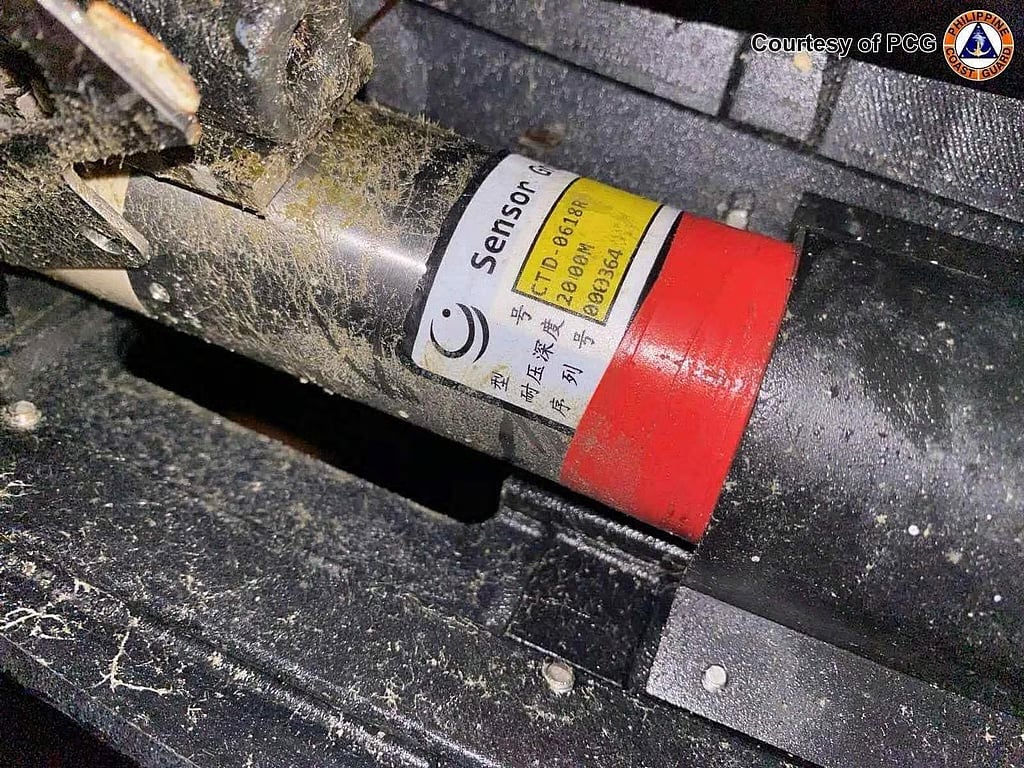
Preliminary inspection revealed the device is mounted on a durable metal frame and contains a Conductivity-Temperature-Depth sensor, a sophisticated probe used for oceanographic studies.
The sensor bears Chinese labeling and a serial number, alongside signs of corrosion from saltwater exposure.
Tarriela cited that investigations of at least three previously recovered units linked them to Chinese deployment, based on evidence like China Telecom SIM cards, iridium transceivers connected to the Beijing-based defense contractor HWA Create, and battery packs marked by China Electronics Technology Group Corporation.
Forensic analysis of these AUVs has shown they are used for advanced underwater surveillance and seafloor mapping, collecting vital data on salinity, temperature and acoustic propagation, which is key for bathymetric charting.
Some devices also had capabilities for onboard data processing and encrypted satellite communications to mainland China.
