
Bangladesh gears for more anti-PM protests
‘We are calling on students and the public all over the country to march towards Dhaka’
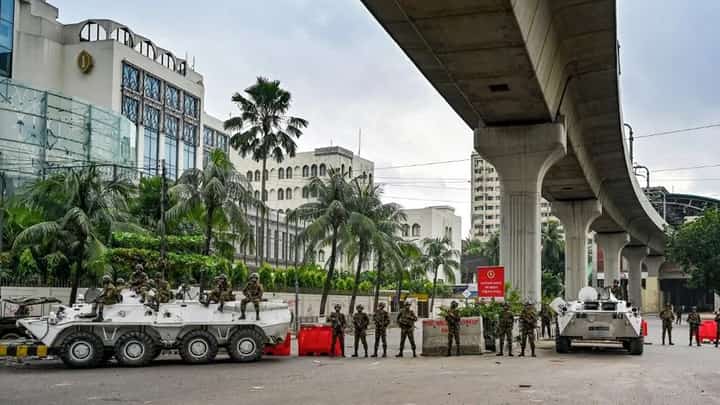
Bangladesh army personnel stand guard during a curfew following clashes between police and Anti-Discrimination Student Movement activists amid anti-government protests in the Shahbag area of Dhaka. Bangladeshi security forces patrolled the capital as protesters demanding Prime Minister Sheikh Hasina’s resignation said they would take to Dhaka’s streets again following the deadliest day of unrest since demonstrations erupted last month.
Munir UZ ZAMAN/Agence France-Presse
Bangladeshi security forces patrolled the capital on Monday as protesters demanding Prime Minister Sheikh Hasina’s resignation said they would take to Dhaka’s streets again following the deadliest day of unrest since demonstrations erupted last month.
Analysts fear violence could surpass that seen on Sunday, when hundreds of thousands of protesters and government supporters countrywide battled each other with sticks and knives, and security forces opened fire with rifles.
Soldiers and police in Dhaka barricaded routes to Hasina’s office with barbed wire in a bid to enforce a curfew that came into effect Sunday evening, AFP reporters said.
Mobile internet was tightly restricted countrywide, offices were closed and the country’s more than 3,500 economically vital garment factories were shut.
Rallies that began last month against civil service job quotas have escalated into some of the worst unrest of Hasina’s 15-year rule and shifted into wider calls for the 76-year-old to quit.
“We are calling on students and the public all over the country to march towards Dhaka,” said Asif Mahmud, one of the key leaders in the nationwide civil disobedience campaign.
“The time has come for the final protest,” he added.
At least 94 people died on Sunday, including 14 police officers, many of whom were killed when protesters stormed a station in the northeastern town of Enayetpur.
The day’s violence took the total number of people killed since protests began in early July to at least 300, according to an AFP tally based on police, government officials and doctors at hospitals.
“The shocking violence in Bangladesh must stop,” United Nations rights chief Volker Turk said in a statement.
Ali Riaz, an Illinois State University politics professor and expert on Bangladesh, warned that Hasina was “digging her heels” in, adding he was “deeply concerned” at the crisis.
“This is an unprecedented popular uprising by all measures,” Riaz said. “Also, the ferocity of the state actors and regime loyalists is unmatched in history.”
Protesters in Dhaka were seen climbing a statue of Hasina’s father Sheikh Mujibur Rahman, the country’s independence leader, and smashing it with hammers, according to videos on social media verified by AFP.
In several cases, soldiers and police did not intervene to stem the protests Sunday, unlike during the past month of rallies that repeatedly ended in deadly crackdowns.
Demonstrators in Dhaka, surrounded by a tightly packed and cheering crowd, waved a Bangladeshi flag on top of an armored car as soldiers watched, according to videos verified by AFP.
“Let’s be clear: The walls are closing in on Hasina: She’s rapidly losing support and legitimacy,” Michael Kugelman, director of the South Asia Institute at the Washington-based Wilson Center, told AFP.
“The protests have taken on immense momentum, fueled by raw anger but also by the confidence that comes with knowing that so much of the nation is behind them.”
In a hugely symbolic rebuke of Hasina, a respected former army chief demanded the government “immediately” withdraw troops and allow protests.