
Price of ‘protection’?
There is nothing wrong with partnership, but a real one should give both sides a voice — not force one side to accept the terms set by the other.
There are times when a so-called “friend” shows his true colors — not when danger comes, but when we need help. Only then do we realize that what we thought was protection may come with a price. Sometimes the cost is money, or something far more precious—our ability to stand on our own as a nation.
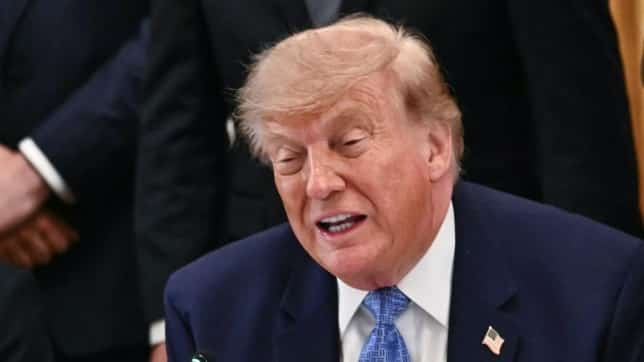
In a recent White House briefing after his Manila visit for the ASEAN summit, US President Donald Trump bluntly said that the Philippines should buy 100 percent of its agricultural and energy imports from the United States starting 1 January 2027, otherwise, “we have problems.”
Sounds casual, but it landed heavily with the weight of a threat dressed up in friendship. Using China as leverage, he said the Middle East and Brazil would not come to our aid in the event of a conflict. So, stop buying from them and depend entirely on America instead.
To some, it is ordinary business with a trade deal, a negotiation, or another round of give-and-take in international commerce. Unpacking it says something deeper and uncomfortable about us as a nation.
We learned in school that Philippine independence was hard won, shaped by generations who fought and sacrificed for our freedom. From Lapu-Lapu, who stood up to foreign forces, to the heroes who fought for independence in 1898, our freedom was never simply handed to us. It was paid for in blood, and carried from one generation to another.
Remember our history — that our ancestors endured centuries of colonial rule so we could govern ourselves—not pass the keys to our economic future to another foreign power. It should concern us when a foreign leader treats our economic choices as a condition for our security. Is our national dignity another item in a contract?
The food on our family tables and the electricity that powers our homes, schools, hospitals, and industries could become bargaining chips in a game between major powers.
What happens if rice prices soar because we have no alternative source? What happens when rice, energy, or livelihoods become dependent on decisions made thousands of miles away by people who have not even set foot in a Filipino village?
For the roughly seven million farmers across the country, and more than a million sari-sari store owners nationwide, these are not abstract issues but everyday realities. Swapping one kind of dependence for another is dangerous.
What stings even more is that the decision seemed to have been made unilaterally for us. A foreign leader announced a “deal” as if everything was already settled, while President Ferdinand Marcos Jr. could only say, “negotiations continue.”
The Department of Foreign Affairs said it was “caught off guard” by Trump’s announcement.
Meanwhile, an opposition lawmaker called for full disclosure of the agreement, asking: “What exactly did Marcos agree to in front of Trump?”
Anyone can easily spot the troubling gap in the statements. History often favors the powerful, while the weaker side can only plead. We’ve seen this happen before and now, under different flags, in different forms, and even in our own country.
There is nothing wrong with partnership, but a real one should give both sides a voice — not force one side to accept the terms set by the other.
All told, this is a story that shouldn’t end in defeat. It can be a wake-up call and an opportunity to put to heart the need to protect our sovereignty, the food on our tables, the power that keeps our homes running, and the farms that feed us.
True freedom is not defined by merely having our own flag, a national anthem, and a current administration hymn. It is having the liberty to decide whom we trade with, what we produce, and how we secure our energy.
It doesn’t mean shutting the door on America or on anyone else. It is keeping our options open, so no single country holds the only key to our future.
In the words of my political science professor, a nation that depends entirely on a single foreign source is tied to a rope, whose length is held by another.
As citizens, we hold more than a vote in our hands. We can keep our local farmers standing, choose local when we can, and remind our leaders that true security is not measured only in guns, missiles, soldiers, and police officers.
Freedom is fought for every day, in small and big ways. And this time, the choice is ours.
Will it be true independence or the deceptive “protection” that comes with chains? What happens next is ultimately up to us.