
PBBM’s legacy unravels
October inflation spiked to 7.8 percent, among the highest in Southeast Asia.
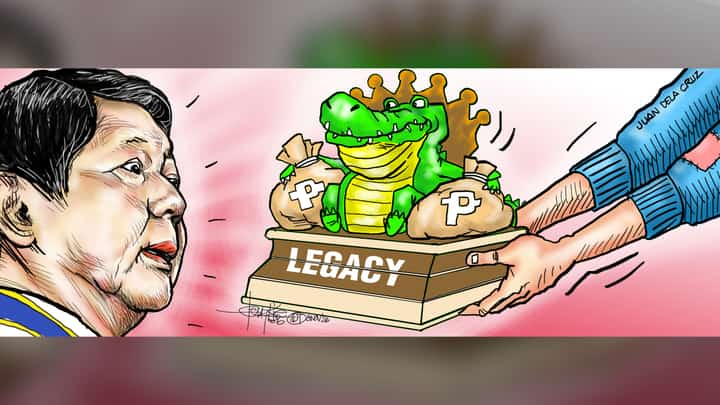
Under the Marcos administration, the country’s problems appear to be converging in a cascade of crises, with fiscal and economic woes compounding one another as political strife takes precedence over development targets.
The irony is that the government has a medium-term development plan designed to sustain the country’s growth momentum. Yet it appears to have been sidelined in favor of patronage-driven initiatives, such as cash aid and infrastructure projects allegedly designed to generate kickbacks.
The country is now grappling not with a single crisis, but with several overlapping ones. S&P Global Ratings has warned that the economy is showing signs of stagflation — a condition in which sluggish economic growth coincides with persistently high inflation.
The string of challenges began with the energy shock from the Middle East conflict, which placed the country under a state of national energy emergency, but the government failed to capitalize on it to ease public suffering from unprecedentedly high prices. The Philippines imports 98 percent of its oil from the Middle East.
October inflation spiked to 7.8 percent, among the highest in Southeast Asia.
The peso broke past P64 per dollar on 27 October, its weakest on record. It later reached P64.17. Oil costs, inflation worries and a wide current account deficit are the causes.
The gross domestic product (GDP) grew only 2.3 percent in the second quarter, and the economy has seen four straight quarters of slowing growth, with the International Monetary Fund projecting the economy to grow a lackluster 3.4 percent in 2026.
Growth has stalled largely because of the flood control scandal. World Bank data showed fixed capital formation contracted for three consecutive quarters from July to September 2025, as the probe into the massive theft of public funds hit both yearly budgets and private confidence.
Former BSP Deputy Governor Diwa Guinigundo said the scandal and the impeachment process amplified the second-quarter slowdown.
The government will release the third-quarter GDP data on 9 November. Economists have a consensus of about three percent, as government spending remains low, as do exports and household demand, mainly because of uncertainty.
Farm output fell five percent in the third quarter, the worst on data going back to 1999, as rice output spiraled 17.8 percent after monsoon damage.
A strong El Niño is next, which could peak toward the end of 2026 and persist into the second quarter of 2027, exposing the country because of its dependence on imported grains.
The Philippines also entered 2026 with the widest budget deficit in Southeast Asia.
National government debt was P19.07 trillion at the end of June, with the debt-to-GDP ratio expected to reach an unprecedented 66 percent this year, or a borrowing level equivalent to P66 for every P100 that the economy produces.
The scandal-driven investment freeze left growth weak before the energy shock arrived. Thin fiscal room limits how much relief the government can give.
A deeper problem that would hit most Filipinos in the gut is the deepening jobs crunch reflected in the September surge in unemployment, which data from the think tank Ibon Foundation showed is the worst among Southeast Asian countries.
The number of employed Filipinos increased by 721,000 year-on-year, but a much larger 909,000 surge in unemployed Filipinos offset the gain.
Underemployment also rose slightly by 34,000 to 5.6 million, pointing to a worsening jobs crisis. The unemployment rate of 5.4 percent was the highest in the region, compared to Indonesia’s 4.8 percent, Malaysia’s 2.9 percent, Vietnam’s 2.2 percent, Singapore’s 2 percent and Thailand’s 0.9 percent.
The actual number of jobless Filipinos may be much higher, given that discouraged and other workers are excluded from official figures and no longer counted as part of the labor force.
The government’s not in the labor force category of able Filipinos grew by 820,000 to 29.2 million.
Young Filipinos are bearing the brunt of the jobs crisis, with many struggling to find decent work as they enter the labor force.
It is difficult to reconcile this reality with the country’s recent past, when the Philippines was among the region’s and even the world’s growth leaders, averaging six percent growth outside the pandemic years.
Yet within just four years of the Marcos administration, that momentum appears to have sharply deteriorated.
Corruption has not only robbed the national coffers. It has also stolen opportunities and the future from an entire generation.