
PAGASA: Another typhoon possible before end of 2026
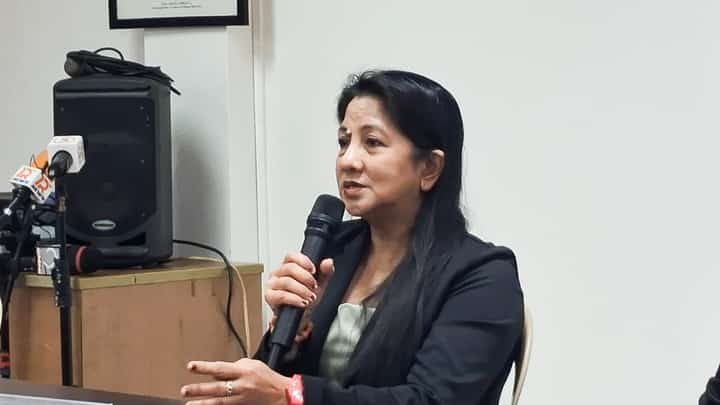
PAGASA Climatology and Agrometeorology Division Assistant Weather Services Chief Ana Liza Solis attended Quezon City Journalist Group Inc. (QCJI) forum on Tuesday, 10 November, at Committee Room 1, QC Hall Legislative Building.
Photograph by Sean Magbanua
At least one more tropical cyclone could enter the Philippine Area of Responsibility (PAR) before the end of 2026, with the possibility of reaching typhoon or super typhoon intensity, the Philippine Atmospheric, Geophysical and Astronomical Services Administration (PAGASA) said Tuesday, 10 November.
Speaking at the QCJI forum, PAGASA climatologist Ana Liza Solis said conditions remain favorable for tropical cyclone development despite the approaching end of the year.
“We are not ruling out the possibility that at least one typhoon may cross the country before the end of 2026. However, there is also a possibility that no additional typhoon will enter before the year ends,” Solis said.
She explained that historically, tropical cyclones developing under El Niño conditions may intensify into typhoons or super typhoons because of warmer ocean temperatures.
However, the possibility of another tropical cyclone entering PAR does not necessarily mean it will make landfall in the Philippines.
Under PAGASA's classification system, a typhoon has maximum sustained winds of 118 to 184 kilometers per hour, while a super typhoon has winds of at least 185 kph.
The weather bureau has recorded 19 tropical cyclones entering PAR so far this year, with Typhoon Samuel, internationally known as Cempaka, becoming the first cyclone to enter the country's monitoring area in November.
Samuel entered PAR on Monday, 9 November, before exiting later that afternoon.
In its 3 a.m. monitoring on Tuesday, PAGASA located Cempaka approximately 1,590 kilometers east-northeast of Northern Luzon, outside PAR.
The typhoon carried maximum sustained winds of 150 kph and gusts of up to 185 kph while moving east-northeast at 20 kph.
PAGASA said Samuel was unlikely to directly affect weather conditions in the Philippines.
The next tropical cyclone to enter PAR will be assigned the local name Tomas.
PAGASA continues to monitor weather systems that could develop or enter the country's monitoring area before the end of December.