
Presidents never alone at The Mansion
Bongbong recounts eerie boyhood Baguio visits
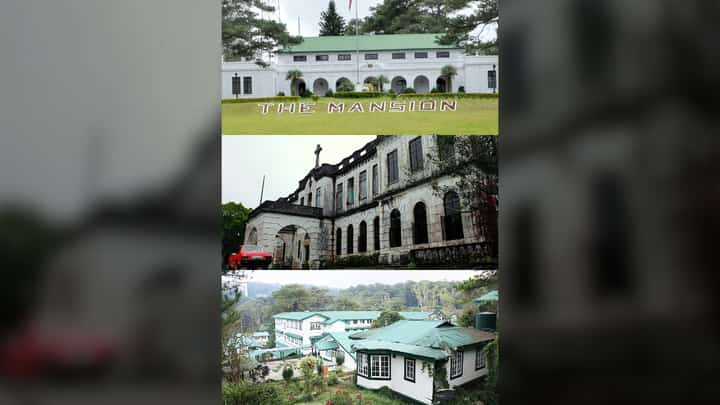
THE Mansion, Diplomat Hotel and Teacher’s Camp in Baguio City — three landmarks steeped in history, mystery and tales of the supernatural.
Photograph courtesy of JAY DIRECTO/agence france-presse and Wiki Commons
President Ferdinand Marcos Jr. says The Mansion in Baguio City may have more occupants than those listed in its guest book.
Marcos recalled feeling an eerie presence at the presidential summer residence during childhood visits, particularly during Holy Week, when he and his companions sometimes sensed something they could not quite explain.
“When we were still young, we usually went there during Holy Week. Maybe it was just our imagination, but we really felt as though something was there,” the President said.
Apparently, the feeling was not confined to young visitors with vivid imaginations. Marcos said even people who lived and worked at the mansion, particularly its caretakers, had reported strange experiences, including unexplained sounds.
“Those who lived there, especially the caretakers, themselves said they felt something, heard things and experienced events they could not quite explain,” he said in a video interview.
The President suggested that the stories could be connected to Baguio’s bloody wartime history, when fierce fighting claimed the lives of American, Filipino and Japanese soldiers.
Unexplained encounters
For Marcos, the possibility that some of those who perished during the war may have remained in Baguio offers one explanation for the stories of unexplained encounters in the mansion.
He may be onto something — at least as far as Baguio folklore is concerned. The summer capital has accumulated enough ghost stories to make its tourist map look like a paranormal itinerary.
The Diplomat Hotel, now known as Dominican Heritage Hill and Nature Park, is perhaps the city’s most notorious haunted landmark.
Before becoming a hotel, the imposing structure served as a Dominican retreat house. Its wartime history, including accounts of Japanese atrocities during the occupation, has given rise to stories of headless apparitions, ghostly priests and nuns, and unexplained wailing.
The building has become a favorite destination for ghost hunters, photographers and filmmakers.
Then there is the Laperal White House along Leonard Wood Road, a Victorian-style wooden mansion that has long been associated with tales of a white lady and other apparitions.
Some accounts describe a woman seen looking out from an upstairs window, while others speak of children and shadowy figures inside the house.
Headless priest
Its wartime history, including reports that Japanese forces used it as a garrison and tortured suspected spies there, has helped sustain its reputation.
The property now houses Joseph’s, an upscale restaurant. Its management has said employees and customers have not reported paranormal encounters. Even the ghosts, it seems, have not been able to interrupt dinner service.
Teacher’s Camp has its own collection of unsettling tales, including reports of a crying woman, a headless priest and unexplained footsteps along empty corridors.
The former Hyatt Terraces Hotel, meanwhile, remains associated with the devastating 1990 Luzon earthquake that reduced the building to rubble and killed hundreds.
A long-running story tells of rescuers hearing taps on pipes and muffled cries for help from the buried structure, while some believe the spirits of those who died still linger on the grounds.
Loakan Road has also figured in local lore, particularly stories of a white lady appearing along the route. Camp John Hay, too, has its share of reported supernatural encounters, especially around an area known as Murder Woods, which is associated with wartime executions.
Tall tales?
Not everyone in Baguio is convinced. A report published in August 2026 quoted a Camp John Hay caretaker who dismissed the stories as gossip, saying he had spent more than 20 years in the area without experiencing anything unusual.
Baguio Rep. Mauricio Domogan also brushed off the tales, saying he had passed Teacher’s Camp countless times without seeing anything strange.
The Mansion House was originally built as the summer headquarters of Governors-General during the American colonial period and later became the official summer residence of Philippine presidents.
On 8 September 2024, it reopened as the Presidential Museum, welcoming visitors to the historic property in the country’s summer capital.