
Easy water for mountain dwellers
An elevated water storage facility and residential tap stands provide a steady flow to homes and the school.
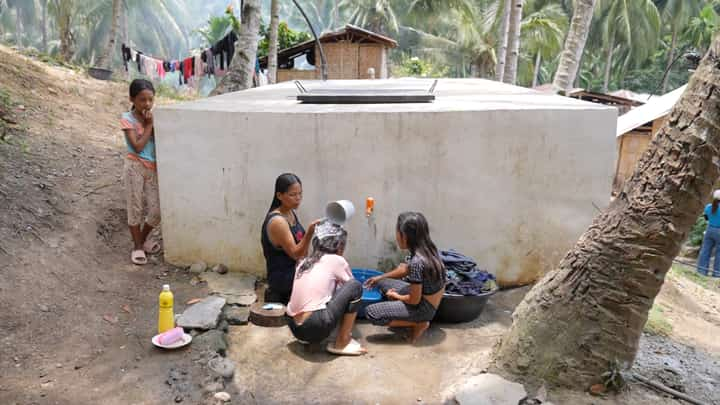
A MOTHER washes clothes while her children take a bath at a communal tap outside their house in Barangay Datal Anggas in Alabel, Sarangani.
PHOTOGRAPH COURTESY OF DENR
For more than 1,000 households in Barangay Datal Anggas, a mountain community in Alabel, Sarangani Province, water used to be accessed the hard way. Residents trekked to wells and springs with empty water containers, line up and wait for their turn at the source, and carry the heavy loads back home.
During dry spells, getting water was more challenging for the mountain residents with wells and streams dried up. There was simply not enough water to drink, cook, bathe and wash.
Now, the ordeal is over as drinking, bathing and washing are normally done by turning on a tap.
The Department of Environment and Natural Resources (DENR) has completed a community water supply systems for the three sitios of Datal Anggas, bringing clean and potable water closer to doorsteps just in time as the very strong El Niño threatens to tighten water supplies across the country.
DENR Secretary Juan Miguel “Mitch” Cuna said the project supports President Ferdinand R. Marcos Jr.’s directive to speed up water projects for communities vulnerable to severe shortages during prolonged dry conditions. He said the DENR continues to maximize available water sources, develop additional supply, and prepare contingency measures for drought-affected communities.
Each of the three water systems completed on 6 April 2026 feature a centralized reservoir designed to steady water flow, an intake box that draws water from a spring, and communal and residential taps.
In Sitio Proper, pipes installed by the municipal government now deliver water directly to homes. Residents no longer need to fetch water from a stream roughly 500 meters away.
“Now that we constructed the community water supply systems, at least residents are no longer burdened with fetching water from the well,” said Glan, Sarangani Community Environment and Natural Resources officer Frank Lebrilla. “They now use the well only for washing clothes and bathing, but for drinking water, they source it from the taps directly at their homes.”
More time for women and girls
In Sitio Ihan, the change has eased a burden carried largely by women and girls.
For its 115 households, fetching water once meant a roughly 30-minute walk to an upland stream about a kilometer away — and another long walk back with heavy containers in hand. When dry weather shrank the water supply, queues at wells grew longer and the task became even harder.
Tap stands closer to home have shortened those journeys. With several access points and a steadier supply, residents are less likely to face long lines during El Niño dry spells.
The payoff goes beyond convenience. With water pumped directly into households, women and girls have more time for education, livelihood, and other activities that can improve their quality of life.
Improved sanitation
In Sitio Ulo Latian, the water system is changing mornings for students at Ulo Latian Integrated School and some 300 households.
Before, children woke up as early as 4 a.m. to bathe in a stream about a kilometer away, then carried water to school for sanitation and other needs. The lack of reliable water had also exposed children to amoebiasis, an intestinal infection caused by a parasite.
Now, an elevated water storage facility and residential tap stands provide a steady flow to homes and the school. Students no longer spend precious early-morning hours hauling water, while teachers report better attendance and performance — gains they link in part to improved sanitation and fewer water-related absences.