
BSP delivers ‘jumbo’ 50-basis-point rate hike
The central bank has now raised rates in its last four monetary policy meetings, bringing its key policy rate to 5.50 percent.
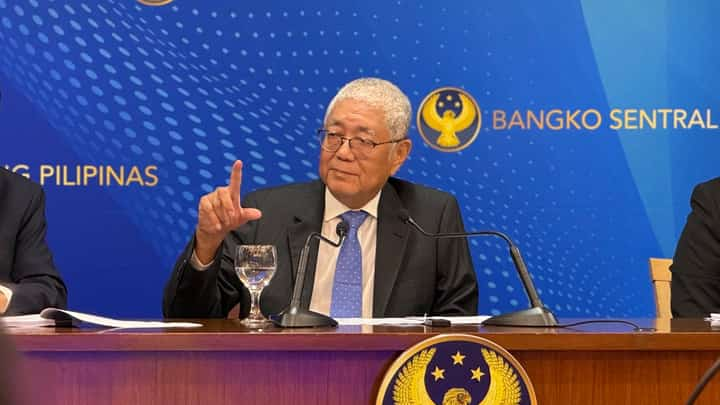
BANGKO Sentral ng Pilipinas Governor Eli Remolona Jr. maintained the central bank's hands-off approach to defending the local currency, stating it does not use monetary policy to support the peso following the announcement of a 'jumbo' 50-basis-point hike at the BSP headquarters in Manila on Thursday afternoon.
Photo by Toby Magsaysay for DAILY TRIBUNE
The Bangko Sentral ng Pilipinas (BSP) has taken an aggressive stance in combating inflation with a “jumbo” 50-basis-point rate hike, defying economists’ expectations with its largest policy rate increase since February 2023.
Central bank Governor Eli Remolona Jr. said at a Thursday afternoon press conference following the Monetary Board’s morning meeting that the inflation outlook for next year played a major role in the decision.
“We took this decisive action because we forecast that inflation will accelerate further in the coming months due to oil prices, transport fares, and the potential effects of El Nino on food prices,” he said.
“This decisive adjustment will appropriately tighten monetary conditions in order to contain spillover effects and firmly anchor inflation expectations.”
The BSP’s target reverse repurchase rate now stands at 5.50 percent, marking a cumulative increase of 1.25 percentage points since the Middle East conflict involving the United States, Israel and Iran began in March.
Inflation surged to a three-year high of 7.2 percent in September, marking the second time this year it has reached that level. BSP Deputy Governor Zeno Abenoja said that while the central bank’s inflation forecast for 2026 remains unchanged, the outlook for 2027 has tilted sharply to the upside as oil supply constraints stemming from the Gulf continue to weigh on the domestic outlook.
He added that inflation could surpass September’s three-year high before the end of the year.
“We think that the inflation rate could average about 6 percent for 2027, but by 2028, we see inflation returning back to target. It could average 3.3 percent by 2028,” he said.
“The actual numbers so far for the first nine months of the year is about 5.45 and a half percent. So that means that the inflation rate could continue to increase in the last quarter of 2026,” Abenoja added.
The central bank has raised its key policy rate at each of the Monetary Board’s last four meetings. Its previous hike in August was enacted partly in anticipation of the El Nino season, which the government fears could be severe, as well as the implementation of the Metro Manila minimum wage increase in September.
Remolona said that while the pass-through effects of the wage hike were limited, the overall figures were worse than expected.
“The numbers we were looking at, the forecasts, were worse than we thought,” he said.
“There were surprising developments on prices, so there was a bit of a sense of urgency to try to dampen these inflationary pressures.”
Asked about the peso, Remolona reiterated that the BSP does not use monetary policy decisions to support the local currency. The peso closed at a third consecutive record low of P63.52 shortly after the rate hike announcement.
“We're not hiking the policy rate to defend the peso,” he said.
“We do intervene a little bit in the foreign exchange market, but that's mainly to avoid swings in the exchange rate that tend to be inflationary. We have estimates of how much the peso has to move before it becomes inflationary, and that's when we tend to intervene,” he added.
Remolona did not provide the specific threshold at which the peso’s depreciation becomes inflationary. He noted that the BSP remains open to raising rates at its final meeting of 2026 in December.
“I would say we remain open to further interest rate hikes. I can't say whether it will be 50 or 25 or bigger,” he said.
“You might remember that in 2022 we did 75 and then 50 and 50. I hope we don't need to do that.”