
Tall senate order of business
The economy needs a boost, and the government has a major role to play as growth slows while prices rise.

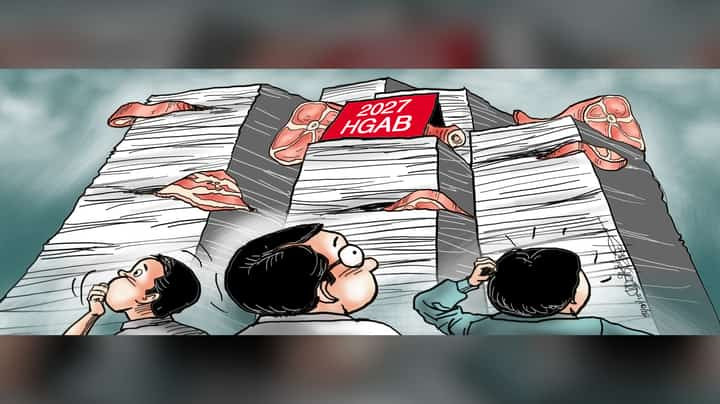
As designed, the 2027 House General Appropriations Bill (HGAB) will do little to stimulate economic growth, leaving little room for expansion and channeling limited fiscal space into projects that favor politicians.
The Cabinet approved a P7.2-trillion National Expenditure Program (NEP), which the Department of Budget and Management submitted to Congress on 11 August.
The proposed budget is P407 billion, or 6 percent, higher than this year’s P6.793-trillion allocation, equivalent to 21.7 percent of gross domestic product (GDP).
The increase appears substantial but barely keeps pace with inflation, which averaged 5.4 percent from January to September and reached 7.2 percent in September.
Independent think tank IBON stated in a report that the increase is only 4.2 percent once interest payments are excluded. Interest payments are fixed in the budget, so they get priority.
The economy needs a boost, and the government has a major role to play as growth slows while prices rise.
GDP expanded 2.8 percent in the first quarter and 2.3 percent in the second, which is the weakest quarter since 2009 outside the pandemic years.
The first-half average of 2.6 percent is less than half of last year’s 5.4 percent. Inflation runs at about three times last year’s 1.7 percent average, and unemployment has averaged about 5.2 percent from January to August, against 4.1 percent a year ago.
Economists call this stagflation, and it is the moment when public spending is expected to matter most. The Middle East war raised fuel costs in March and cut remittances, which account for roughly nine to 10 percent of GDP.
The flood control scandal froze public works, and investment fell 9.2 percent in the second quarter. A sound budget would therefore favor farm support, climate-ready infrastructure and public health because these raise output and protect households.
The House went the other way. It passed the HGAB on third reading, with 281 votes in favor, 13 against, and one abstention. Budget watchdogs counted P541.4 billion in “pork” in the bill, and the soft pork is 94.1 percent higher than in the executive’s proposal.
The additions went to programs lawmakers can steer toward administration allies. About P25 billion more went to crisis assistance, an additional P25 billion for medical support, a P5 billion increase for Tulong Panghanapbuhay sa Ating Disadvantaged/Displaced Workers (TUPAD) and P10 billion for the Presidential Assistance to Farmers and Fisherfolk.
Hard pork grew too. The House added P180 billion for public works, raising the project count from 11,303 to 16,270 and restored P107.4 billion for flood control.
Meanwhile, the essential health facilities program lost P4.5 billion, and the basic education facilities fund lost P3.1 billion. The payouts and projects help families and districts in the short run, but they build little lasting capacity.
The hardest work now falls on the Senate Finance Committee under Senator JV Ejercito, who vowed the Senate will not rubber-stamp the House bill.
He has promised an independent review, a ban on last-minute insertions in the Bicameral Conference Committee, a livestream of that committee’s meetings and a role for civil society groups in the review.
The Constitution bars Congress from raising the President’s total, so every peso restored to health or schools must come from somewhere in the budget. Ejercito must therefore find the money in the very items the House enlarged, and those items have sponsors.
The Senate must defend its changes before a House that passed its bill by a wide margin and that holds most of the insertions.
Time is running short. If Congress fails to pass the 2027 budget before the year ends, the 2026 General Appropriations Act would remain in force under a reenacted budget.
The impeachment trial unfolding alongside the budget deliberations adds to the pressure on the Senate panel.
As the 2028 elections draw closer, competing political demands are likely to intensify, making timely passage and rigorous scrutiny even harder to reconcile.
Cash subsidies should come from funded social protection programs, not from discretionary funds, with rules against political use.
Agriculture, disaster preparedness and climate-resilient infrastructure deserve more funding amid rising oil prices, the threat of El Niño, and looming food inflation.
Public hospitals and the Philippine Health Insurance Corp. (PhilHealth) must also be strengthened, while every budget amendment should be made public, identifying the project, its funding source and its sponsor.
Revenue collections are likely to fall as a weakening economy erodes the tax base, making prudent spending and transparent allocations even more critical.
The Senate finance panel will have to do much of the heavy lifting.