
Baguio Cathedral: Where a city sought refuge

BAGUIO CITY — The staircase from Session Road climbs toward the cathedral, leaving behind the traffic and commerce of the city center. At the top, the twin towers stand above the streets, marking a place that has witnessed Baguio’s transformation, its wartime devastation and the enduring faith of its people.
The Baguio Cathedral and Diocesan Shrine of Our Lady of the Atonement is a familiar landmark in the City of Pines. Its significance, however, extends beyond its place on the skyline. The church carries a history shaped by missionary work, the destruction of war and generations of devotion.
In 1945, as American forces bombed Baguio to retake the city from Japanese occupation, civilians sought shelter inside the cathedral. Much of the city was reduced to rubble, but the church survived. Residents later recalled refugees crowding inside as the bombardment continued, uncertain of what they would find when they emerged.
The building had been intended for worship. During the bombing, it became a refuge. Its survival entered local memory not simply as an architectural fact, but as part of the story of a city devastated by war.
The cathedral’s history began decades earlier. Belgian missionaries from the Congregation of the Immaculate Heart of Mary arrived in the area in 1907, establishing the Catholic mission that would grow alongside Baguio. The first chapel, dedicated to St. Patrick, stood near downtown Session Road before the mission moved to the hill where the cathedral now stands. The hill was known as Kampo to the Ibaloi before the Catholic mission renamed it Mount Mary.
The present church was consecrated on 9 July 1936 under the title of Our Lady of the Atonement. Its twin towers and Neo-Romanesque architecture have since become part of Baguio’s familiar landscape. The parish was established in 1936 and grew into the mother church of the local Catholic community.
A STATUE of Jesus Christ crucified, with the Virgin Mary at the foot of the cross, stands in front of the Baguio Cathedral and Diocesan Shrine of Our Lady of the Atonement in Baguio City.
A STONE monument displaying the Ten Commandments.
The cathedral’s place in the city has not remained untouched by time. The 1990 Luzon earthquake damaged Baguio and prompted repairs to the church. Over the decades, commercial development also changed the view around the cathedral, even as its elevated location continued to distinguish it from the streets below.
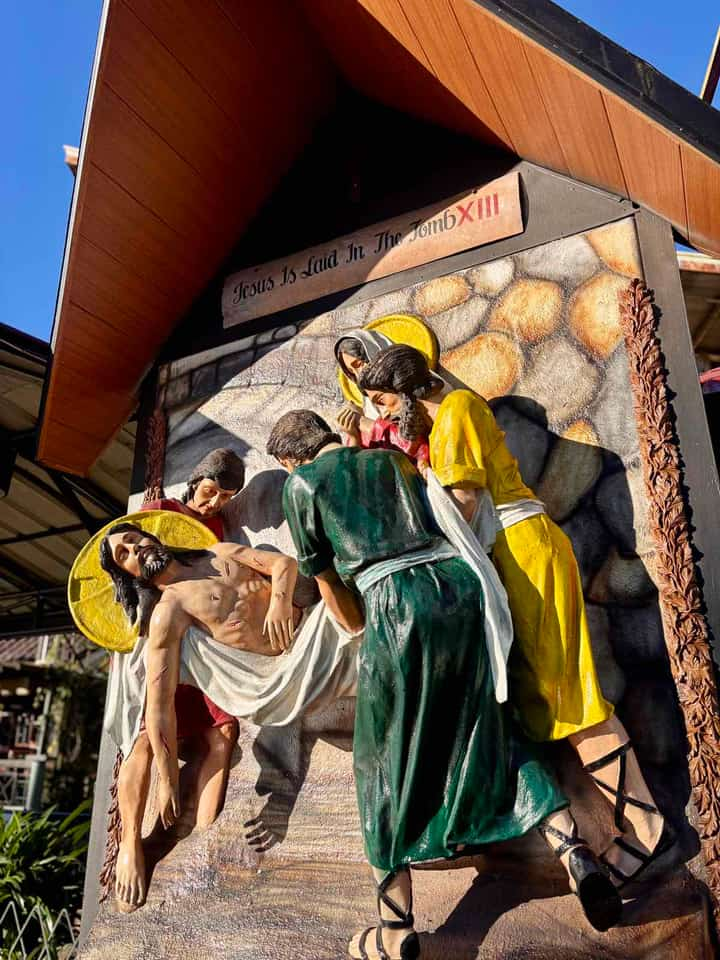
The approach from Session Road has become part of the experience. The Pilgrim’s Stairs, refurbished and inaugurated in March 2022, lead visitors toward the cathedral through a route marked by religious statues. The climb connects the busy commercial district to a place set apart for prayer and worship.
On 21 November 2025, the cathedral was formally declared the Diocesan Shrine of Our Lady of the Atonement. The declaration followed a long-standing petition from the Catholic faithful and recognized the church’s continuing significance to Catholics in Baguio and Benguet. The ceremony also marked the installation of its first rector.
The designation gave formal recognition to a devotion that had existed across generations. The cathedral’s patronal feast is celebrated on 9 July, the date associated with its dedication. The annual observance links the present-day shrine to the church’s beginnings and the Catholic mission established in the region more than a century ago.
Today, the cathedral serves as the seat of the Diocese of Baguio, which covers Baguio City and Benguet. It remains a place for Mass, pilgrimage and private prayer, as well as a landmark for residents and visitors navigating the city.
Baguio continues to change around it. Businesses open and close. Buildings rise. Traffic moves along Session Road. The cathedral remains above the city, its history shaped by the people who built it, those who sought shelter inside it and the faithful who continue to return.
In 1945, civilians entered the church because the world outside had become dangerous. Today, people enter for reasons that are often private and cannot be seen from the staircase. The circumstances differ, but the cathedral’s place in the city’s memory endures.
Some buildings become landmarks because they are visible. Others become landmarks because people remember what happened inside them. In Baguio, the cathedral is both.