
DOST rolls out water, business tech in Quezon
Secretary Renato Solidum Jr. calls for innovations that deliver practical solutions as CALABARZON launches projects supporting water access, local enterprises and community resilience.
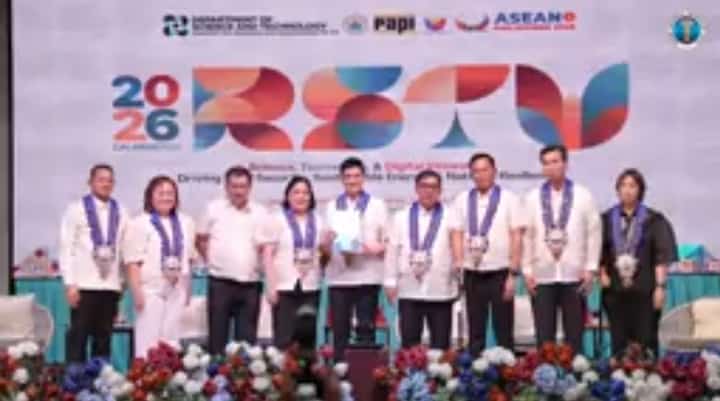
DOST Secretary Renato U. Solidum Jr., Undersecretary for Regional Operations Sancho A. Mabborang, DOST-CALABARZON Regional Director Emelita P. Bagsit, Quezon Provincial Science and Technology Director Maria Esperanza Jawili, and other officials gather during the 2026 Regional Science, Technology and Innovation Week at the Quezon Convention Center in Lucena City, Quezon, on 12 October 2026.
LUCENA CITY, Quezon — The Department of Science and Technology (DOST) launched a series of community-focused technology initiatives in CALABARZON on Monday, 12 October, aimed at improving access to clean water, strengthening local businesses and promoting sustainable development.
The projects were presented during the opening of the 2026 Regional Science, Technology and Innovation Week (RSTW) at the Quezon Convention Center, where DOST Secretary Renato Solidum Jr. emphasized the importance of translating scientific research into practical solutions that benefit communities.
Among the initiatives was a solar-powered water purification system for Jomalig, Quezon, designed to help address the island municipality's limited access to safe drinking water.
In Lucena City, DOST launched a Digital Business Locator Platform to support local business development and improve access to business information.
The department also introduced food safety-compliant vending carts in San Francisco, Quezon, as part of efforts to modernize street food vending and improve sanitation standards.
Other activities included the turnover of Project ROAM three-dimensional models and air quality monitoring equipment to partner local government units, as well as science, technology and innovation plans for Tanay, Rizal, and Lucena City.
Agreements were also signed for the Community Empowerment through Science and Technology program in San Francisco and Tagkawayan, Quezon, in partnership with Southern Luzon State University.
In his keynote address, Solidum said scientific advancement should be measured not merely by the development of new technologies but by their ability to address community needs, create economic value and improve lives.
"The true measure of innovation is not merely whether we can invent something new. It is whether that innovation can solve a problem, create value, improve lives, and make a difference," Solidum said.
He cited DOST-CALABARZON's progress in transferring 107 technologies to 193 adopters, demonstrating efforts to bring research outputs closer to businesses, industries and communities.
The regional office also assisted more than 5,350 micro, small and medium enterprises and industries in 2025 through its Small Enterprise Technology Upgrading Program.
According to Solidum, SETUP-assisted enterprises generated more than P1.59 billion in gross sales and created 2,118 jobs during the same period.
He said the department's Three-Horizon Science, Technology and Innovation Economic Strategy seeks to improve business productivity, expand the commercial application of research and develop capabilities in emerging industries.
Solidum also highlighted the importance of cooperation among government agencies, academic institutions, private enterprises and local communities in addressing food security, sustainable energy and disaster resilience.
"Because science must solve problems. Technology must create opportunities. And innovation must deliver impact," he said.
The opening ceremonies brought together Quezon Governor Angelina Helen Tan, DOST-CALABARZON Regional Director Emelita Bagsit, DOST Undersecretary for Regional Operations Sancho Mabborang and other government, academic and industry representatives.
The three-day RSTW, which runs until 14 October, showcases technologies and partnerships intended to support innovation-driven economic growth and strengthen community resilience across CALABARZON.