
Nobel peace laureate Pillay calls US sanctions on ICC 'unacceptable'
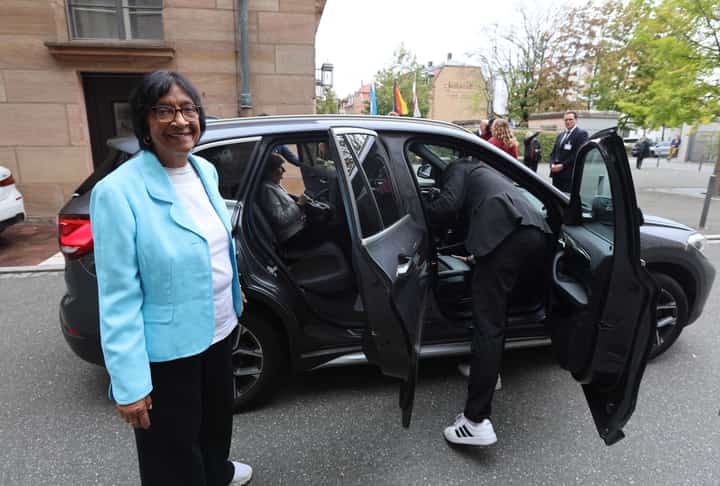
The 2026 Nobel Peace Prize laureate, South African lawyer and champion of international law Navi Pillay (L) leaves after she gave a press statement on October 9, 2026 at the historic Courtroom 600 of Nuremberg's Palace of Justice, venue of the 1945-1946 Nuremberg Trials against leaders of defeated Nazi Germany, in Nuremberg, southern Germany, where she was attending the Nuremberg Forum 2026 conference of the International Nuremberg Principles Academy. The Nobel Peace Prize was awarded to South Africa's Navi Pillay, the judge who headed the Rwanda genocide tribunal and who last year presided over a UN commission which accused Israel of genocide in Gaza. Pillay, currently a judge on the International Court of Justice in a case where Myanmar also stands accused of genocide, has been "instrumental in ensuring that war crimes, crimes against humanity, and genocide are prosecuted," said Jorgen Watne Frydnes, the chair of the Norwegian Nobel Committee in Oslo.
Frank BOXLER / AFP
The winner of this year's Nobel Peace Prize, judge and former UN rights chief Navi Pillay, on Saturday called sanctions announced bythe US on the International Criminal Court (ICC) "unheard of, unacceptable".
"There is so much tension and anxiety over the continued existence of international courts, mainly the International Criminal Court in The Hague," Pillay said via video link from Nuremberg during an event at the Nobel Peace Center in Oslo.
Pillay also lamented that "there are hundreds of staff who feel they are under threat".
"Most importantly, sanctions have been announced by one country against the judges, just for the judicial orders they issue. This is unheard of, unacceptable," the 85-year-old South African lawyer said.
The Norwegian Nobel Committee on Friday announced that Pillay, who once sat on the ICC, was this year's recipient of the prestigious Nobel Peace Prize.
Both the United States, whose leader Donald Trump has long coveted the award for himself, and ally Israel condemned her being awarded the honour.
Hours after Pillay was named the laureate, the United States announced new sanctions against the ICC, provoking swift condemnation from member states and the United Nations.
US Secretary of State Marco Rubio said Washington would ban transactions with what he described as a "rogue court", escalating a long-running campaign by Trump's administration against the Hague-based tribunal.
'History will judge'
The court rejected the US sanctions as an attack on international law and warned in a statement that "history will judge this moment".
In addition to serving on the ICC, Pillay was the UN human rights high commissioner from 2008 to 2014 and she headed the UN Independent International Commission of Inquiry (COI), which found last year that genocide was occurring in Gaza. The body does not speak on behalf of the UN.
Israel has rejected the COI's findings, calling them "distorted and false".
Israel's foreign ministry said the award legitimised "anti-Israel hatred", adding that it thought that Nazi propagandist Joseph Goebbels must be "applauding from hell".
Israeli Prime Minister Benjamin Netanyahu said the awarding of the prize to Pillay showed the Nobel committee had "lost its moral compass" by honouring "a bigot".
Trump, who last month called on ICC member states to quit the court, meanwhile labelled the committee's choice as "a disgraceful and embarrassing decision", telling a rally of his supporters in Syracuse, New York he had "never heard of" Pillay.