
Supreme Court dismissal reinforces impeachment court independence — Tongol
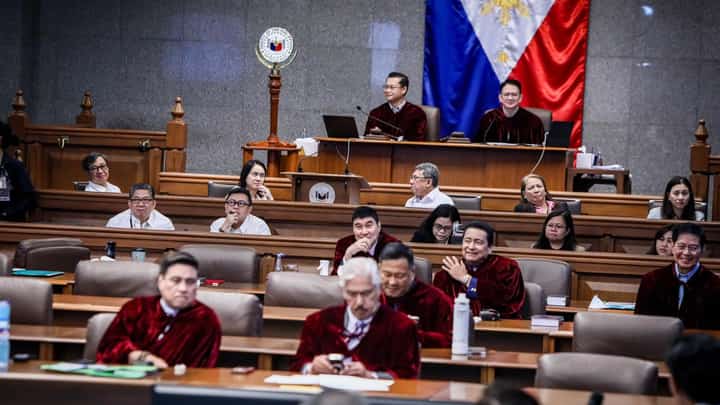
The Senate, sitting as an impeachment court, during the 28th day of the impeachment trial against Vice President Sara Duterte.
Aram Lascano / DAILY TRIBUNE
The Supreme Court’s dismissal of petitions challenging the 23 September ruling that effectively lowered the threshold for convicting Vice President Sara Duterte reinforces the Senate impeachment court’s independence, according to its spokesperson Reginald Tongol.
Tongol’s statement on Wednesday came shortly after the SC unanimously struck down separate petitions filed by lawyers Victor Rodriguez and Ernesto Francisco Jr., as well as disbarred lawyer Berteni Cataluña.
The dismissal allows the Senate impeachment court to proceed with the trial next week “without unnecessary stalling or external distractions,” Tongol said.
This is primarily because the 23 September ruling “stands undisturbed,” according to Tongol.
“The Supreme Court’s prompt dismissal of these cases on procedural grounds—specifically lack of standing and prematurity—effectively confirms the interpretations and proceedings of the Senate Impeachment Court are constitutionally bulletproof,” his statement read.
“By junking these challenges, the Highest Court has drawn a definitive firewall around the independence of the Senate as an Impeachment Court, confirming that its proceedings cannot be held hostage by premature judicial meddling or collateral litigation,” it added.
Senate President Win Gatchalian also welcomed the SC decision, saying it shows that the high court respects the impeachment court’s constitutional independence and the principle of separation of powers.
He said the decision highlights that the impeachment court’s proceedings fall “within its bounds and within its constitutional allowance.”
“Two petitions were filed, one was a TRO (temporary restraining order), and the other was a prayer for status quo ante [order]. Both were dismissed, so that means the trial will continue,” Gatchalian told reporters in a chance interview.
Despite the separation of powers, the SC can still intervene in the affairs of a co-equal branch in cases of grave abuse of discretion.
In dismissing the petitions, the SC cited the petitioners’ lack of standing and the prematurity of their complaints for judicial review.
Previously, Duterte’s defense hinted that it would elevate the amended threshold to the SC and that seeking a TRO from the high court was also an “option.”
The petitions sought to either stop or nullify the impeachment court’s 23 September decision on the grounds that it effectively amended or altered the 1987 Constitution by introducing qualifications not found in its text.
The petitioners challenged the ruling’s constitutionality and asked the Supreme Court to immediately intervene and set it aside.
Under the 23 September decision, the impeachment court will base the two-thirds requirement on the concurrence of members who, at the time of voting, are legally and factually capable of participating in the impeachment proceedings.
As a result, senator-judges who are detained, suspended, suffering from physical or medical incapacity, whose whereabouts are unknown, or who are beyond the Senate’s coercive reach will be excluded from the computation.
The recent decision reversed the 6 July ruling by Presiding Officer Chiz Escudero, which set the conviction threshold at 16 based on the 24-member Senate, despite the absence of Senators Jinggoy Estrada, Rodante Marcoleta, Ronald “Bato” dela Rosa and Loren Legarda.
Like the defense, members of the Senate opposition bloc contended that the absence of their minority peers does not automatically create a vacancy warranting an amendment to the 16-vote threshold.
Gatchalian and his allies denied lowering the threshold, claiming that the impeachment court still upheld the constitutionally mandated two-thirds requirement for conviction because the new decision did not bar absent colleagues from casting their votes on the day of judgment, tentatively set for December.
He said absent minority senators could vote as long as they were physically present in the impeachment courtroom. He added that even senator-judges who attend the entire trial but are absent on judgment day can be excluded from voting.
Estrada and Marcoleta are both detained on plunder charges, while dela Rosa remains in hiding as he evades an International Criminal Court warrant. They have been unable to attend Duterte’s trial since it began on 6 July.
Legarda, meanwhile, has missed the proceedings since 3 August after going on medical leave abroad. She has since extended her leave amid a preliminary investigation by the Ombudsman into plunder and graft complaints.