
Debt, deficits, scandals beset people’s money
Around 40 percent of the P7.2-trillion budget is already committed to automatic obligations like the National Tax Allotment and debt interest payments.


TRACING great fall University of the Philippines School of Economics professor JC Punongbayan is also the author of Twin Plagues: How Duterte and Covid-19 Wrecked the Philippine Economy, a 2026 book on the country’s recent economic history. Drawing on economic data and government policies, Punongbayan examines how institutional erosion under the Duterte administration, compounded by the Covid-19 pandemic, contributed to what he describes as Southeast Asia’s deepest economic contraction and the Philippines’ worst postwar recession.
Photo courtesy of JC Punongbayan/Facebook
As the House of Representatives just concluded budget deliberations on the proposed P7.2-trillion national budget for 2027, the final full-year budget for the Marcos administration, University of the Philippines School of Economics professor JC Punongbayan highlighted major concerns surrounding government spending.
The government faces a revenue shortfall of over P1 trillion every year. Punongbayan noted that every deficit adds to the country’s outstanding debt, which currently stands at a record high of P19 trillion. The debt-to-GDP ratio is approximately 65 percent and rising, according to his estimates.
He flagged this trajectory as a major concern, warning that high debt servicing could reduce funds available for critical sectors such as education, infrastructure and social protection.
“That only means that the interest that we’ll have to pay for our debts is only expected to be higher in the future,” he said.
Punongbayan added that around 40 percent of the P7.2-trillion budget is already committed to automatic obligations like the National Tax Allotment (NTA) and debt interest payments, leaving a much smaller pool of discretionary funds for government departments.
However, he clarified that running a deficit is not inherently bad for a developing country: “We need to make sure that the things we spend on are quite productive and will help us pay for all the debt that we have accumulated.”
The Philippines continues to face a significant infrastructure gap despite years of heavy capital outlay, largely due to the nation’s archipelagic geography and severe urban traffic congestion.
“Even if you remove corruption in government, that doesn’t remove the fact that we will need a lot more infrastructure to connect our islands and make sure that traffic is abated, which, by the way, also poses significant losses on the economy, billions of pesos per day,” Punongbayan pointed out.
Red flags raised
Following recent flood-control corruption scandals, Congress appears to have shifted focus toward the Local Government Support Fund (LGSF).
Punongbayan identified these allocations as “soft pork projects, otherwise known as ayuda programs.” The proposed LGSF allocation for 2027 is over P58 billion, significantly higher than historical levels, which typically did not exceed P20 billion.
He noted that these funds can become highly politicized, citing the LGU support for stadium rehabilitation in Naga City as an example, as it involves President Marcos and former Vice President Leni Robredo.
With the 2028 national elections approaching, he warned that such financial assistance programs risk fueling political patronage.
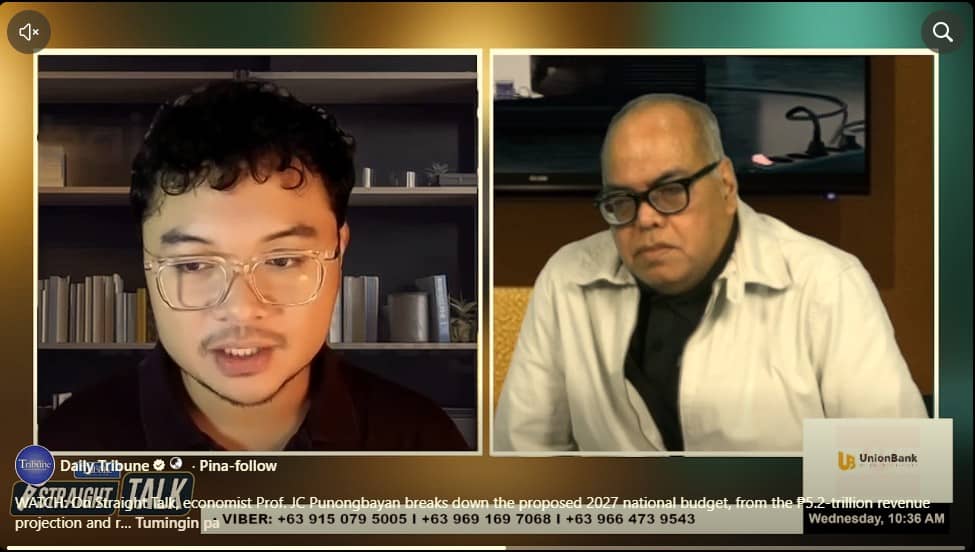
HARDLY a guarantee Bicameral conference committee hearings being livestreamed does not guarantee genuine transparency as proceedings are lengthy, and civil society groups have no avenue to intervene or ask questions, University of the Philippines School of Economics professor JC Punongbayan related to Straight Talk host Chito Lozada.
Screengrab from Straight Talk
“In the run-up to 2028, there are fears that this will be quite discretionary and will help the election of local leaders,” he said.
Congress also frequently expands social assistance programs beyond the executive branch’s original proposals, slating P74 billion for programs such as AICS, MAIFIP and TUPAD.
Not enough transparency
Although bicameral conference committee hearings are livestreamed, Punongbayan emphasized that public broadcasts do not guarantee genuine transparency. The proceedings are lengthy, and civil society groups have no avenue to intervene or ask questions.
“Personally, I’m not so convinced that the Senate’s open ear to civil society is going to do a lot more to improve the transparency of the budget process,” he said.
Corruption scandal, weak GDP
Punongbayan identified two major factors behind the weak second-quarter GDP growth, which slowed to 2.3 percent, the lowest rate since 2021. First, private consumption slowed as rising prices forced households to cut spending. Second, and more critically, economic growth suffered from the fallout of the flood-control controversy.
“Since last year, the government has been a lot more careful in disbursing amounts for public construction projects, and this has, essentially, meant that spending on public construction has decreased a lot, and this has dragged growth down substantially,” he explained.
Punongbayan argued that discretionary “pork barrel” spending continues to survive in various forms despite the Supreme Court’s landmark 2013 ruling abolishing the Priority Development Assistance Fund system.
“Congress people are wise and smart and wily. They will find a way to put in their pork one way or another,” he said, noting how congressional insertions are routinely integrated earlier in the process through the National Expenditure Program.
Punongbayan stressed that less visible discretionary pools like the LGSF demand far greater public oversight. Ultimately, with mounting deficits, the government faces a defining choice: Responsibly manage its debts today or pass the financial burden on to future generations of Filipinos.