
'VERY WRONG': Drilon debunks Cayetano's 'mistrial' claims as impeach court settles threshold issue
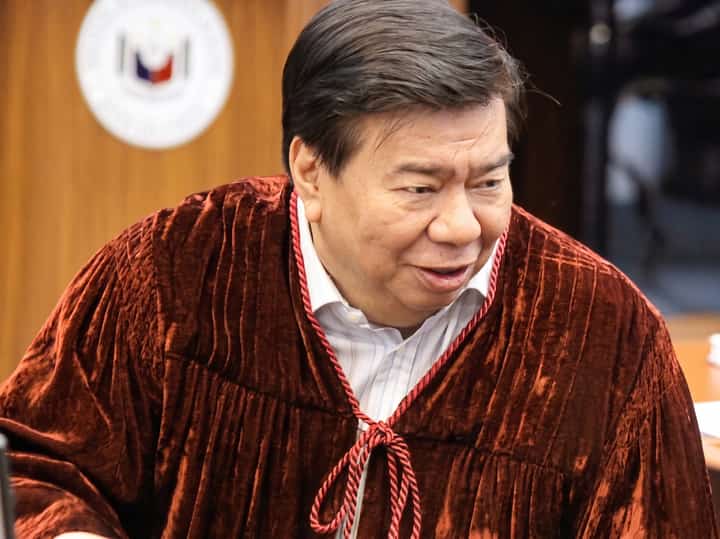
Former Senate president Franklin Drilon on Sunday dismissed as unfounded Senator Alan Cayetano’s claims that changing the conviction threshold needed to convict Vice President Sara Duterte in the middle of the trial could potentially render the entire proceedings void, arguing that past rulings could always be reviewed by senator-judges if deemed warranted.
Cayetano, a Duterte ally, maintained that questions over the threshold had already been settled by Presiding Officer Chiz Escudero as early as 6 July—the onset of the trial—rendering any revisit by the Senate impeachment court unnecessary.
Drilon countered, however, that Escudero deliberately did not structure his ruling as final in anticipation of potential legal challenges and to allow the Supreme Court to weigh in on the issue, considering the absence of several senator-judges.
“A mistrial? That’s incorrect. First of all, Senator Escudero’s ruling can be appealed to the impeachment court—to the 24 senators, or however many there are—who constitute that court. That’s why his ruling is not set in stone,” the erstwhile Senate leader said in Filipino in a radio interview.
“In fact, he acknowledges that an appeal can be made to the Supreme Court en banc; therefore, the claim of a mistrial is baseless,” he added.
Drilon pointed out that the threshold issue goes beyond a mere attempt to alter the rules midway through the trial. Instead, it centers on a dispute over a constitutional provision that the Senate, which retains authority to interpret its own rules, ultimately has the power to resolve.
Cayetano has opposed efforts to review Escudero’s 6 July ruling as it would effectively lower the conviction threshold needed to find Duterte guilty of the impeachable offenses leveled against her, which could derail her presidential ambition in 2028.
In that decision, Escudero upheld the constitutional requirement that two-thirds of the full 24-member Senate, equivalent to 16 votes, is needed to convict an impeached official even in the face of the absence of four of their colleagues from the trial.
In a Facebook live on Friday, Cayetano argued that fairness dictates that abiding by the established rules of the impeachment court requires consistency from beginning to end, warning that altering them as the proceedings progressed could trigger a mistrial and risk rendering the proceedings void from the outset.
With Senators Jinggoy Estrada, Rodante Marcoleta, Bato dela Rosa, and Loren Legarda unable to attend the trial due to their legal battles, Senator Erwin Tulfo previously warned that insisting on a voting threshold of 24 will result in an “acquittal by default,” regardless of how the evidence is presented.
This, he said, also compromises the fairness of the proceedings.
Cayetano issued the warning days before the impeachment court hands down the decision on whether to retain Escudero’s ruling scheduled for 23 September.
Prior to this, the impeachment court heard the positions of retired Supreme Court chief justices Hilario Davide Jr., Artemio Panganiban, and Reynato Puno, and associate justice Adolfo Azcuna, whom it tapped as amici curiae (friends of the court).
Their legal advice would shape the court’s decision on how to lawfully interpret Article XI, Section 3(6) of the 1987 Constitution, the provision that sets the conviction threshold, to prevent a possible deadlock on the day of judgment against Duterte, tentatively set for December.
Of the four magistrates, only Azcuna maintained that the denominator for computing the two-thirds should remain at 24 sitting senators as long as they hold office.
In the same vein, Cayetano rejected treating constitutional voting requirements as mere numbers that could move depending on circumstances, as maintained by Davide, Panganiban, and Reynato Puno.
In disputing Cayetano’s assertions, Drilon argued that the term “all members of the Senate” should be interpreted as those who are within the court’s compulsory jurisdiction, as upheld by the SC in a 1949 ruling, Avelino v. Cuenco.
In that decision, Drilon said the SC established that the basis for a majority should be the number of members capable of participating in a session, rather than strictly fixed at 24.
“So if you cannot compel them to be brought to the Senate because they are abroad, in hiding, or in the custody of the courts due to a plunder case, then they should not be counted among ‘all members of the Senate,” Drilon pointed out.
Furthermore, he said the positions of the amici curiae are non-binding on the impeachment court because the no less than the Constitution empowers the Senate to try and decide all impeachment cases and therefore retains the sole power to interpret its own rules.
The Senate impeachment court is set to put to rest the debate on whether to maintain or lower the threshold on Wednesday, 23 September, after the defense and prosecution panels present their respective positions in oral arguments that day.
Prior to this, an all-senator caucus will be held on Monday.