
Senators mix emotions after seeing 'frail' Digong for first time since ICC arrest
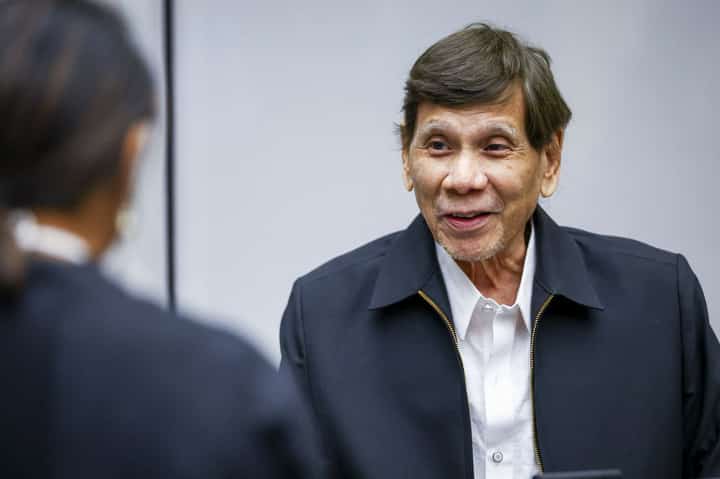
Former Philippine President Rodrigo #Duterte appears at the International Criminal Court (#ICC) in The Hague on 16 September 2026 during a preparatory session as he faces charges over his “war on drugs,” which killed thousands. The 81-year-old previously appeared by video link when he was first brought to the court in The Hague but has since skipped hearings, with his defense team claiming he was too ill.
Piroschka VAN DE WOUW / POOL / AFP
Senator JV Ejercito admitted Thursday that he felt a sense of sadness after seeing former president Rodrigo Duterte appearing extremely thin and frail in his first public appearance since his arrest on an International Criminal Court warrant in March last year.
Ejercito previously deemed Duterte his “friend” and even got the endorsement of the erstwhile leader when he sought Senate reelection in 2022.
“I felt sad when I saw him for the first time in a long while. He was like skin and bones, very frail,” he told reporters in a chance interview.
The San Juan lawmaker attributed his emotions to having worked closely with Duterte on his flagship program “Build, Build Build.”
Senator Robin Padilla, a staunch Duterte ally, said he was moved to tears of joy after seeing Duterte after over a year, but such feelings were overshadowed by sadness given he remained detained in The Hague despite his advanced age.
“I was surprised and unexpectedly shed tears of joy upon seeing him…I know Tatay (Father) Digongt is strong-willed. He has the courage and compassion. But at 81 years old, his body can no longer withstand imprisonment,” Padilla told reporters in Filipino.
Although dealing with his own legal trouble, detained Senator Rodante Marcoleta, another ally, admitted he was happy to see the former president looking pleasant.
Clad in a white button-down shirt and a black collared jacket, Duterte looked well and in better spirits during the ICC third status conference for his crimes against humanity case on Wednesday, despite his counsel’s claim that he was suffering memory impairment.
This marked his first public appearance in one year and six months after his arrest on 11 March last year. Unlike his first court appearance on 14 March last year, which was virtual, Duterte was present in the courtroom alongside ICC prosecutors, his defense team, counsel for the victims, and the three judges of the Trial Chamber III.
He was seated at the back, behind his lawyers, and finished the proceedings, which lasted a little over an hour. He is set to stand trial on 30 November.
Shortly after the conference, the ICC Trial Chamber III released a second decision ordering Duterte’s continued detention.
The chamber ruled that Duterte remains a flight risk, likely to obstruct the judicial proceedings and intimidate witnesses, especially since his trial is less than two months away.
“In light of these developments, the chamber finds that the prospect of the accused facing a trial, and (in the event of a conviction), a lengthy prison sentence, has increased. There is, therefore, a likelihood of the accused absconding and/or obstructing or endangering the investigation or the court proceedings,” the decision reads.
“In respect of the latter considerations, owing to the prosecution’s submission of the witness and evidence lists (thereby disclosing the identities of the witnesses and the contents of their expected testimony), this increases the accused’s ability to interfere with witnesses, either directly or through his family or supporters in the Philippines,” it added.
In a filing earlier this week, defense lead counsel Peter Haynes claimed that Duterte still suffers from significant memory impairment, preventing him from retaining recent information and reliably accessing memories.
Duterte’s condition, he alleged, makes it challenging for his lawyers to engage him meaningfully with the charges, the alleged incidents, and thousands of disclosed items of evidence.
Haynes claimed that Duterte could barely recognize him as his counsel, as well as his family, and that there were instances when he thought “he is living in 2007 or 2008.”
As a result, the defense urged the chamber to conduct another round of medical examinations, allowing a neurologist and other medical experts to assess Duterte’s health anew and determine whether he remains physically and mentally capable of attending the trial.
However, in the same ruling, the chamber said that there were no notable changes in Duterte’s circumstances or medical reassessments that warrant his temporary release.