
Tesla starts paid Cybercab rides

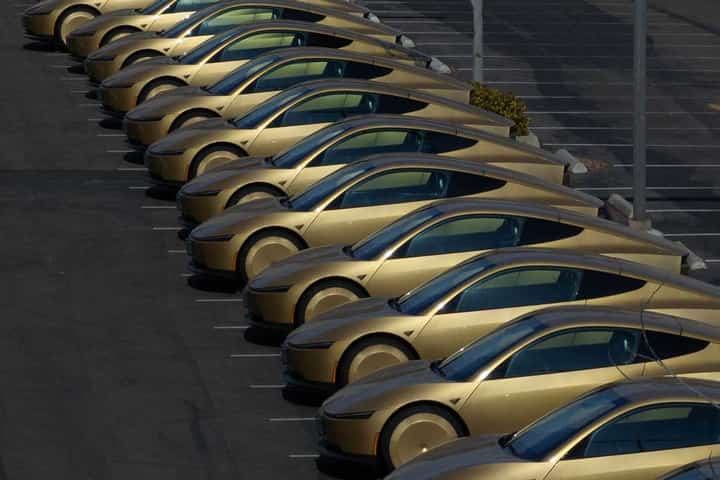
FLEET Tesla Cybercabs line up as the automaker begins offering paid rides in its two-seat autonomous vehicle without a steering wheel or brake pedals.
Photograph courtesy of Tesla
Tesla has begun offering paid rides in its Cybercab, a two-seat autonomous vehicle built without a steering wheel or brake pedals.
The company said passengers can now hail the Cybercab through its Robotaxi service for errands, commutes and other trips. Tesla also said the vehicle has room for items such as luggage, golf clubs and scooters.
The rollout gives the public its first chance to ride in a Tesla vehicle designed from the start to operate without conventional driver controls. Tesla began producing the Cybercab at its Austin, Texas factory in July.
A wider launch, however, may still take time.
The Cybercab cannot be driven in the usual way because it has no steering wheel or pedals. That creates regulatory hurdles in the United States, where many states require special approval for vehicles that operate without traditional controls.
Tesla currently uses the Cybercab within its own Robotaxi service. The service operates in six US cities, including Austin, Dallas, Houston and Miami.
According to the Texas Department of Motor Vehicles, Tesla is authorized to operate 314 vehicles in the state for paid driverless rides. Most are Model Y sport utility vehicles, while 45 are Cybercabs. It remains unclear how many of those vehicles are already carrying passengers.
Tesla first showed the Cybercab nearly two years ago. At the time, the company said it planned to sell the vehicle for less than $30,000. It is the automaker’s first completely new passenger vehicle since the Cybertruck arrived in 2023.
The company has also posted a form inviting businesses to express interest in buying Cybercabs for fleet use. That suggests commercial operators may be among the first outside customers.
Private ownership may take longer because of existing road rules.
Tesla would likely need an exemption from federal vehicle regulations before it could deploy large numbers of Cybercabs. Amazon-owned Zoox received similar federal approval in July for up to 2,500 of its autonomous vehicles, which also operate without a conventional driver’s seat.
Tesla has not yet secured the same type of exemption.
The Cybercab also enters a market where other autonomous taxi operators already have larger fleets.
Waymo, owned by Google’s parent company, Alphabet, operates about 4,000 autonomous vehicles across 14 US cities. In Texas alone, Waymo has more than 700 vehicles, while Avride operates 344 Hyundai Ioniq 5 units.
Tesla’s current autonomous vehicles also still rely on human support. Workers in command centers can step in when the software encounters a problem. Human crews also handle cleaning and maintenance.
The company already sells Full Self-Driving Supervised software for existing Tesla vehicles such as the Model Y. The system can handle much of the driving, but the person behind the wheel must remain ready to intervene.
The Cybercab takes a different approach because there is no steering wheel to take over.
That makes the vehicle a major part of Tesla chief executive Elon Musk’s long-running plan for fully autonomous transport. It also puts more attention on how quickly Tesla can expand the service and meet regulatory requirements in the states where it wants to operate.