
ASEAN enjoys investors’ trust, logs $243.9-B FDI
The ASEAN region logged $200 billion in foreign investment for the fifth time, reflecting investor confidence in Southeast Asia and helping investors plan for future jobs and projects.
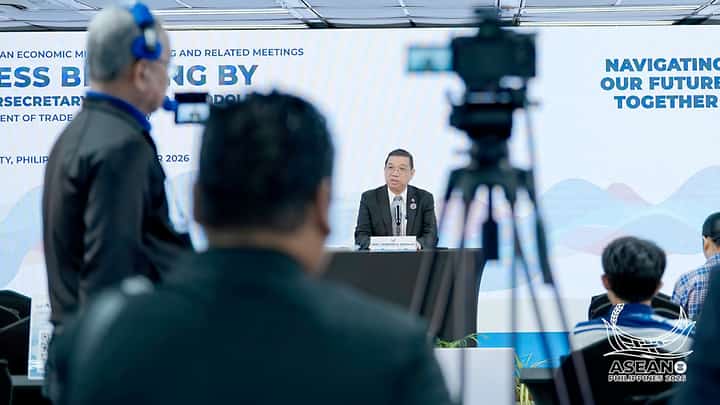
PHILIPPINE Trade and Industry Undersecretary Ceferino Rodolfo said the ASEAN region continue to enjoy the confidence of foreign investors, as it continue to breach $200 billion for fifth consecutive year, during a press briefing on Saturday at the sidelines of the ASEAN Economic Ministers Summit over the weekend at the Philippine International Convention Center.
Photograph courtesy of ASEAN Secretariat
Economies of members of the Association of Southeast Asian Nations (ASEAN) continue to enjoy the confidence of investors outside the regional bloc, as Southeast Asian countries pulled in a record $243.9 billion in foreign direct investment last year.
Philippine Trade and Industry Undersecretary Ceferino Rodolfo discussed this in a briefing on Sunday, as trade and investment ministers from ASEAN’s 11-member states wrapped up their annual investment meeting in Manila this week.
According to Rodolfo, the ASEAN region logged $200 billion in foreign investment for the fifth time, reflecting investor confidence in Southeast Asia and helping investors plan for future jobs and projects.
Rodolfo said the record inflows show investors still trust the region even as trade tensions and global uncertainty make businesses more cautious elsewhere.
“ASEAN continues to stand out as one of the world’s most dynamic and attractive investment destinations,” he said. “The message from ASEAN today is clear: ASEAN remains open for business, committed to regional cooperation, and determined to compete successfully in the industries of the future.”
He said that confidence is already turning into jobs Filipinos can point to. Projects the Philippines approved in 2025 alone are projected to create more than 153,000 jobs, and projects approved in just the first six months of 2026 add nearly 54,000 more, over 200,000 jobs already in the pipeline in a year and a half of approvals.
P6T in Green Lane status
Further, he said the Philippine government’s Green Lane program, which fast-tracks the country’s biggest strategic investments, has certified 239 projects worth P6.32 trillion since it started.
Once those are fully built and running, they’re expected to employ around 421,000 people.
Rodolfo said much of investments go into electronics manufacturing and the region’s growing digital and tech industries. Governments are also funding clean energy and power grids, which means fewer brownouts and steadier bills, along with digital infrastructure that brings faster, more affordable internet to more communities.
“The meeting also highlighted the need to move beyond simply increasing investment volumes toward attracting investments that generate innovation, quality jobs, strengthen industrial capabilities, and contribute to sustainable development,” Undersecretary Rodolfo said.
Ministerial meeting outcome
Meanwhile, ministers of the 11-member regional bloc welcomed that the ASEAN economy expanded by 4.9 per cent in 2025 and is projected to grow by 4.5 per cent in 2026, remaining well above the projected global growth rate of 3.0 per cent despite uncertainties arising from the Middle East crisis and global geo-economic.
“ASEAN’s economy continues to demonstrate resilience, supported by sustained manufacturing activity, resilient exports and investment, and steady domestic demand,” the Ministers’ Joint Statement read.
Further, the ministers welcomed the strong performance of ASEAN’s external sector, with merchandise trade expanding by 13.7 per cent to $4.4 trillion in 2025, while foreign direct investment inflows increased by 10.1 per cent to $245.7 billion, underscoring continued investor confidence in the region.
In terms of ASEAN trade in services, it expanded by 7.5 percent in 2025, increasing from $1.3 trillion to $1.4 trillion compared with the previous year.
On the other hand, intra-ASEAN trade in services grew by approximately 5.1 percent during the same period.
On the digital economy and emerging sectors, the ministers welcomed the conclusion and the preparations for the signing of the ASEAN Digital Economy Framework Agreement (DEFA) on the sidelines of the 49th ASEAN Summit, as well as developments on the ASEAN Leaders’ Declaration on the Cross-Border Movement of Digital Workers, which will complement DEFA by supporting digital talent mobility across the region.
The ASEAN Declaration on the Advancement of Space Science, Technology, and Innovation Cooperation will also reflect ASEAN’s growing focus on the sectors that will define the region’s future competitiveness.
“The Meeting underscored that the ASEAN DEFA will provide a stronger foundation for a more integrated, inclusive, competitive, and trusted digital economy, helping businesses, particularly MSMEs, participate more easily in the region’s digital economy and enabling seamless cross-border digital transactions. The Meeting reaffirmed its commitment to the signing of the Agreement at the 49th ASEAN Summit in November,” the ministers said.