
Hog farmers to PBBM: Save us from P22.5-B loss
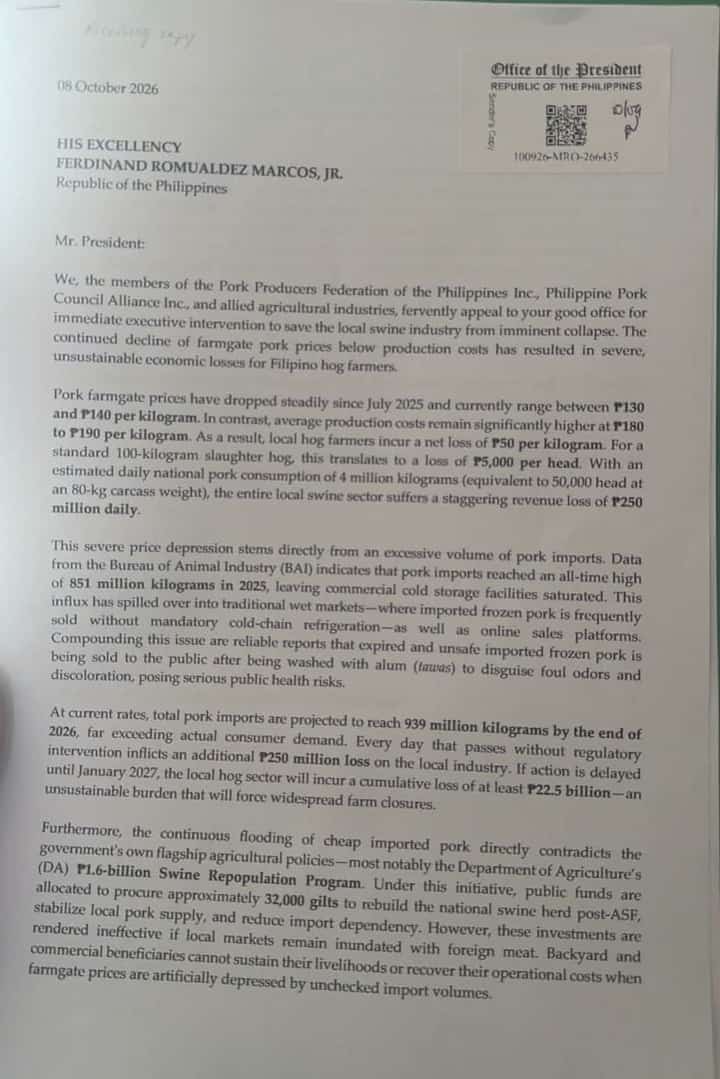
The letter of Pork Producers Federation of the Philippines Inc. (PPFPI), Philippine Pork Council Alliance Inc. and allied agricultural groups sent to the Office of the President
Pork Producers Federation of the Philippines Inc.
Hog farmers’ groups have called on President Ferdinand Marcos Jr. to take immediate action to save the local pork industry, which is suffering losses due to low farmgate prices and the continued influx of imported pork.
In a letter to President Marcos dated 8 October 2026, the Pork Producers Federation of the Philippines Inc. (PPFPI), Philippine Pork Council Alliance Inc. and allied agricultural groups requested the immediate implementation of measures to protect local pig farmers and ensure consumer safety.
AGAP Party-list Rep. Nicanor Briones wrote to Agriculture Secretary Francisco Tiu Laurel Jr. and Bureau of Customs (BOC) Commissioner Ariel Nepomuceno on 2 October to request immediate action against problems caused by imported pork, including possible misdeclaration and undervaluation of imported products.
The groups, in their letter, said that the farmgate price of pork has dropped to P130 to P140 per kilo, compared with the production cost of P180 to P190 per kilo. As a result, pig farmers are losing at least P50 per kilo, or P5,000 for every 100-kilogram live pig.
The sector is estimated to be losing P250 million per day. The groups also warned that losses could reach P22.5 billion within 90 days if the government does not act immediately.
851 million kilos imported
Based on data from the Bureau of Animal Industry (BAI) cited in the letter to Marcos, pork imports reached a record 851 million kilos in 2025 and are expected to reach 939 million kilos by the end of 2026 if the current trend continues.
As a result, the groups proposed restoring the tariffs on in-quota pork imports to 30 percent and on out-of-quota imports to 40 percent, from the current 15 percent and 25 percent, respectively. They also requested temporary quantitative restrictions or limits on the amount of pork imported for up to 200 days, starting in October 2026.
The proposals also include aligning the tariff on pork jowls with the tariff on pork meat, publishing actual transaction values of imported pork, and limiting import clearances for mechanically deboned meat (MDM) to accredited meat processors.
Briones, in his letter to Secretary Tiu Laurel, requested the immediate implementation of higher tariffs, import limitations, strict inspections of imported pork offal and MDM, and the same animal health regulations as those applied to local pork.
Briones also requested the publication of transaction values of imported pork to serve as a basis for proper taxation and to prevent undervaluation, misdeclaration and misclassification.
In his letter to BOC Commissioner Nepomuceno, on the other hand, Briones requested a thorough inspection of imported pork products subject to lower tariffs and their placement in the red lane to identify possible technical smuggling.
He also suggested the filing of cases under Republic Act No. 12022, or the Anti-Agricultural Economic Sabotage Act, with industry representatives if there is sufficient basis.
Frozen pork flooding
Meanwhile, the groups also expressed concern over reports that imported frozen pork is being sold in markets and on online platforms without proper cold-chain refrigeration. There are also allegations of expired or unsafe meat being washed with alum to mask odors and discoloration.
The groups stressed that the DA’s P1.6-billion Swine Repopulation Program, which aims to purchase about 32,000 gilts, or young female pigs, to boost local production after the impact of African swine fever (ASF), must be accompanied by protection for the local market.
According to them, if the market continues to be flooded with imported meat, programs aimed at revitalizing the industry and maintaining the livelihoods of local pig farmers may be rendered ineffective.
Because of this, Briones and the pork producers’ groups called on the government to take immediate action to stop the sector’s continued losses, protect local agriculture and ensure consumer safety.