
Senators call out NIA over massive budget request; flag 'irrigation projects scam'
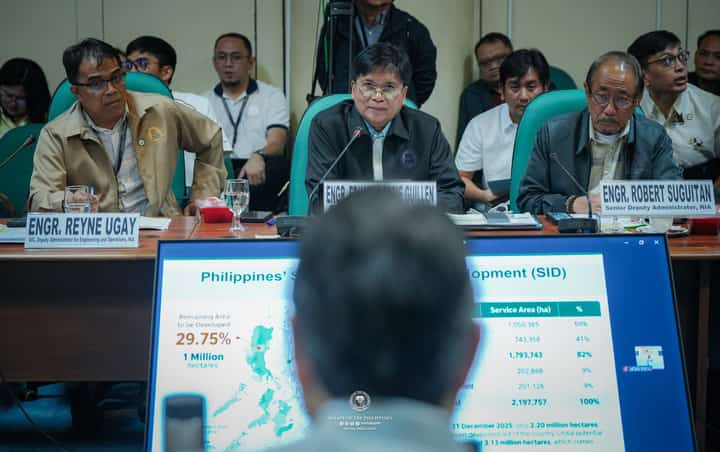
NIA Administrator Eduardo Guillen came face-to-face with Senators Kiko Pangilinan and Imee Marcos during the deliberations on the agency's budget on Thursday, 17 September.
Senate PRIB/JOSEPH VIDAL
Senators Kiko Pangilinan and Imee Marcos called out the National Irrigation Administration (NIA) on Thursday for requesting a whopping P233.85 billion budget for 2027 despite the agency still having nearly P17 billion in unspent funds this year, with billions worth of projects remaining idle or non-operational.
Originally, the NIA proposed P233.85 billion for 2027, but the Department of Budget and Management slashed it by P186.41 billion, leaving the agency with only P47.43 billion.
The NIA’s initial request represents a staggering P169.49 billion increase, nearly four times its current budget of P63.37 billion.
“What was the rationale behind coming up with such a huge budget, when in reality you know it won’t be approved?” Pangilinan stressed, noting that the government has limited fiscal space.
“I am also perplexed by this huge increase requested. Although, of course, we want to accommodate all of that because it is necessary with the impending Godzilla El Niño, as they call it. But […] there is almost P17 billion in continuing appropriations that you didn’t spend in the 2026 budget,” Marcos chimed in.
NIA Administrator Eduardo Guillen said that although they acknowledged that the proposed budget stood little chance of approval, “We just need to show the real situation […] for Congress and Senate’s appreciation of what our constituents need.”
The NIA faced the Senate committee on finance, presided over by Pangilinan as vice chair, to defend its budget for next year, including its planned irrigation projects aimed at helping farmers and boosting agricultural productivity ahead of the expected severe drought to be brought by “Super El Niño” later this year.
However, Marcos raised alarm over a report of the Commission on Audit revealing that NIA has nearly 46,000 hectares across 660 irrigation systems that are non-operational.
The audit findings showed that of NIA’s 110 irrigation projects aggregating P12.7 billion in 2025, 63 were damaged, with a total cost of P7.7 billion.
Although 47 of them were completed, state auditors found them to be non-operational. They amounted to P4.9 billion.
‘Irrigation scam’
Guillen claimed the projects are still under warranty, although not all are eligible for repair, specifically those affected by natural disasters.
The NIA chief emphasized that this is precisely why they are requesting a quick response fund (QRF), a built-in standby fund they can tap for rehabilitation and reconstruction during calamities. He said the lack of QRF in previous years contributed to idle projects.
Marcos, however, did not buy Guillen’s reasoning. She argued that the projects in question are not subject to QRF because they are new.
Marcos took issue with the sharp increase in NIA’s QRF, from P300 million this year to P1.7 billion for 2027, although the latter remains a proposal and subject to Congress’ approval.
A representative of COA told the panel that some of the flagged irrigation projects were “partially implemented” to date.
Aside from this, Marcos also flagged the NIA for over 146 irrigation contracts that missed their target completion, and 17 others amounting to P1.58 billion were terminated, as mutually agreed upon by the NIA and the contractor, due to right-of-way issues, based on the same audit report.
She also questioned the NIA’s non-compliance with the procurement law involving 137 contracts to the tune of P15 billion
“Why is the procurement [law] not followed? Are those negotiated bids? This is nerve-wracking...There’s already flood control, and now there’s irrigation scam,” Marcos lamented.
Guillen, meanwhile, countered that of the 17 terminated contracts, five had already been given notice to proceed, four were currently under review, and four were being repackaged. He said one was “terminated by convenience.”
As for the 137 contracts, Guillen said they already complied with the audit recommendations and submitted the necessary documentation, which the COA representative confirmed.
Still, Marcos contended that it was not “very reassuring” given that the NIA has been embroiled in similar issues in previous years.