
House transparency zarzuela
The danger resurfaces: a budget assembled in a room with the lights off, then presented afterward as though it had always undergone a thorough and open process.
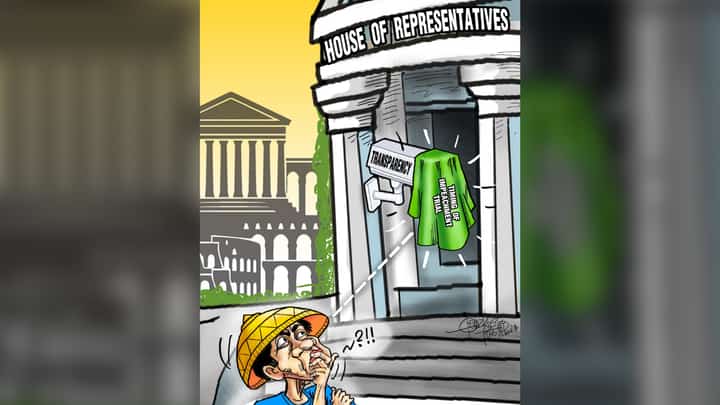
While attention is focused on the impeachment trial, the 2027 budget process has begun in the background, with early signs that the administration’s promise of transparency is being thrown out the window.
When the House of Representatives opened plenary deliberations on the proposed 2027 national budget on 15 September, civil society groups said they learned of the proceedings only at 8 p.m. the previous night, just 12 hours before they began.
Budget watchdog groups said the short notice appeared to be deliberate, to effectively shut them out of meaningful participation.
The People’s Budget Review, which brought together transparency and civil society groups, was held on 8 September, the final day of committee hearings, when little remained for them to scrutinize.
It also ran opposite the Department of Social Welfare and Development and Department of Labor and Employment hearings, two agencies where ayuda, or cash doles, grow legs and find their way into patronage networks.
The Senate Committee on Finance under Senator JV Ejercito, in contrast, met with civil society groups directly, opened its hearings to sectoral representatives, and asked what would make its process useful to the public it serves.
The smaller chamber can manage this, so the House can too. This is not a matter of will, and its absence invites a harder question about what the House majority has to protect.
Independent groups were limited to three minutes to speak, which feels more like choreography than consultation.
The pattern continued in the dark corners where budgets are actually made. The Budget Amendments and Realignment Sub-Committee (BARSC), for instance, is where the real work happens: where line items are inserted, projects are swapped and the difference between a budget on paper and a budget in practice gets written.
The committee promised to share its schedule, but it has not. It held a four-hour executive meeting that civil society learned about second-hand; nobody was told whether the BARSC met, or whether anyone would be allowed to watch.
Thus, the danger resurfaces: a budget assembled in a room with the lights off, then presented afterward as though it had always undergone a thorough and open process.
The Supreme Court has said before, in voiding the Priority Development Assistance Fund (PDAF), that legislators cannot identify projects after enactment.
The High Tribunal named that discretion exercised without visibility invites abuse, regardless of what the item is called in that particular budget cycle. Insertions made in a closed sub-committee, unaccompanied by masterplans or technical justification, are PDAF’s grandchildren.
This budget was written 18 months before a national election and somehow explains everything about the sub-committee’s silence.
A pre-election budget is not merely a fiscal document; it is a war chest disguised as an appropriations bill. Every ayuda line, every Unprogrammed Appropriation (UA), every insertion that cannot be traced to a masterplan may constitute a 2028 poll-spending extravaganza.
The closed sub-committee can build that political war chest without anyone keeping count.
The Committee on Appropriations should not release schedules on the eve of each session.
Please publish the project-level files of the House version, including insertions and remove anything without documentation or alignment to an actual development plan.
The SC’s decision to strike methods used to create the Disbursement Acceleration Program reminded the political branches that even executive discretion over public funds answers to constitutional limits when it substitutes for what only Congress can lawfully authorize.
The same logic applies in reverse: a legislature that hides its own amendment process from the public it taxes is not exercising discretion but evading accountability.
The House professes the budget process remains open — only on paper.