
Spotting Larry Alcala and inspiring the nation to keep drawing itself
At the centennial exhibition ‘Return to the Popular: Drawing the Filipino Imagination,’ National Artist Larry Alcala’s familiar lines move from newspapers and memory into an animated, participatory present
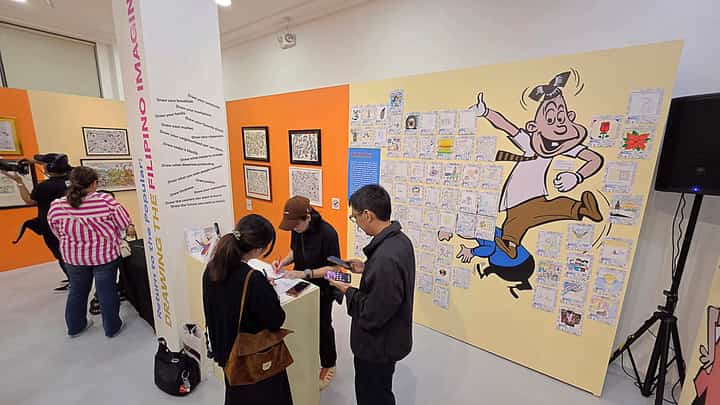
The rain had already entered the exhibition before the guests did. On one wall of the Manila Metropolitan Theater’s Gallery 2 was Larry Alcala’s drawing of a flooded Central Luzon community, its calamity observed through the genial, clear-eyed humor that made generations of Filipinos pause over his pages. Outside the frame, severe weather had forced the organizers to postpone the opening reception and close the exhibition for a day. A scene drawn decades ago had found its way back into the present.
For Ana Alcala, the National Artist’s granddaughter, the coincidence sharpened the work’s meaning. When someone from the National Commission for Culture and the Arts (NCCA) suggested using the flood illustration for the closing announcement, she saw the “enduring relevance and timelessness” of her grandfather’s art.
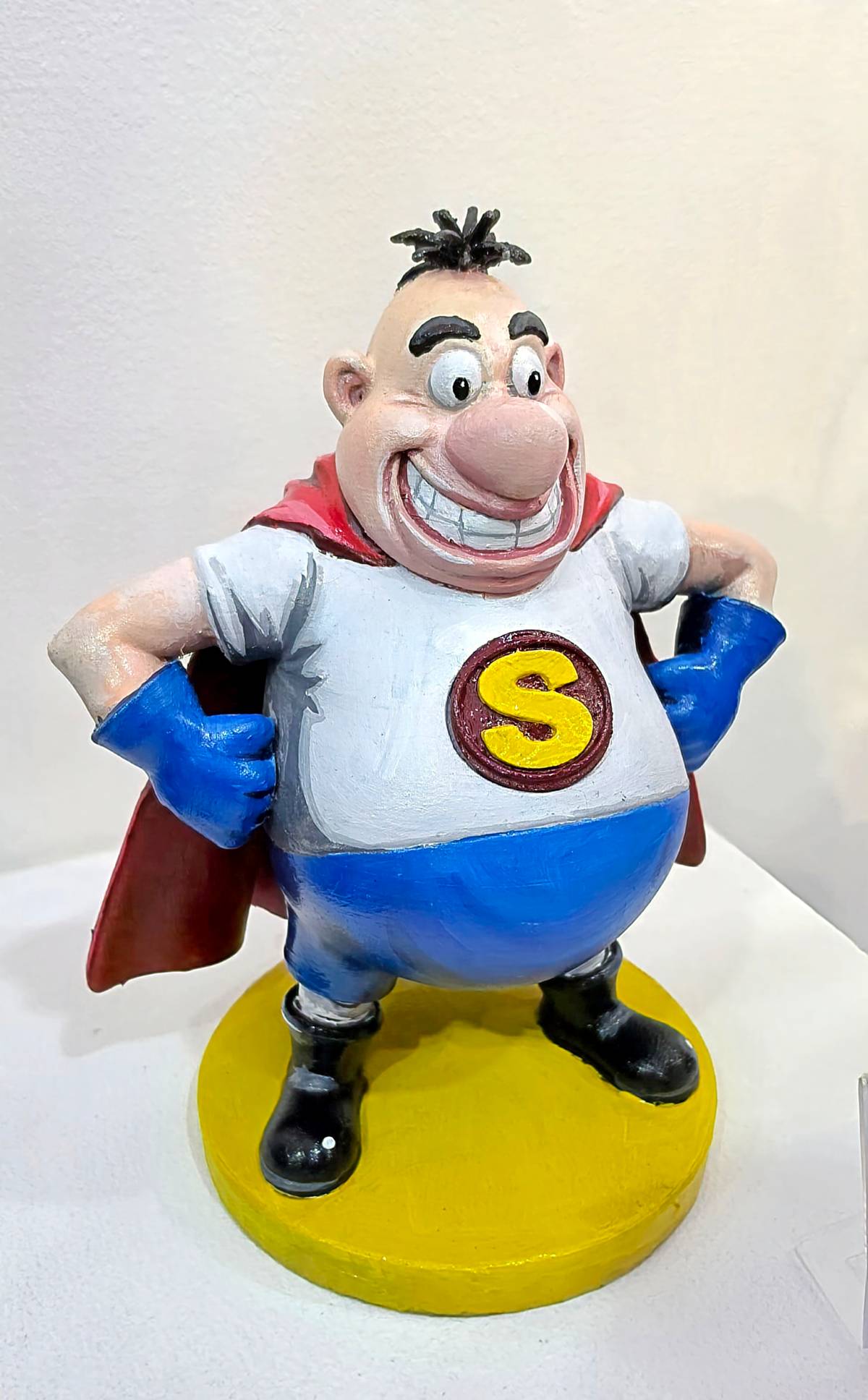
A figurine rendition of Alcala’s Siopawman.
“Unfortunately, 30 years on, that’s still something that is an all-too-familiar scene pa rin, na community flooded,” she said during the rescheduled reception on 27 August. “But, of course, told through the lens of humor.”
The delayed gathering gave Return to the Popular: Drawing the Filipino Imagination an opening worthy of Alcala: ordinary life interrupting ceremony, and humor making the inconvenience bearable and discussable.
Organized by the NCCA, Cultural Center of the Philippines (CCP), the Filipino Heritage Festival, Inc. and the Larry Alcala Estate, the exhibition opened to the public on 19 August, a day after the birth centenary of Lauro “Larry” Alcala, who was born on 18 August 1926, and runs until 19 September. Co-presenters include the University of the Philippines College of Fine Arts, Samahang Kartunista ng Pilipinas (SKP), Lennon Group, Worldwide Womb, Tony &, and Hala! Media. The exhibit begins Larry Alcala 100, a year-long series of exhibitions, collaborations and public activities celebrating one of the country’s most beloved cartoonists and visual storytellers, running until August 2027.
Curated by visual artist and professor Jose Santos “Chong” P. Ardivilla, Return to the Popular unfolds like a comic strip, punctuated by large illustrations of Alcala’s characters on walls and corners. It gathers reproductions of the beloved Slice of Life pages, original works, archival sketches and memorabilia, as well as works by members of the Samahang Kartunista ng Pilipinas inspired by Alcala. Digital and participatory installations bring Alcala’s visual world into the habits and technologies of another generation.
The setting is apt. The Manila Metropolitan Theater (Met) has long been a house of popular entertainment at Lawton, Ermita, Manila, where performances passed into the country’s cultural memory. Alcala made a comparable stage of the printed page. Within its small borders, he gathered the everyday dramas, ambitions, absurdities, and contradictions of Filipino life until his drawings became shared experiences.
Ardivilla’s curatorial note argues that returning to Alcala means returning to the popular “not as something ordinary or secondary, but as a powerful cultural space where art reaches its widest public.” Alcala’s art seldom waited behind museum walls. It arrived with the newspapers and magazines, with advertisements and books, folded into the daily ritual of reading. People found neighbors, relatives, strangers and themselves in it.
That recognition rests on formidable observation. Cartoonist Roni Santiago recalls Alcala’s delightfully cluttered studio and the remarkable clarity of the drawings produced there. Archival sketches in the exhibition show that their apparent ease came from discipline: confident lines, expressive figures and carefully balanced compositions refined over years. Even when satirical, the exhibit notes, Alcala’s cartoons avoided cruelty. The laugh did not require the humiliation of its subject.
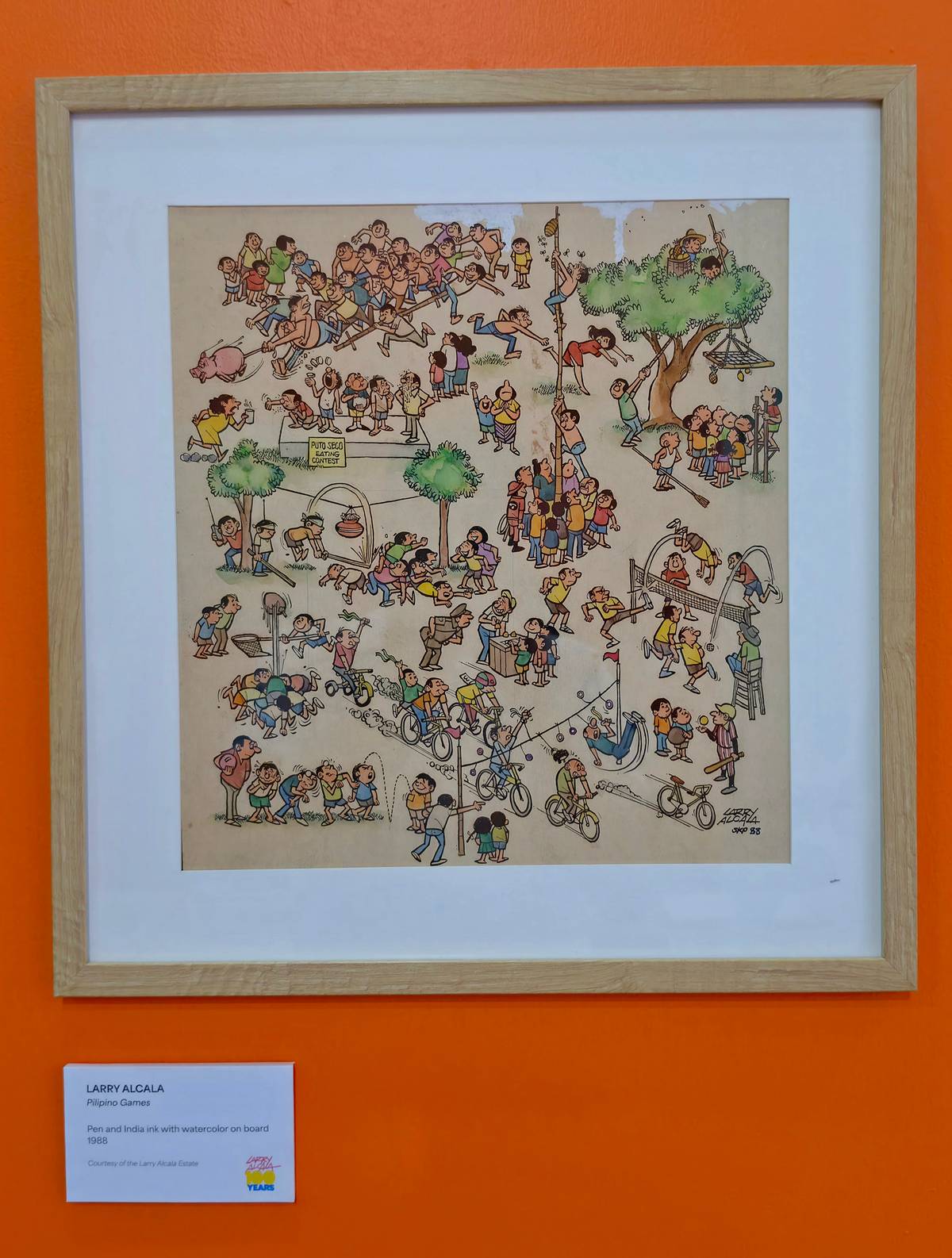
‘CENTRAL Luzon Floods’ (pen and India ink on board, 1993).
Ana described humor as both lens and language. “Humor has that unique ability to allow us to create conversations, to think about our shared experiences, our lives, including both the good and the bad things,” she said.
Subjects that might otherwise be difficult or uncomfortable could be approached through laughter.
“He saw Filipino culture and life through the lens of humor. And I think that’s so powerful because, at the end of the day, if we can still laugh at ourselves, then maybe there is still hope,” she further said.
Alcala began cartooning while still a student and built a career that spanned more than five decades. His characters became fixtures of Philippine popular culture: the bumbling detectives of Kalabog en Bosyo, the amiable Mang Ambo, the unlikely superhero Siopawman and the crowded, wordless panoramas of Slice of Life. In the latter, readers searched for Alcala’s bespectacled, sideburned likeness hidden amid street scenes, celebrations and neighborhood commotion. Looking became part of the joke. It also trained the eye to recognize the density of Filipino communal life.
The country formally recognized Alcala as National Artist for visual arts in 2018, 16 years after he died in 2002. The honor affirmed a practice that had already lived intimately with its public. His work helped establish cartooning and illustration as serious visual forms without separating them from ordinary readers.
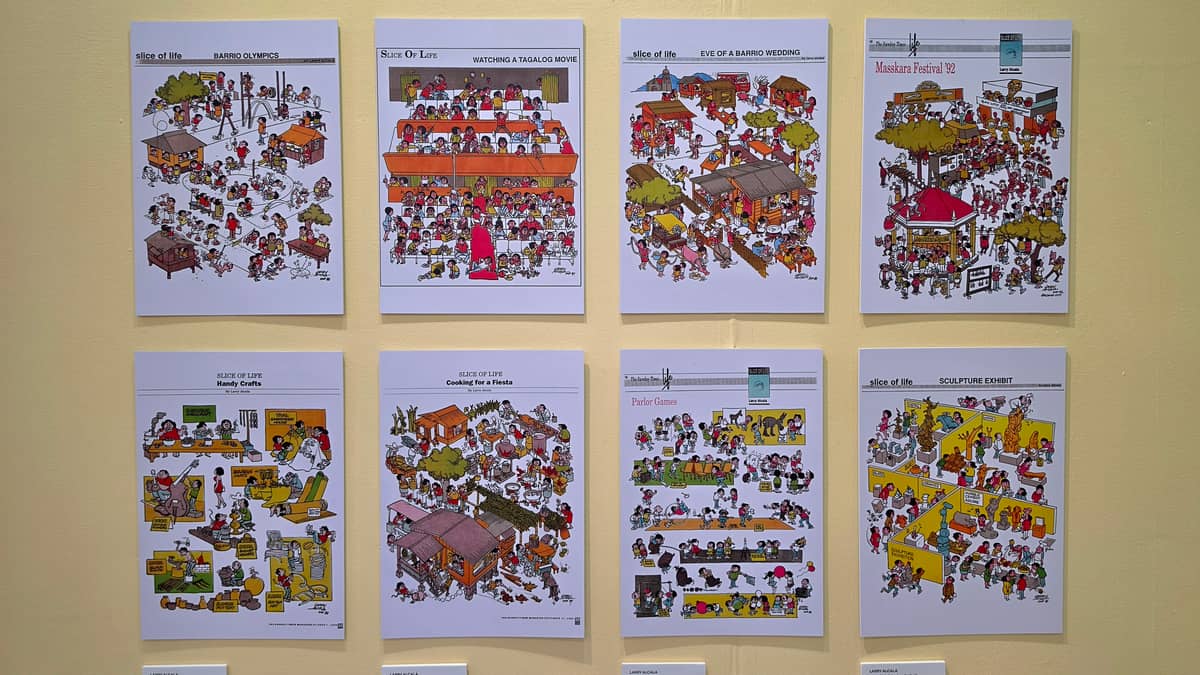
REPRODUCTION of ‘Slice of Life’ illustrations.
His influence also extended well beyond the funny pages. Alcala taught at the University of the Philippines College of Fine Arts and helped establish its program in visual communication, preparing artists for work in advertising and design. He was a commercial artist who produced campaigns for various brands, adjusting his distinctive hand to different briefs without losing its clarity.
That part of his practice occupies the physical center of the exhibition. A long, glass-covered drawing board displays storyboards, character and poster studies, sample illustrations, a Christmas card design, newspaper clippings and a cartoon for The Peninsula Manila, all from the Larry Alcala Estate. Around it, bright orange walls hold framed works and large cutouts of familiar characters. The placement feels quietly declarative: at the heart of this survey is the worktable, where a cultivated line met the demands of deadlines, clients, teaching and mass circulation.
Alcala also helped found the Samahang Kartunista ng Pilipinas in 1978 to advance cartooning as a profession. He hoped Filipino cartoons might one day be syndicated and appear simultaneously in several publications. That ambition did not fully materialize, but a durable fellowship did. The organization remains active, and its younger members contribute works to the exhibition, interpreting Alcala’s visual language through their own styles. The lines differ, as the exhibition panel observes, but they travel toward the same destination: laughter.
Return to the Popular does more than place this lineage under glass. Drawn to Life, an interactive digital experience, dissolves the boundary between viewer and image by allowing visitors to enter Alcala’s hand-drawn world as characters. The gesture makes explicit what his work had always suggested: the Filipino public was his central and most enduring cast.
A Living Slice of Life uses live streams of information about the city’s traffic, weather, and social activity to create an evolving animated environment inspired by Alcala’s teeming scenes. Technology does not attempt to replace his hand. It carries forward his method of watching the nation change from moment to moment and locating its story in ordinary people.
Elsewhere, The Nation Draws Back turns spectators into makers. Visitors choose postcards and prompts, respond with drawings, write their names and ages, and pin their work to a communal display. Stick figures, uncertain squiggles and elaborate illustrations are equally welcome. The activity rejects perfection as the price of participation. Drawing begins, the exhibit says, with the courage to place an idea on paper.
For Ana, that invitation reaches beyond artistic production. “When we say creativity, it’s not just creativity as an artistic expression, but also creativity as a way of life, as a way of thinking, as a way of seeing the world,” she said.
The centennial campaign’s rallying cry, “Creativity is for Everyone,” asks people to notice imagination in daily life and “unlock the artist that is in all of us.”
The exhibit carries that belief into a series of free cartooning workshops organized with UP’s Department of Visual Communication and the Samahang Kartunista ng Pilipinas. Sessions from August to November introduce children and other participants to character design, comic strips, basic cartooning, life and form, cardboard characters and moving images. The program recalls Alcala the teacher, who treated cartooning as a profession, an art and a means of communicating ideas.
The Larry Alcala Workshop Series comprises five free sessions held at the Met and the CCP — the Basic Kartooning Workshop for Children: Character Design and Comic Strip on 12 September with Ardie Aquino, Giodesk Guiao and Celso Quijano Jr.; Expressing Thoughts with Cartoons on 12 September with Boboy Yonzon, Barry Jose and Mike Yonzon; Line and Form with Crown Dolot on 22 September; Cardboard Characters with Sebastian Cacho on 17 October; and Moving Images with Melvin Calingo on 21 November.
Standing at Lawton, Ana borrowed Ardivilla’s description of the site as a crossroads of art and everyday life and called the Met a “grand cathedral of popular art.” The phrase suits an exhibition that restores dignity to forms sometimes dismissed because they are familiar, funny, or widely circulated. Here the newspaper page and the gallery wall do not compete for authority. They meet, and the public moves between them.
At the drawing board in the center, one encounters the evidence of a life’s labor. At the participatory wall, visitors add their own hesitant or confident marks. Between them lies the exhibition’s account of Alcala’s continuing place in Philippine culture. He did not merely draw the Filipino crowd from a distance. He stood within it, hid his face among its many faces, and invited readers to look closely enough to find him — and, perhaps, themselves.
The flood remains. The traffic thickens. Neighborhoods change, and the tools of drawing acquire screens, projections and live data. Yet Alcala’s proposition survives these changes: everyday life deserves attention, and humor can make recognition less painful. As Ana told the gathering, “If we can still laugh at ourselves, then maybe there is still hope.” A century after his birth, Mang Larry’s nation is still drawing itself, one line at a time.