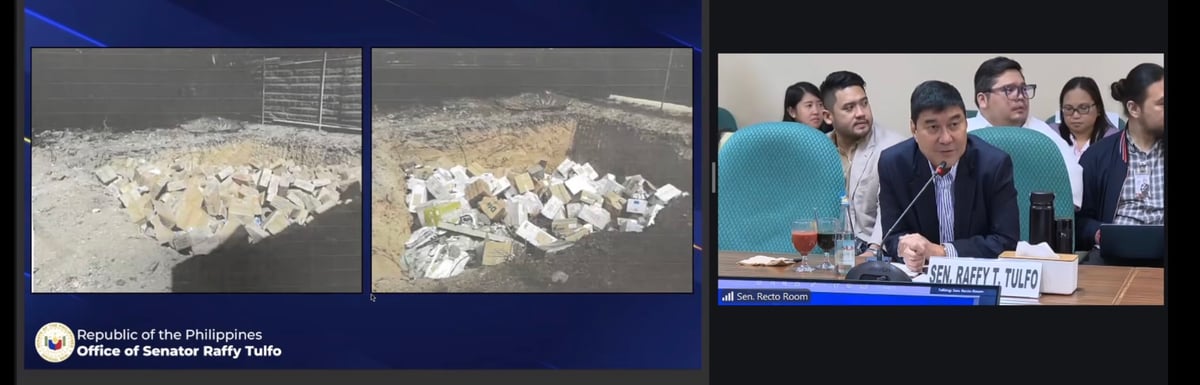
Senator Raffy Tulfo warned the Department of Health (DOH) on Friday to gear up for an impending blue ribbon probe following reports that billions of pesos’ worth of expired medicines are being dumped into burial pits, despite mounting complaints that free medications fail to reach patients in public health centers and government hospitals.
Tulfo confronted DOH officials during Senate deliberations on the agency’s proposed 2027 budget, presenting photos obtained by his office showing stacks of medical boxes being disposed of underground. This was despite the DOH consistently vouching that expired medicines are being returned to suppliers for replacement.
Data cited by newly appointed DOH Secretary Edwin Mercado revealed that in 2025 alone, the value of expired stock totaled approximately P217 million, while near-expiry stock reached P477 million, or almost half a billion.
“So it is very clear that there is corruption here. It would be best for the Blue Ribbon Committee to investigate this, because it has been happening every year,” Tulfo said in Filipino before the Senate finance committee, calling the scheme “modus.”
The BRC is currently chaired by Senator Erwin Tulfo, the senator’s brother.
The lawmaker attributed the recurring pattern of medicine wastage to a suspected kickback scheme.
Citing a source, Tulfo alleged that the scheme involves the DOH entering into last-minute or emergency purchases from a favored supplier to bypass mandatory competitive bidding. This allegedly allows the DOH to secure cheaper medicines, though the downside is that they have a short shelf life.
“And of course, if it’s cheap, there’s a kickback involved. Just imagine how many millions the procurement officer pocketed in kickbacks from those billions’ worth of expired supplies,” Tulfo lamented.
DOH embroiled in same issue over the years
Mercado confirmed that one of the DOH undersecretaries who recently resigned was in charge of the procurement process. He added that the DOH would form an investigative committee to address the underlying issue.
A resolution filed by Tulfo last May showed that from 2015 to 2018, the amount of expired DOH medicines and medical supplies reached as high as P18 billion. State auditors have flagged recurring inventory wastage in the DOH over the years, but it remains unaddressed.
In 2019, the Commission on Audit discovered that P2.2 billion worth of expired and about-to-expire drugs were stocked in DOH-run warehouses.
The DOH was called out for a similar issue in a 2022 audit report, which showed that more than P7.43 billion worth of medicines were expired, near expiry, damaged, or undistributed.
In 2023, over P11.2 billion worth of expired drugs and medicines, including 24,539 bags of donated dialysis solutions and over P7.03 million worth of Covid-19 vaccine vials, were also found to have expired in DOH warehouses and health facilities.
Meanwhile, in 2024, audit findings revealed that the DOH continues to engage in the same practices, with over P134.3 million worth of medicines and supplies found expired or nearing their shelf life, resulting in wasted public funds.
“Someone should go to jail for this. Someone’s head should roll. That amount is really scandalous,” Tulfo pointed out.
Who's to blame?
DOH Undersecretary Gloria Balboa blamed the recurring issue of expiring medicines on a “systems problem.”
She explained that because the medicine demand is based on forecasts prepared a year in advance for budget and procurement planning, delays and failed bidding can disrupt the initial plan, causing projected quantities to either stockpile or expire.
Balboa said the ideal shelf life for medicines is 18 months upon delivery, although the DOH still accepts those with at least 15 months, provided the supplier replaces them once they are within 6 months of expiration.
Tulfo asked for a receipt of the guarantee letter from the supplier, but Balboa was unable to produce one.
Currently, Mercado told the panel that the DOH is enforcing strict procurement regulations requiring stocks to have an 18-month shelf life.
“You need to establish a system—ideally, a perfect one—so that no medicines will expire anymore. If some expiration is unavoidable, it shouldn’t amount to hundreds of millions...But if we’re talking about hundreds of millions while many health centers are not even receiving medicines, that is absurd,” Tulfo lamented.
Under DoH Administrative Order 2016-0008, medicines and drugs past their expiration date should be disposed of, as they may be unsuitable for use and their quality cannot be guaranteed.