
Conscience, evidence, nothing else
Set beside the Erap impeachment trial, the Corona trial of 2012 looked, on its surface, like vindication: A chief justice accused of hiding wealth beyond his declared means was convicted in a full trial.

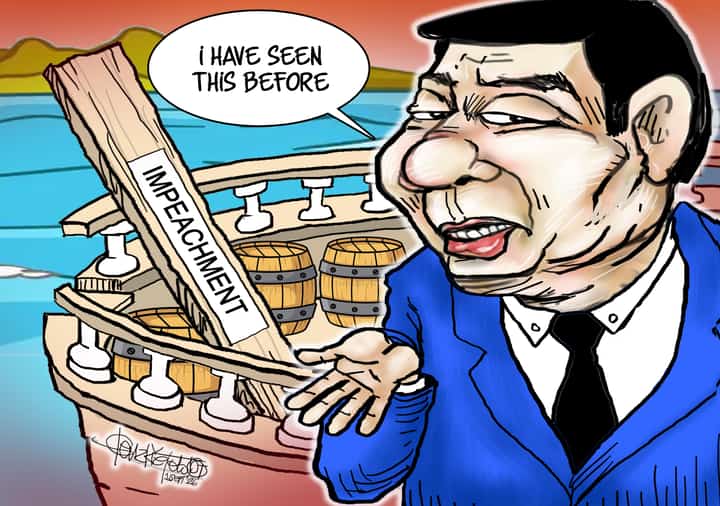
Citizen Frank Drilon, the former Senate president, spiced up his memoir “Being Frank” with unadorned, confessional reminders to Filipinos, particularly those taking part in impeachment trials.
He underscored that he voted according to his conscience in both impeachment trials — against Erap Estrada and Renato Corona — stressing that he followed the evidence in each case.
His bio gives a striking lesson to today’s senator-judges — that one honest man’s vote, however sincere, tells us little about whether the institution around him is honest as well. The real history of past impeachments is the history of institutions built to deliver accountability that have, again and again and in different ways, fallen short of expectations.
The very first real test of the process — the trial of former President Joseph Estrada in 2000 and 2001 — collapsed in precisely the way architects of the 1987 Constitution had hoped to prevent — when 11 senators voted not to open the second envelope purportedly containing evidence of a secret bank account.
Estrada’s opponents, rather than wait out the verdict of an institution they no longer trusted, rushed to the streets, ousting a sitting president through EDSA II and forcing the Supreme Court (SC), in Estrada v. Desierto, to anoint an outcome that had bypassed the constitutional process that would have made such a shortcut unnecessary.
The historical precedent remains a subject of constitutionalist debate since allowing institutions to be bypassed once will always tempt others to do it again.
Set beside that history, the Corona trial of 2012 looked, on its surface, like vindication: A chief justice accused of hiding wealth beyond his declared means was convicted in a full trial.
Drilon’s book, to its credit, tackled the allegation that discretionary funds, dressed as “incentives,” simply polite vocabulary for a bribe, were funneled to senators who voted for Corona’s guilt.
That money, moreover, had a history of its own worth excavating rather than being treated as an incidental detail, since the discretionary funds were almost certainly drawn from the same well that would, within a year, produce questions about the Priority Development Assistance Fund (PDAF), the pork barrel that had bankrolled legislative politics for a generation.
The Napoles exposé of 2013 raised the question of its constitutionality, a question the Supreme Court answered decisively by striking down the PDAF as an unconstitutional intrusion on the separation of powers.
Later, in its ruling voiding portions of the succeeding Disbursement Acceleration Program, the SC reaffirmed its stance against discretionary money.
In both decisions, the SC held that government lump sums, however defensible at the time of their release, corroded accountability.
The incentive allocations of 2012 were not a footnote to the Corona trial but a reflection of the PDAF scandal that came a year after.
A correct verdict purchased by corrupt means does not purify itself simply because the underlying accusation happened to be true — and this is the discomfort Drilon’s memoir leaves us sitting with, because the same trial that produced Corona’s wheelchair entrance may also have produced a troubling outcome.
As another impeachment court now sits, hearing another set of allegations against another official and weighing evidence under the same constitutional framework that the Corona trial helped shape, the earlier trial leaves lessons worth carrying forward.
Its most important lesson is not that an impeachment fails, but that a conviction is not the same as an institution vindicated.
Every senator who explains a vote by citing the evidence should be pressed — gently but persistently — on whether the evidence was truly the only thing that moved him.
Drilon’s own formulation — that institutions are built to work but are only as clean as the hands that operate them — applies with the same force to the trial unfolding today as it did then.
Accountability that tolerates corruption along the way to produce an outcome is not accountability at all. It is political theater.