
Hard lessons: Two trials, one Frank
Drilon is the rare public figure people still turn to for procedural common sense, because he has been on both sides of the bench — the senator who broke from a president, and the senator-judge who convicted a chief justice.

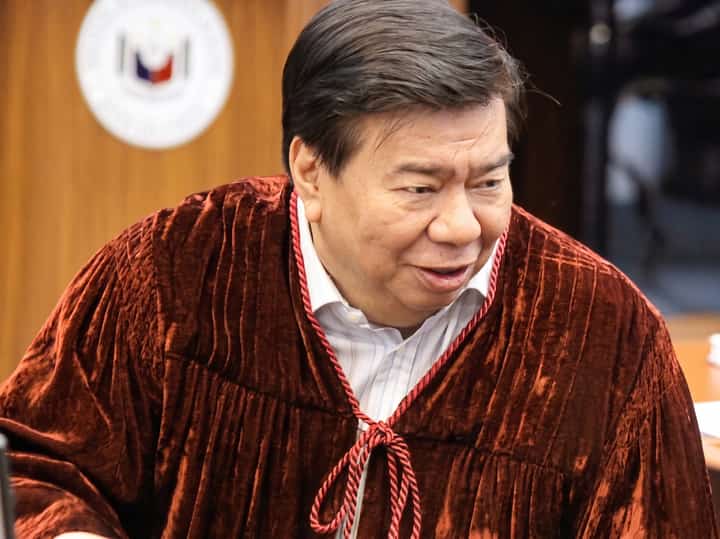
Public patience’s limit Speaking from experience in two defining impeachment trials in the past, public service veteran Franklin Drilon warned that if the trial of Vice President Sara Duterte is dragged out too long, public opinion will turn, not due to weak evidence but because the wait wears people down.
Photographs courtesy of Franklin Drilon/ Facebook
Former Senate President Franklin Drilon has sat through two impeachment trials as a judge. He has lived through a third, decades ago, as a young lawyer watching history from outside the chamber. Now, as the Senate hears the impeachment case against Vice President Sara Duterte, Drilon watches again.
He said as much on a recent guest appearance on the DAILY TRIBUNE’s online program Straight Talk. Impeachment, he said, is not just a legal mechanism.
It holds the highest officials of the land accountable: the President, the Vice President, the Chief Justice, and the heads of the constitutional commissions. But the audience is not only the senator-judges. It is the public. And the public’s faith in the process, he said, is what keeps their faith in democracy and the justice system alive.
That is why he warned about impeachment fatigue. The prosecution must weigh two competing pressures. One is the need to lay out full evidence of wrongdoing.
The other is the public’s impatience to see the case move. People do not want a courtroom drama that drags in exhaustive legal detail. They want to know, plainly, what happened and how it will end. Drag it out too long, Drilon warned, and public opinion turns — not because the evidence is weak, but because the wait wears people down.
He was asked, too, about the pace of the trial. The prosecution had floated adding more hearing days a week, hoping to finish presenting evidence on all four articles by the end of September — a deadline that already looked doubtful. As a former Senate President who once ran the floor himself, Drilon was asked what the Senate leadership should actually do to compress the calendar, rather than talk about compressing it.
Drilon is the rare public figure people still turn to for procedural common sense, because he has been on both sides of the bench — the senator who broke from a president, and the senator-judge who convicted a chief justice.
His memoir, Being Frank, explains why.
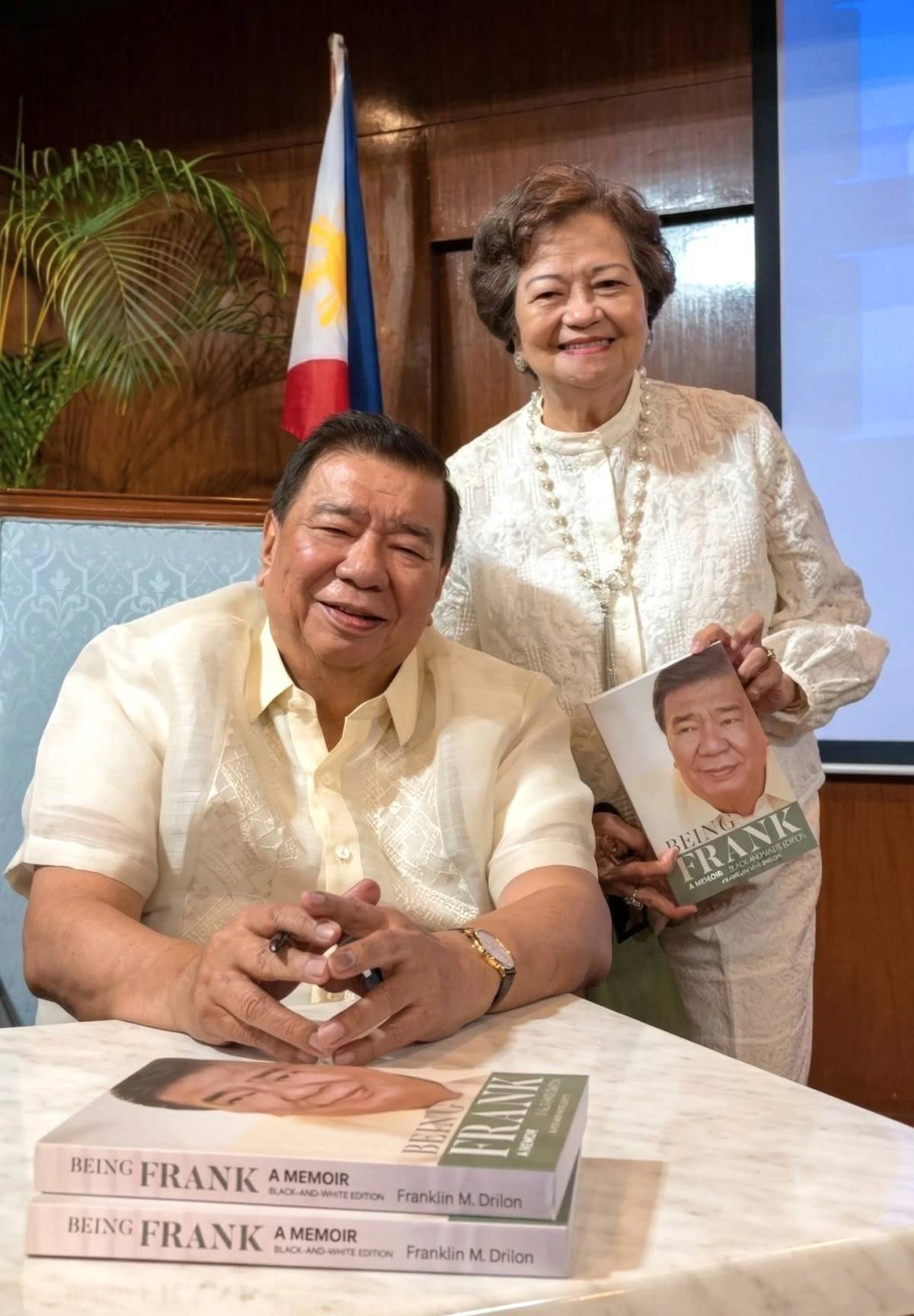
For all to remember During the mini launch of his memoir Being Frank, at the UP College of Law’s Alumni Weekend, Senator Franklin Drilon (left) personally handed a copy to former Chief Justice Teresita Leonardo-De Castro. The University of the Philippines Law Alumni Foundation co-published the memoir. Drilon donated all proceeds from book sales during the event to the foundation
Erap’s trial that collapsed
Drilon knew Joseph “Erap” Estrada for years before the impeachment trial began in December 2000. He was not part of Erap’s inner circle. He had supported Erap’s 1998 presidential run, and he became Senate President for the first time that July. But the alliance, in his own words, was never close.
Erap had won the presidency in 1998 by the largest margin in Philippine electoral history. He had built a career, on screen and in the Senate, as a champion of the poor. He was one of the “Magnificent 12” senators who voted to end the American military bases treaty in 1991. His fall, when it came, was as dramatic as his rise.
It began in October 2000, when Ilocos Sur Governor Luis “Chavit” Singson accused Erap of taking nearly 600 million pesos in payoffs — money Singson said came from illegal gambling operations and diverted tobacco tax funds meant for farmers in his province. The scandal became known as Juetengate. Singson’s testimony carried weight precisely because he was not a political rival. He had been Erap’s ally.
Drilon called for an investigation almost immediately. In November, then-Camarines Sur Governor Luis Villafuerte tried to talk him out of treating the matter as a crisis, arguing it was a passing political storm. Drilon disagreed. Some things, he told Villafuerte, are bigger than politics. Weeks later, Drilon, House Speaker Manuel Villar, and more than forty legislators withdrew from Erap’s coalition. It cost Drilon the Senate presidency, a month after Singson’s revelations and just before the House impeachment vote.
The trial opened 7 December 2000 — the first impeachment of a sitting head of state in Asia. Supreme Court Chief Justice Hilario Davide Jr. presided. Twenty-one senators sat as judges. The prosecution, led by Congressman Joker Arroyo, accused Erap of bribery, graft, culpable violation of the Constitution, and betrayal of public trust. The defense, led by former Chief Justice Andres Narvasa, assembled some of the country’s most formidable legal names.
The case turned on a single piece of evidence: a sealed envelope, believed to contain records tying Erap to a hidden bank account. On 16 January 2001, the senator-judges voted 11–10 against opening it. Drilon had voted to open it. Then House prosecutor Joker Arroyo, in protest, declared that the prosecution rested, a walkout, not a concession. Senate President Aquilino “Nene” Pimentel Jr. resigned on the spot. Nine more opposition senators followed him out of the chamber.
Drilon describes the moment as the collapse of the constitutional process itself — not merely the end of a trial, but the emptying of legitimacy from the room. The case could not go on without them, and everyone knew it. What followed did not happen in the Senate. It happened in the streets. Within days, crowds filled EDSA again. The military withdrew its backing. Erap left Malacañang. Gloria Macapagal-Arroyo was sworn in as president.
For Drilon, the lesson was not really about Erap. It was that when institutions fail to complete their own process, the people will complete it for them.
Corona’s trial that finished
Eleven years later, Drilon sat again as a senator-judge, this time for the impeachment of Chief Justice Renato Corona in 2011 and 2012.
He had opposed Corona’s appointment from the start, calling it a “midnight appointment” by outgoing President Gloria Macapagal-Arroyo, made just after the 2010 election, after Corona had served eight years as her chief of staff and before that as associate justice.
The House impeached Corona on 12 December 2011, with eight articles. Most concerned favoritism toward the Arroyo administration and abuse of judicial funds. But the case that stuck, and the only one that led to conviction, was Article II: Corona’s failure to accurately declare his assets and liabilities on his Statement of Assets, Liabilities and Net Worth, or SALN. Prosecutors said he failed to disclose a Taguig apartment and large undeclared bank deposits.
Drilon was Corona’s most persistent critic on the impeachment court. He watched the trial’s theatrical turns — Corona once walking out of the chamber, later returning in a wheelchair after what his lawyers called a medical emergency.
Drilon read these moments plainly: not as spontaneous acts, but as calculated attempts to reframe a legal case as political persecution. The Senate’s public rebuke of the behavior, he writes, backfired on Corona instead.
Conviction imprinted in history
On 29 May 2012, the Senate impeachment court convicted Corona by a vote of 20–3. He became the first chief justice removed by impeachment, and was permanently barred from public office. Senators who voted to convict cited the case of a low-level court employee once dismissed for a minor SALN omission — the principle, as Drilon puts it, that the law applying to an ordinary citizen must apply equally to the country’s highest magistrate.
Here Drilon draws the contrast directly. Where the Estrada trial collapsed in political maneuvering over an unopened envelope, the Corona trial reached its constitutional conclusion. Evidence was presented. Votes were cast. Procedurally, at least, justice was served.
But Drilon does not let himself, or his readers, celebrate too easily. He notes later allegations that senators who voted to convict Corona received additional discretionary funds — a troubling echo, he writes, of the very corruption the trial was meant to punish. If true, it means even a constitutional process that reaches its intended end can still be shadowed by the same politics that derailed justice in 2001.
Same chamber, watching again
Read together, Drilon’s two accounts describe the same institution behaving in two different ways, once buckling under political pressure, once holding, however imperfectly, to its own rules.
That is the frame he brings to the Duterte impeachment trial now underway. His warning about impeachment fatigue is not abstract. It is the same warning the Erap trial should have taught the country in 2001: that public perception, once it turns, can overtake the evidence itself.
And his call for the Senate leadership to actually compress the calendar, not just talk about it, comes from a man who has run that floor and knows how easily a trial can slip out of a chamber’s control.
Drilon’s own answer to the compression question was lost to a technical glitch during the broadcast. But Being Frank already contains his answer, in a different form. In both trials, he writes, he voted his conscience and followed the evidence.
The broader lesson, he says, is sober. Even the country’s highest ideals can be corrupted by the very forces meant to be overcome. The task is not only to make the system work. It is to make sure it works for the right reasons.
Whether the Senate manages that this time, with senator-judges keenly aware of the precedents Drilon lived through, remains the story still being written.