
Walang pasok
Real resilience requires fewer heroic efforts after an emergency because we have done more of what must be done before it happens.

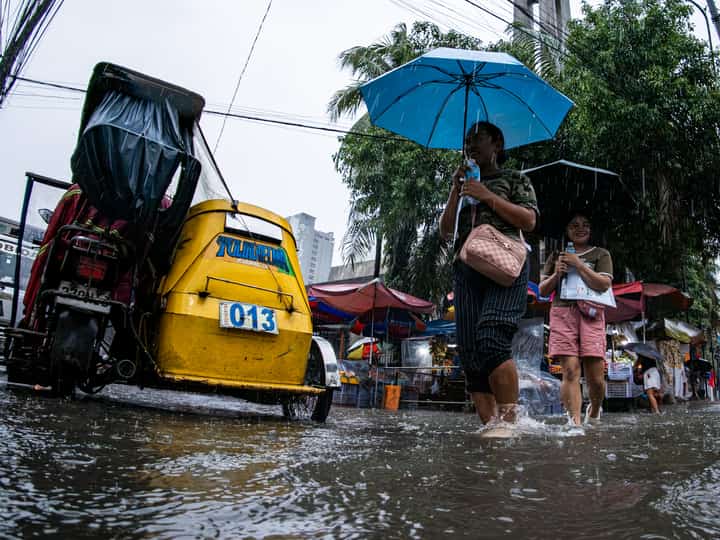
Motorists and commuters wade through gutter-deep floodwaters at the corner of Taft Avenue and Escoda Street in Manila on August 8, 2026, after PAGASA issued an Orange Rainfall Warning over Metro Manila at 11:02 a.m.
“Walang pasok.” Two words familiar to almost every Filipino.
When heavy rains fall, floodwaters rise, a typhoon approaches, or extreme heat makes classrooms and workplaces unsafe, we wait for the announcement.
For good reason. Suspending classes or work is first and foremost a decision to protect people.
But something has changed in what happens next: Classes can shift to alternative learning modes. Some employees can work from home. Government offices can adopt alternative work arrangements while essential services continue.
We learned much of this during the pandemic, when institutions improvised and some temporary arrangements became part of how we work, learn and deliver services.
While that is progress, it is not necessarily adaptation.
A suspension is a response to risk. An alternative arrangement can provide continuity. Adaptation requires something more: learning from disruption and changing the system so that the next disruption does not find us just as vulnerable as before.
This matters as our climate changes.
Our country’s first National Adaptation Plan (NAP), completed under President Ferdinand R. Marcos Jr., identifies climatic impact drivers that will increasingly shape development: rising temperatures and drought, sea-level rise and extreme sea levels, extreme precipitation, and changing wind patterns and tropical cyclones.
Their effects do not respect the boundaries between systems. One flooded road can prevent a teacher, a nurse and a government employee from reaching work. A power outage can stop both an online class and a work-from-home arrangement. And lost connectivity can turn a digital solution into no solution at all.
Adaptation, therefore, cannot simply mean finding another way to keep everything going. It requires understanding which functions are essential, where their vulnerabilities lie, and how they can be protected or restored when one part fails.
Nor does resilience mean keeping everything running regardless of circumstance. Sometimes stopping is precisely the correct response. Safety remains the first consideration.
What matters is what each disruption teaches us.
Did students continue learning effectively? Who could not participate? Could the government still provide essential services? Did electricity, telecommunications and transport hold? What failed and why?
The answers should change what we do before the next disruption.
Our learning systems may need stronger offline options, workplaces clearer continuity arrangements, and government services greater digital redundancy.
The same applies to the infrastructure on which these systems depend. The means and extremes of our climate are changing. Climate projections in our NAP already tell us how. Infrastructure standards must therefore be designed not for the climate of the past, but for the conditions they will face over their lifetime.
This is future-proofing: using what we know about tomorrow to make better decisions today.
On National Heroes Day, we rightly honor Filipinos who step forward when circumstances demand more: teachers, health workers, first responders, public servants, utility workers and countless others whose service keeps communities functioning through difficult times.
There will always be moments that call for courage and sacrifice. But good governance should not repeatedly require extraordinary individual effort to compensate for vulnerabilities we already know how to address.
Hindi dapat laging kabayanihan ang kailangan para malampasan ang panganib na dapat at kaya naman nating paghandaan. (Heroism should not always be required to overcome dangers that we ought to — and are capable of — preparing for.)
Real resilience requires fewer heroic efforts after an emergency because we have done more of what must be done before it happens.
We already have better science, climate information and plans built upon them. Making them work — and making their benefits felt every day — requires conscientiousness in our decisions, consistency in carrying them through, and capacity to deliver.
Perhaps there is a quieter kind of heroism in that, too: doing what must be done, and doing it well, every single day.
Change is not necessarily adaptation. Continuity is not necessarily resilience. The test is whether what we learn changes decisions, improves systems and leaves people less vulnerable the next time they are tested.
There will still be days when the safest and most responsible decision is to say, “Walang pasok.”
The measure of progress is not whether we eliminate those days. It is whether we learn enough from each disruption to make the next one less disruptive.
We should always honor extraordinary courage when circumstances demand it. But perhaps resilience is also built through something less visible: the conscientiousness, consistency and capacity to do what must be done before those circumstances arise.