
Restore and respect navigational rights, freedoms
Even amid conflict, it is possible to reduce risks, protect civilians and safeguard the movement of essential goods.

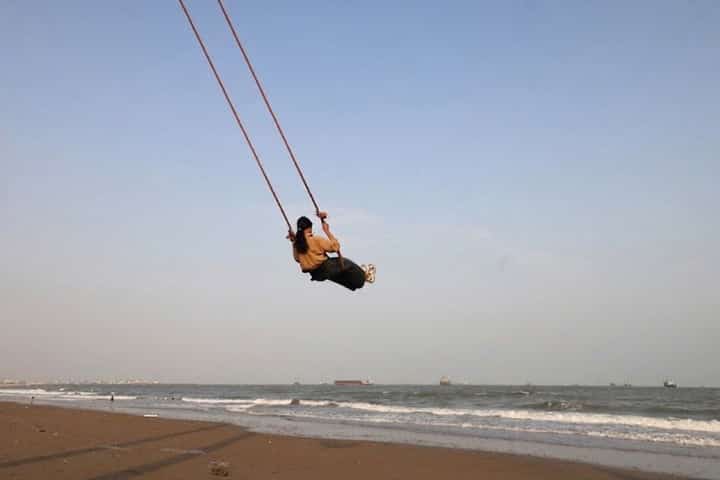
AN Iranian enjoys a swing erected along the seashore, as vessels are seen in the Strait of Hormuz off the port city of Bandar Abbas, in southern Iran on 10 August 2026.
ATTA KENARE/AGENCE FRANCE-PRESSE
Today, conflicts in different regions are converging in their impact on the world’s most vulnerable people.
In the Middle East, ongoing attacks and the disruption of maritime traffic in the Strait of Hormuz and the Red Sea — around Bab al-Mandab — are constraining the movement of energy, fertilizers and other essential commodities.
In the conflict following Russia’s full-scale invasion of Ukraine, attacks are threatening shipping routes vital for the export of oil, grain and other agricultural products.
These crises are choking arteries of global trade and squeezing the global food system especially hard.
The result is clear: higher prices, deepening hunger, weaker harvests and greater suffering — especially for the world’s most vulnerable people.
In the Strait of Hormuz alone, transits have come to a near standstill. Meanwhile, oil prices remain about 33 percent higher since the start of the conflict. Global container rates are 84 percent higher than a year ago. And the costs of fertilizers and other essential inputs are also sharply increasing.
Navigational rights and freedoms are not abstract principles. They are international law. Those rights and freedoms are vital for international peace and security — and for the flow of food, energy and essential goods on which billions of lives depend. And so my appeal is clear.
We need:
Full respect for international law — including the law of the sea and international humanitarian law;
Protection for civilian shipping, infrastructure and civilian seafarers;
The upholding of navigational rights and freedoms;
An immediate end to attacks against commercial shipping and civilian infrastructure in the Black Sea; The full restoration and respect of navigational rights and freedoms in the Strait of Hormuz;
And an end to attacks against shipping in the Red Sea and around Bab al-Mandab.
Maritime chokepoints must never become instruments of coercion. And the world’s food supply must never become collateral damage of conflict.
In March, I established a Task Force to develop and propose practical mechanisms including to address humanitarian needs triggered by the Strait of Hormuz crisis. This particular effort is led by the Executive Director of the United Nations Office for Project Services, UNOPS — and includes UNCTAD, the International Maritime Organization, and the International Chamber of Commerce. They have worked with others to develop a practical and time-bound confidence-building mechanism focused initially on fertilizers and related raw materials — but with the ability to be extended to other products.
The mechanism would not authorize passage through the Strait of Hormuz or alter the rights or obligations of any Member State under international law. Sovereign decisions remain entirely with participating Member States. The United Nations would serve as a neutral facilitator.
The purpose is simple: to reduce immediate risks, support more orderly and predictable transit, and help rebuild the confidence necessary for diplomacy and de-escalation. It can be operationalized quickly.
International support for this effort has been encouraging, particularly from vulnerable countries that understand what is at stake when maritime lifelines are disrupted.
What is needed now is the cooperation and political will of the parties.
I urge all concerned to engage seriously and constructively.
This mechanism is not a substitute for fully restoring navigational rights and freedoms, or for the political solutions needed to end these conflicts. But it is a practical first step. A demonstration that, even amid conflict, it is possible to reduce risks, protect civilians and safeguard the movement of essential goods.
The alternative is continued disruption, deeper mistrust and mounting hardship for people far beyond the regions directly affected.
But I want to be very clear. The unimpeded exercise of navigational rights and freedoms is a cornerstone of peace, security and shared prosperity and must be respected. Protecting it is a legal obligation and a humanitarian imperative.
And today, more than ever, millions of vulnerable people around the world depend on the collective ability of all parties to uphold it.
(United Nations Secretary-General António Guterres’ press encounter on the United Nations’ Efforts to Uphold Navigational Rights and Freedoms in New York on 24 August 2026.)