
Hunger rate declines by 2.9%, DSWD welcomes SWS national survey

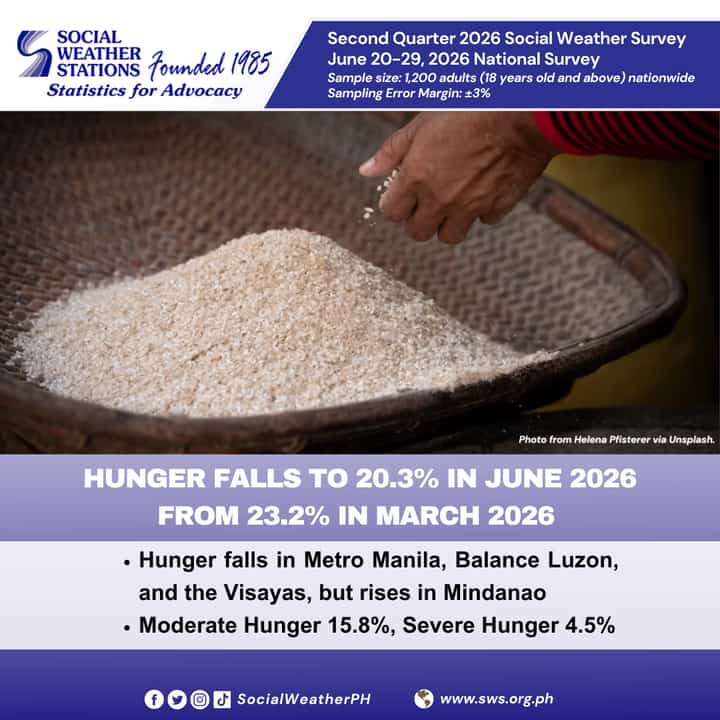
Latest survey by the Social Weather Stations (SWS) showed a decline in the number of Filipino families experiencing involuntary hunger in the second quarter of 2026.
The research firm conducted a nationwide survey from June 20 to 29 and found that 20.3 percent of Filipino families experienced involuntary hunger, or being hungry and having nothing to eat at least once in the past three months.
“This is 2.9 points down from 23.2% in March 2026. It is 0.1 point above the 20.2% average of 2025, and 0.8 point below the record-high 21.1% average of 2020 during the COVID-19 pandemic,” the SWS stated.
According to the survey, Mindanao recorded the highest hunger rate at 24.0 percent, followed by the Visayas at 22.3 percent, Metro Manila at 21.0 percent, and Balance Luzon at 17.3 percent.
SWS stressed that the 2.9-point decline in hunger between March and June was driven by decreases in Metro Manila, Balance Luzon, and the Visayas, despite an increase in hunger in Mindanao
The Second Quarter 2026 SWS survey used face-to-face interviews with 1,200 adults aged 18 and above nationwide, with 300 respondents each from Metro Manila, Balance Luzon, the Visayas, and Mindanao.
DSWD welcomes survey results
The Department of Social Welfare and Development (DSWD) welcomed the latest findings, saying the decline reflects the impact of the government’s efforts to address hunger.
“The results are encouraging as they show that our fellow Filipinos are feeling the impact of the government’s programs and initiatives against hunger,” DSWD Assistant Secretary Irene Dumlao said.
Dumlao attributed the decline partly to the government’s anti-hunger initiatives, particularly the Walang Gutom Program (WGP) and Walang Gutom Kitchen (WGK).
“The decrease in hunger in several parts of the country shows that these interventions are gaining traction, particularly the Walang Gutom Program,” she said.
Under the WGP, the DSWD provides beneficiaries with P3,000 in monthly food credits that can be used to purchase nutritious food from accredited merchants and retailers.
The agency currently has 600,000 beneficiaries receiving food assistance through the program.
Meanwhile, the DSWD’s Walang Gutom Kitchen provides free hot meals to individuals and families experiencing involuntary hunger.
The agency currently operates WGK facilities at the Nasdake Building in Pasay City, Pier 4 OKK Square Unit in Cebu City, and the FGL Building in Zamboanga City.
The DSWD, however, announced its plan to establish similar kitchens in nine additional strategic areas nationwide.
“While the overall trend is encouraging, we recognize that hunger remains a challenge in some areas. We will use these findings to improve our programs, identify where assistance is most needed, and ensure that our interventions remain responsive to the families we serve,” Dumlao said.