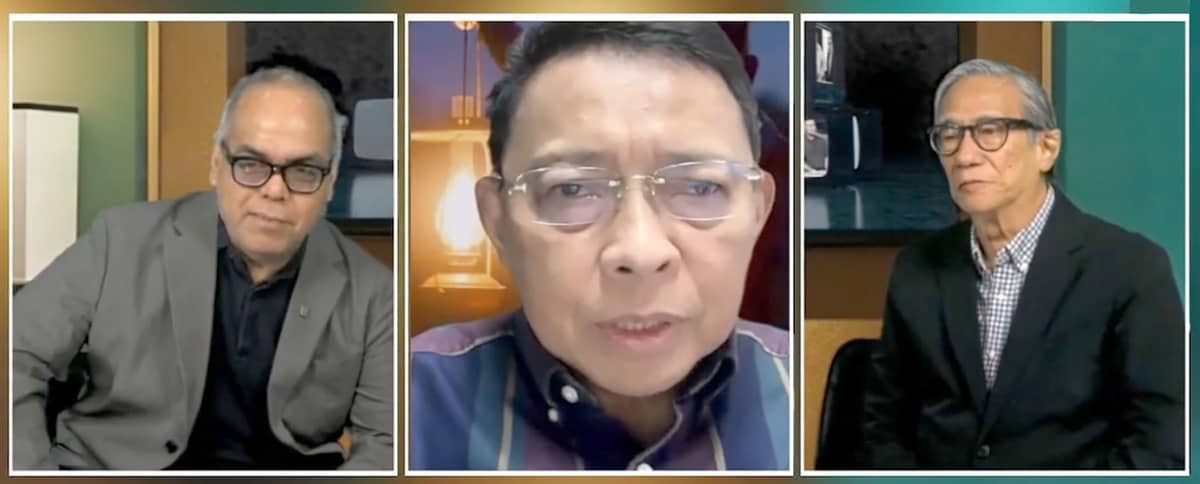
Guinigundo graduated cum laude and ranked first in his AB Economics class at the University of the Philippines School of Economics.
He later earned an MSc in Economics from the London School of Economics as a Central Bank of the Philippines scholar. His career at the BSP eventually brought him to the position of deputy governor for the Monetary and Economics Sector. He also served as alternate executive director at the International Monetary Fund in Washington, D.C., from 2001 to 2003, and headed research at the Southeast Asian Central Banks Center in Kuala Lumpur from 1992 to 1994. From 2009 to 2012, he chaired the EMEAP Monetary and Financial Stability Committee, which is tasked with regional and global surveillance.
He retired from the BSP in 2019, when Francisco G. Dakila Jr. succeeded him as deputy governor for the Monetary and Economics Sector.
But retirement from the central bank did not mean retirement from economic debate.
Guinigundo continues to write and comment on Philippine economic and political developments, and the media regularly seeks his views.
In his recent assessment, one of his strongest concerns was the economic damage that can follow corruption allegations in public infrastructure.
Cost of rot
“Corruption is not just a political problem, but it is an economic cost,” he said.
The distinction is important. A scandal involving public funds may begin as a question of accountability, but its consequences can travel through the economy. When infrastructure projects stall, construction activity and employment can weaken. When businesses become uncertain about procurement and government execution, private investment can also suffer.
And for Guinigundo, the damage to confidence may outweigh the immediate loss of government spending.
A government can increase spending to cushion a slowdown, he acknowledged. But public expenditure cannot indefinitely replace private investment.
“Government spending can cushion a downturn,” he said, “but it cannot permanently substitute for private investment.”
That observation reflects the discipline of a central banker who has spent decades watching economies respond to shocks. Government has an important role during periods of weakness, but sustainable growth ultimately requires an environment in which households and businesses are willing to participate, invest and take risks.
For Guinigundo, restoring that environment requires action on problems that are within the government’s control.
He points to legitimate, high-impact infrastructure projects, faster procurement and permitting, more efficient fund releases and stronger protection for vulnerable households. He also stresses the importance of demonstrating that allegations involving misuse of public funds are addressed through a functioning justice system.
“These are low-hanging fruits,” he said. “These are within our control.”
That phrase may be one of the most revealing in understanding Guinigundo’s approach. His economic analysis is technical, but his prescriptions are often remarkably practical.
He is less interested in grand declarations than in whether government agencies can execute what they have already promised.
The same principle applies to inflation.
For ordinary Filipinos, Guinigundo argues, declining inflation does not automatically mean that life has become affordable. Prices may rise more slowly while remaining too high for families whose purchasing power has already been eroded.
“What they need is not only actual evidence or demonstration that prices are rationalizing, that inflation is coming down, but they have to feel it,” he said.
That concern reflects the human dimension of his economic thinking. Macroeconomic indicators matter, but they matter because they eventually affect wages, household budgets, employment, and families’ ability to meet their needs.
Perhaps this ability to move between the technical and the human has defined Guinigundo’s public voice.
He can speak about risk premiums, fiscal space, capital flows and inflation expectations with the precision of a career central banker. But he also speaks about classrooms, hospitals, roads and bridges — the tangible things public money could provide if used properly.
He noted the enormous opportunity cost of corruption in public spending: resources lost to leakage are resources that could otherwise finance infrastructure and essential services.
The idea returns to stewardship, a concept that has another meaning in Guinigundo’s life.
Alongside his career in economics and central banking, he is the senior pastor of Fullness of Christ International Ministries in Mandaluyong. His professional life focuses on monetary and financial stability; his ministry centers on faith and service.
The two roles may seem far apart, but there is a common thread: responsibility.
Whether discussing billions of pesos in public expenditure or the purchasing power of an ordinary household, Guinigundo repeatedly returns to how resources are managed and whether institutions fulfill their responsibilities.
His long career has given him a rare vantage point. He has seen the Philippine economy from inside its central bank, represented the country in international financial institutions, participated in regional surveillance and financial-stability discussions, and observed how global investors assess emerging markets.
Yet his message today is not simply that the Philippines needs faster growth. It needs growth built on confidence.
Confidence that public funds are used properly. Confidence that regulations are predictable. Confidence that policies will be implemented consistently. Confidence that institutions can hold people accountable. And confidence among businesses and households that the economic future is worth investing in.
That is why Guinigundo’s economic commentary ultimately becomes a portrait of institutions as much as markets.
The economist reads the figures.
The former central banker understands the risks.
The international policymaker sees how the Philippines is viewed from outside.
For Diwa Guinigundo, an economy’s state cannot be separated from the state of the institutions managing it.
The numbers may show where the country is going.
But, in his view, governance helps determine whether it gets there.