
Corruption, impeachworsened growth skid

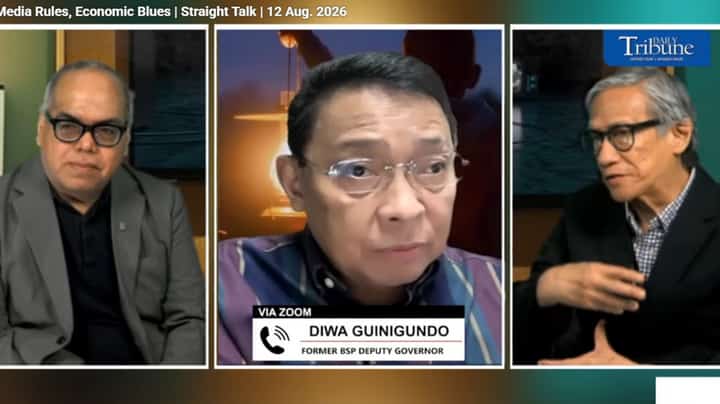
PERCEPTIONS of corruption are a major turn-off for investors, former Bangko Sentral ng Pilipinas Deputy Governor Diwa Guinigundo (center) tells ‘Straight Talk; hosts Chito Lozada (left) and Teddy Montelibano.
SCREENGRAB from straight talk
The flood control scandal and the ongoing impeachment process amplified the economic slowdown in the second quarter, economist and former Bangko Sentral ng Pilipinas (BSP) Deputy Governor Diwa Guinigundo said.
Guinigundo on Wednesday emphasized that the political and governance issues were not the sole reasons behind the weak economic performance but had become a “major domestic amplifier” of the slowdown, alongside poor governance and weak execution of public works projects.
“The flood control scandal and even the impeachment process in progress, this is not the whole narrative. This is not the whole story of why we grew by only so little. But it is a major domestic amplifier together with, shall we say, bad governance and very poor execution of public works projects,” Guinigundo said during DAILY TRIBUNE’s Straight Talk.
The economy grew by 2.3 percent in the second quarter, its weakest pace since 2009 outside the pandemic years, with industry contracting during the period.
Guinigundo described the slowdown as both cyclical and structural, citing weak investment, softer consumption, and disruptions in infrastructure development.
He said the ongoing investigation into the flood control controversy and issues surrounding the budget had disrupted infrastructure development, while four consecutive quarters of declining investment pointed to deeper structural problems involving competitiveness.
Guinigundo indicated that the political and governance issues had also affected confidence among businesses and investors.
“The infrastructure paralysis was homegrown precisely because it sent a chilling effect,” he said.
He explained that the impact of the flood control controversy could extend beyond government infrastructure spending. If public works projects stop, construction, employment and investment could immediately be affected.
Confidence essential
But Guinigundo said the larger economic damage could come from the resulting loss of confidence.
“If businesses conclude that procurement is unpredictable or public funds are misallocated, private investment will also weaken,” he said.
According to Guinigundo, the perceptions of corruption and bad governance could discourage businesses from investing or expanding their existing operations in the Philippines.
“The bigger damage is on confidence,” he said.
Guinigundo also stressed that the slowdown could not be attributed solely to weak government spending or the domestic political issues.
Government spending increased by 8.3 percent, but private fixed investment fell sharply. Guinigundo said public spending can cushion an economic downturn but cannot permanently substitute for private investment.
He said the decline in private investment was linked to uncertainty, weak confidence, high costs and governance concerns.
Guinigundo also distinguished between domestic problems that the government can address and external shocks that are beyond its control.
He cited the flood control controversy, governance failures, regulatory consistency and policy consistency as issues that can be addressed domestically, while the Middle East conflict and increases in global oil prices were largely beyond the country’s control.
“We need to make sure that we manage our domestic affairs more competently and more cautiously,” he said.
Guinigundo said the government could help restore economic momentum by accelerating legitimate, high-impact infrastructure projects and clearing bottlenecks in procurement, permitting and fund releases.
He also said restoring business and investor confidence would require demonstrating accountability in cases involving the alleged misuse of public funds.
Meanwhile, he also said achieving the government’s full-year growth target would be “extremely difficult.”
The economy grew by only 2.6 percent in the first half, meaning growth would have to accelerate significantly in the second half to meet the government’s 3.5 percent to 4.5 percent target.
He said reaching the lower end would require second-half growth of 4.4 percent, while hitting the upper end would require 6.4 percent growth, which he described as “almost impossible.”