
Modernize farming to sustain upper-income status
The Philippines is mainly farmland. The greatest number of our people live on land suited for rice, and we are surrounded by water abundant in fish and other seafood.
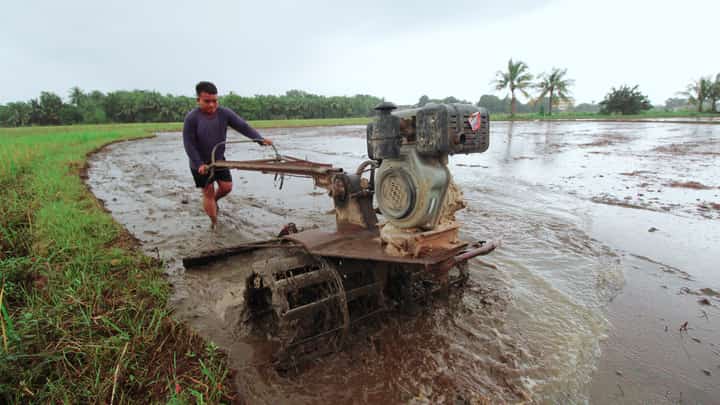
A young farmer uses a kuliglig to till the muddy farmland to prepare for the next crop of rice seedlings that will be planted in Morong, Bataan on Sunday morning.
Jonas Reyes
The World Bank has promoted the Philippines to an upper-income economy. That means that while we are somewhat wealthy, we can no longer enjoy some of the billions in foreign assistance that only lower-income nations can receive.
Now we are on our own. “Magsariling sikap tayo” (Let us strive on our own). And solve inflation ourselves.
The Philippines is mainly farmland. The greatest number of our people live on land suited for rice, and we are surrounded by water abundant in fish and other seafood.
With a workforce eager to work where they are, what is needed is legislation for upskilling farm machination.
For now, what must the administration do to overcome persistent inflation, increase productivity, and strengthen the labor market, now that the World Bank has enriched our “image?”
To tackle persistent inflation, lift productivity, and strengthen the labor market, the Marcos administration must prioritize structural agricultural modernization and bridge workforce skills investments.
Taming Persistent Inflation
Boost the domestic food supply: Invest heavily in local farming, cold-chain logistics, and efficient farm-to-market roads to cut food waste and transport costs.
Calibrate trade investments: Strategically manage nonmonetary measures and ease import bottlenecks for essential commodities during domestic supply shortages.
Increasing Economic Productivity
Upgrade critical infrastructure, accelerate the modernization of transport, and expand high-speed internet connectivity to lower operating expenses for local enterprises.
Improve the investment climate: Address regulatory inconsistencies, high power costs, and bureaucratic delays to attract competitive capital.
Strengthen the Labor Market
Expand workforce upskilling: Partner with industries to provide targeted training in digital literacy, technical roles, and emerging fields like artificial intelligence.
Promote quality job creation: Shift focus from vulnerable or part-time work toward generating formal, high-value employment.
Explore economic risks and outlook details from the Philippine Institute of Developmental Studies.
The Marcos administration’s specific executive strategies focus on a minimum wage hike alongside a heavy legislative and budgetary shift toward agricultural machination.
Wage Policy Adjustments
Phased wage increase: The Regional Tripartite Wage and Productivity Board implemented Wage Order NCR-27, mandating an P85 daily minimum wage hike for Metro Manila workers. The first tranche of P60 was rolled out on 2 July 2026, with the additional P25 scheduled for 20 January 2027.
Court intervention and pushback: Construction firms successfully petitioned for a temporary restraining order (TRO).
To sustain its new upper-middle-income status, the Marcos administration must protect vulnerable families, lower high electricity and business costs, and keep inflation under control. The country achieved this milestone after its gross national income (GNI) per capita reached $4,850, surpassing the $4,636 threshold.
Protect Vulnerable Families
Expand targeted social aid like the 4Ps conditional cash transfer program. Reach near-poor households to shield them from price shocks.
Balance infrastructure projects with social spending on health and education.
Lower Energy and Business Costs
Raise the share of renewable energy to 35 percent by 2030 to cut residual power prices.
Upgrade the power grid and increase market competition.
Clear up infrastructure rules to make it easier and cheaper to do business.
Manage the Economy
Keep inflation low without stopping economic growth.
Attract more local and foreign investments to create quality jobs.
Email: arturobesana2@gmail.com