
India, ADB delegation studies Maynilad's water loss management

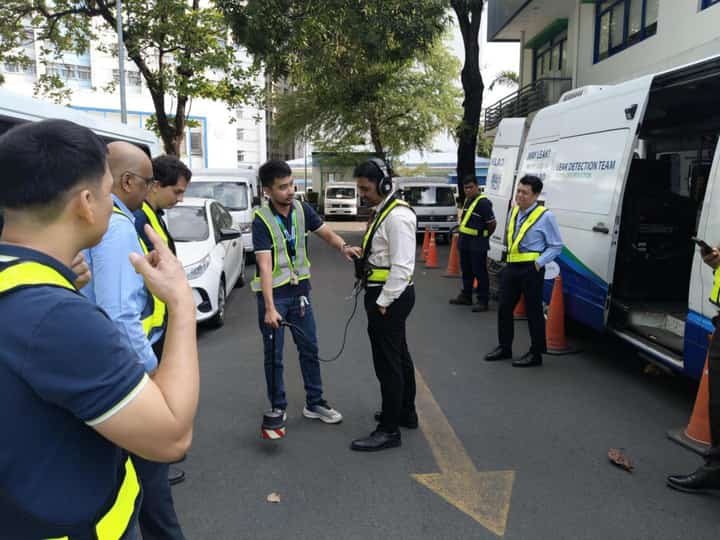
INDIA, ADB DELEGATION STUDIES MAYNILAD’S LEAK DETECTION OPERATIONS. Saurabh Singh (center, in white), Deputy Secretary of India’s Department of Economic Affairs, tries Maynilad’s acoustic leak detection equipment during a benchmarking visit facilitated by the Maynilad Water Academy and supported by the Asian Development Bank. The delegation observed Maynilad’s non-revenue water (NRW) management and leak detection operations as part of discussions on possible future knowledge-sharing and capacity-building initiatives
A delegation from the Government of India, the Asian Development Bank (ADB), and ADB's India Resident Mission visited Maynilad Water Services Inc. to study the company's non-revenue water (NRW) management and leak detection practices.
Led by Saurabh Singh, deputy secretary of India's Department of Economic Affairs, the delegation took part in technical sessions and field demonstrations conducted by the Maynilad Water Academy (MWA).
ADB identified Maynilad's approach to reducing non-revenue water as a valuable reference for its capacity-building initiatives, citing the company's integration of field operations, monitoring systems, workforce training, and operational accountability.
The delegation also observed Maynilad's field-based acoustic leak detection, centralized monitoring through its Central Control Room, workforce development programs, and on-the-ground implementation of NRW reduction initiatives within its concession area.
According to ADB, the visit could support future efforts to help water utilities in South Asia adopt operational models that address persistent water losses and improve service reliability.
ADB and the Maynilad Water Academy have collaborated for several years on capacity-building initiatives, including technical training programs, learning sessions, and study visits for water utilities across the region.
The visit also opened discussions on possible follow-up initiatives, including technical exchanges, peer learning activities, and sharing elements of the academy's training programs with utilities in India and other ADB member countries.
"Many utilities face similar challenges with water losses, but sustained NRW reduction requires more than equipment. It requires trained personnel, consistent field execution, and operational systems that support fast detection and response," said Edmundo M. Perez II, officer in charge of the Maynilad Water Academy.
MWA combines classroom instruction with field-based application to train utility personnel in water operations, leak detection, and non-revenue water management.