
Marcos approves release of Duterte, Carpio tax records for impeachment trial

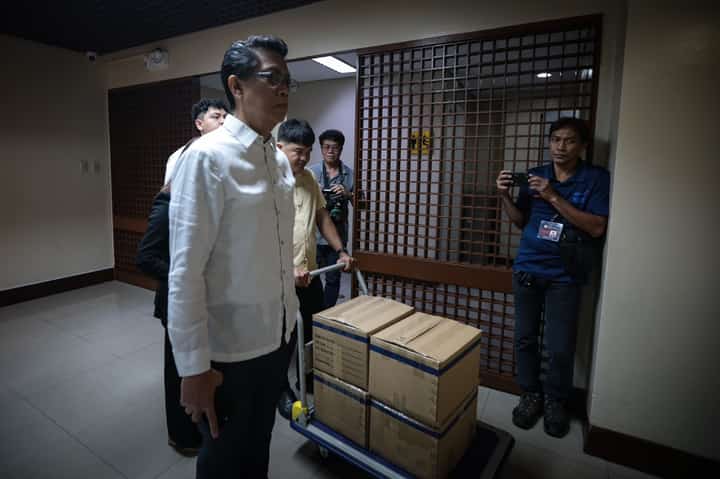
Officials from the BIR and the various bank accounts of Vice President Sara Duterte and her husband Atty. Manases "Mans" Carpio appeared at the Senate on Thursday, 30 July, to submit documents in compliance with the subpoena of the impeachment court. The documents are meant to serve as evidence for Article II of the impeachment, Duterte's unexplained wealth.
Aram Lascano
The tax records of Vice President Sara Duterte and her husband, Atty. Manases "Mans" Carpio, were formally submitted to the Senate after President Ferdinand Marcos Jr. approved their release, a House prosecutor said.
Rep. Terry Ridon announced Thursday, 30 July, that officials from the Bureau of Internal Revenue (BIR) turned over the couple's tax records in compliance with a subpoena issued by the Senate impeachment court.
Ridon said Marcos' approval was required under Section 71 of the National Internal Revenue Code (NIRC), which provides that income tax returns and similar records may only be disclosed upon the President's order.
Despite the documents being used in the ongoing impeachment trial, Ridon clarified that the request for presidential approval came from the BIR and not from the House prosecution panel.
"To be clear, the BIR commissioner will have to get approval from the President. As far as we know, because they complied and submitted the tax documents, they got approval from the President," Ridon said during a press conference.
He added that copies of the tax records would be furnished to both parties before they are marked as evidence and formally presented before the impeachment court.
The House Committee on Justice earlier found probable cause to include an article of impeachment alleging unexplained wealth against Duterte. The allegation stemmed from the purported improper declaration of her cash on hand and cash in bank in her Statements of Assets, Liabilities and Net Worth (SALNs) from 2019 to 2024.
Reports from the Anti-Money Laundering Council (AMLC) also identified transactions involving Duterte and Carpio amounting to P6.7 billion between 2006 and 2025, including 630 covered transactions and 33 suspicious transactions.
Under the Anti-Money Laundering Act, transactions exceeding P500,000 are classified as covered transactions and are subject to reporting requirements.
The allegation of unexplained wealth is contained in Article II of the impeachment complaint against the Vice President.
Four weeks into the trial, the House prosecution panel has completed presenting evidence on Article IV, which concerns Duterte's alleged grave threats against President Marcos, First Lady Liza Araneta-Marcos, and former House Speaker Martin Romualdez. Prosecutors have since begun presenting evidence on Article I, which deals with the alleged misuse of confidential funds.