
‘Surprised, but restrained’: Duterte defense won’t cast aspersions over subpoena ruling

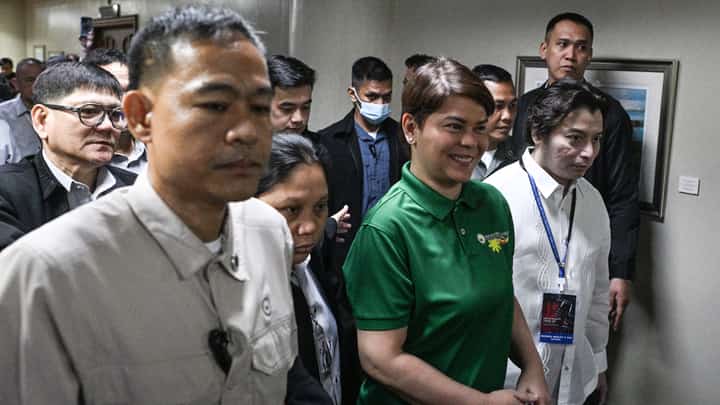
VICE President Sara Duterte, accompanied by lawyer Michael Poa, makes a surprise appearance at the Senate on Tuesday for a closed-door strategy meeting with her defense team as her historic impeachment trial unfolds. Inset: Senate President Sherwin Gatchalian confers with Senator Francis ‘Chiz’ Escudero, the presiding officer of the impeachment court, during the proceedings.
PHOTOGRAPH BY ARAM LASCANO FOR DAILY TRIBUNE/AGENCE FRANCE-PRESSE
Lawyers for Vice President Sara Duterte said on Tuesday they were surprised by a disclosure that the Senate impeachment court's ruling authorizing subpoenas for her financial records had been largely drafted before oral arguments were heard.
Defense spokesperson Michael Poa said the team would not “cast aspersions” on the impeachment court after spokesperson Regie Tongol said that most parts of the ruling read by Presiding Officer Sen. Francis “Chiz” Escudero on the subpoena request were already finished before the 6 July opening of the trial.
"I'd be lying if I said I wasn't surprised that something like that happened. But nonetheless, I don't think we should cast aspersions against the integrity of the court or anything like that. It is what it is. That was the resolution. That was the ruling," Poa told reporters ahead of Tuesday's proceedings.
On Monday, the Senate impeachment court granted prosecutors' request to subpoena Duterte's bank, tax and anti-money laundering records as part of efforts to prove allegations that she amassed unexplained wealth while in office.
The court said the records met the legal requirements for subpoenas and could be used to establish a baseline of Duterte's financial activities relevant to Article II of the impeachment complaint.
Poa said there were several possible explanations for why the ruling had been substantially prepared before oral arguments, including that senator-judges had already studied the legal issues but remained open to changing the decision after hearing both sides.
He, however, rejected suggestions that the oral arguments had been rendered meaningless.
"I cannot say the exercise was useless. At least we were able to ventilate the position of the defense, and the public heard the arguments of both the prosecution and the defense," Poa added.
The defense had opposed the subpoenas, arguing they were overly broad and risked eroding statutory privacy protections beyond the impeachment case itself. Prosecutors countered that the records were directly relevant to the unexplained wealth charge and satisfied the legal standards of relevance and specificity, arguments the impeachment court ultimately accepted.
"We are not afraid of the documents. If all of those documents come out, we are ready to confront each one of them," Poa said.
He added that the defense had yet to decide whether to elevate the subpoena ruling to the Supreme Court, adding that he had informed Duterte of the impeachment court's decision but had not yet discussed in detail whether to pursue further legal remedies.
"We're still studying our options. Before I ask the Vice President to make a decision, I have to present the pros and cons," he explained.
BIR records may require Marcos approval
Poa said presidential approval may still be required before the Bureau of Internal Revenue (BIR) releases Duterte’s tax records, despite the Senate impeachment court’s order compelling the production of her financial documents.
He said the requirement applies specifically to BIR records under Section 71 of the National Internal Revenue Code, which generally protects the confidentiality of taxpayer information and limits the disclosure of tax records except under certain circumstances.
“For BIR documents specifically, the exception is Section 71, where before those can be released, there has to be approval of the President,” Poa said.
Under the law, tax information obtained by the BIR is generally treated as confidential, with disclosures allowed only in instances authorized by statute or upon proper authority. The defense argued that the subpoena issued by the impeachment court does not automatically override these confidentiality safeguards.
Poa clarified that the same requirement does not apply to Duterte’s bank records or documents from the Anti-Money Laundering Council (AMLC), which are governed by separate rules.
For AMLC records, approval from the council is required before disclosure, while bank records are subject to banking secrecy and other applicable legal procedures, he said.
Under the process as he understands it, Poa said the BIR would first evaluate whether it would comply with the subpoena and, if it decides to release the records, make a recommendation to President Ferdinand Marcos Jr. for approval. ###