
The earthquake I survived—but never escaped


BAGUIO CITY — The afternoon of 16 July 1990, began like any other ordinary day. In just 45 seconds, it became a lifelong nightmare.
A magnitude 7.8 earthquake ripped through Luzon. Inside the pitch-black darkness of a local movie theater, the world suddenly convulsed with terrifying force.
Aurora Theater at Upper Mabini St.
Philippine News Agency Archives
As thick, suffocating dust filled the air, a panicked mass of people scrambled desperately toward exits they could no longer see. Amid the chaos, a nameless hand gripped my shirt collar with incredible strength, carried me, and threw me through a breaking exit into the daylight just moments before the entire structure collapsed into a heap of twisted concrete.
Stepping onto the unstable pavement outside, my instinct was simply to survive. But the true horror of the disaster was only beginning to unfold.
Something struck me hard in the back. I turned, expecting to see a fallen brick or a piece of timber. Instead, I found myself staring at the severed head of an elderly woman, her face frozen in the final, terrifying realization of what had happened.
My brother and I immediately began a frantic sprint through the crumbling streets of Baguio, desperately searching for our mother, who was selling sweepstakes tickets and newspapers on a sidewalk beneath one of the city's buildings.
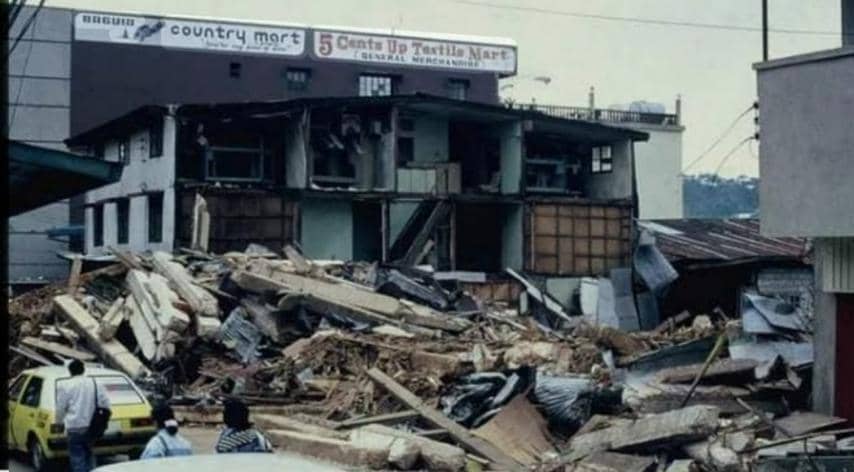
The mountain city had transformed into a valley of death, revealing just how fragile concrete structures could be against the overwhelming force of nature. Massive beams trapped victims in an instant, pinning bodies beneath shattered rubble while the agonizing cries of survivors echoed through the streets. People wept openly amid the ruins, and the unmistakable stench of death settled over the city.
The sights, sounds, and smells of that afternoon became permanently stitched into the minds of those who survived. Time moved forward, but those memories never did.
More than three decades have passed, yet the trauma has never truly left.
Dreams and vivid flashbacks still visit me, sometimes causing me to wake up crying or screaming, disturbing everyone else in the house. My nephew, who works in the medical field, once told me that these symptoms resemble post-traumatic stress disorder. Yet life moved on, and somehow I never found the time—or perhaps the courage—to seek professional help.
The psychological scars remain as raw as they were decades ago.
Talking about the earthquake has become its own burden. Whenever the subject comes up, I instinctively try to tell the story with humor—not because it is funny, but because laughter is the only way I can stop myself from breaking down in front of other people. Beneath that smile, however, the wounds remain open. Pride often demands that I appear strong, even when the memories continue to bleed inside.
In the years after the disaster, Baguio slowly rebuilt itself. Hotels reopened, businesses returned, and the city's familiar pine-lined streets gradually came back to life.
In response to the tragedy, authorities initially imposed strict building height limits and enforced construction standards intended to prevent history from repeating itself. Safety became the priority.
Today, however, those lessons seem increasingly forgotten.
Thirty-six years later, local safeguards appear to be overshadowed by national approvals and the relentless push for development. The hard-earned lessons of 1990 risk being buried beneath bureaucracy, as profit and expansion seem to take precedence over structural caution.
Developers often assure the public that today's buildings are constructed with stronger materials and more advanced engineering than those of decades past. They insist modern structures are designed to withstand future earthquakes.
Perhaps they are right.
But for those of us who watched entire buildings collapse like paper, those assurances offer little comfort. We have already seen what the earth is capable of.
Baguio today is more crowded than ever, filled with sprawling commercial complexes, high-rise condominiums, and endless concrete development. Many of the open spaces where terrified residents once sought refuge have disappeared beneath new foundations.
For younger generations, this transformation may symbolize progress.
For survivors like me, it often feels like something else entirely.
Every new tower is a reminder that if another earthquake of that magnitude strikes, there may be fewer places left to run.
Some people survived the 1990 earthquake.
Others, like me, survived—but never truly escaped it.