
Threat still a threat, prosec team says
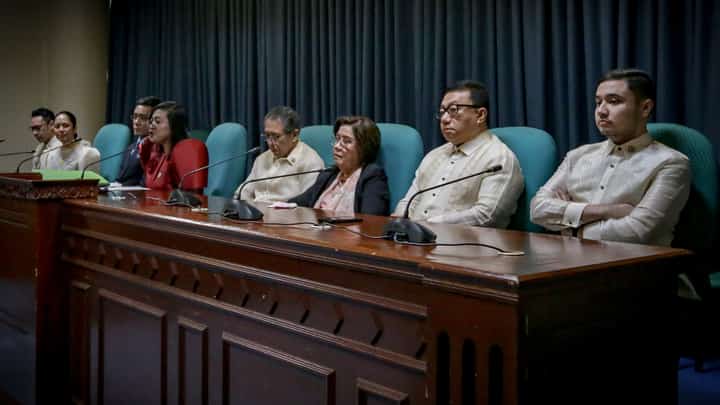
The prosecution team from the House of Representatives answers media queries on 22 June, during the second day of the pre-trial conference for Vice President Sara Duterte's impeacment trial.
Aram Lascano
Threats from Vice President Sara Duterte were “conditional,” but it remains a crime under Philippine law, members of the House prosecution said.
During a press briefing to sum up the first week of the impeachment trial, officials addressed the narrative that the defense of the Vice President sought to establish during its cross-examination of the first witness presented in the proceedings.
For the counsels of the respondent, their client’s seditious remarks were conditional as there was a supposed plot against her that was labeled “Oplan Romanoff,” allegedly intended to eliminate members of the Duterte clan.
VP Duterte revealed the claimed plot in late 2024, saying an unnamed source raised it during a Zoom call.
The dark operation was supposedly named after the Russian imperial family, the Romanovs, who were shot and stabbed to death by Bolshevik revolutionaries in Yekaterinburg in July 1918.
However, House private prosecutor Atty. Jay Tolosa pointed out that the conspiracy floated by officials close to the Vice President has been substantiated by evidence proving it was, in fact, real.
“We only heard about Oplan Romanoff in this trial through the statement of the defense counsel. It is clear that there is not an ounce of evidence that they can lay out to prove it in any way,” he expressed.
“It remains an allegation. And at the end of the day, it seems that by raising this matter, they’re making the point that they’re trying to justify the threats by raising this,” he added.
Tolosa maintained that even if the plot had substance, it could not rationalize the open and public threats directed to President Ferdinand Marcos Jr., first lady Liza Marcos, and former House Speaker Martin Romualdez.
The lawyer noted that such questions remain unanswered throughout the first three days of the trial.
House Deputy Speaker Rep. Paolo Ortega echoed the sentiment of the legal luminary, noting that the supposed existence of “Oplan Romanoff” does not diminish the fact that what Duterte said was a “grave crime” and that saying otherwise was nothing more than an excuse.
“As I said, this is not a joke. It’s a grave crime, regardless of the threat. Saying it’s a conditional threat is just an excuse for people who state grave threats,” Ortega said.
“Those things are not minor, something that can not be set aside. That’s a threat to the highest official of the land,” the solon explained.
Further adding to his sentiment that the threat was serious, Ortega stated that it was the first time in history that the second-highest official in the country uttered that she devised a way to kill high-ranking officials, much less the President of the state.
Meanwhile, House public prosecutor Rep. Ysabel Zamora responded to a question during the press conference on whether she thought that there would be an issue with the statement of National Bureau of Investigation (NBI) senior John Mark Calilung, who said that the threat was “absolute.”
Palace rebuttal
Amid the ongoing impeachment trial of Vice President Sara Duterte, the Executive Department did not hesitate to comment on what transpired at the 8 July hearing, after the defense panel said that the alleged grave threat uttered by Duterte against President Ferdinand Marcos Jr., First Lady Liza Araneta Marcos, and former House Speaker Martin Romualdez was hypothetical and conditional.
“The statement that she had already spoken to someone to kill the President, the First Lady, and the former House Speaker was not hypothetical. It was seen. It was not a figment of the imagination. It was not fantasy,” Palace press officer, Presidential Communications Office Undersecretary Claire Castro said when asked by the DAILY TRIBUNE in a Palace briefing on Thursday.
Because of the word ‘kapag pinatay ako’ (when I am killed), defense counsel Mark Vinluan, on Wednesday, argued that the threat was hypothetical and conditional (“kapag pinatay ako”), therefore, not a high crime or an impeachable offense.
Castro also maintained that the Vice President herself admitted in the video that the threat is not a joke. Raffy Ayeng