
Diocese of Laoag opposes proposed offshore wind projects in northern Ilocos Norte
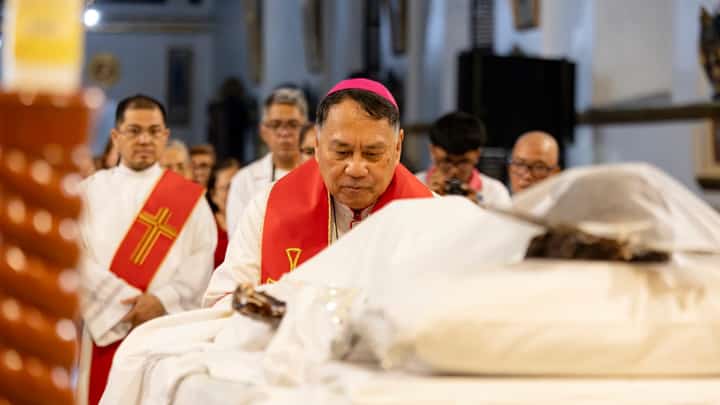
The Roman Catholic Diocese of Laoag has formally expressed its opposition to the proposed offshore wind projects covering the coastal waters of Burgos, Bangui, and Pagudpud, citing concerns over their impact on fisherfolk, marine ecosystems, and the livelihoods of coastal communities.
In a circular letter dated 28 June 2026, Bishop Renato P. Mayugba, DD called on the clergy, religious, and lay faithful to defend what the diocese described as the “common home” amid plans to establish massive offshore wind farms in northern Ilocos Norte.
The document, titled “Defending Our Common Home (Manifestation of the Diocese of Laoag vis-à-vis Proposed Offshore Wind Project in Burgos, Bangui and Pagudpud),” said the diocese reached its position after months of consultations with small-scale fisherfolk, coastal residents, and various sectors, guided by the teachings of Pope Francis’ encyclical Laudato Si’.
While acknowledging the need to transition to renewable energy, the diocese stressed that green energy projects should not come at the expense of vulnerable communities or the environment.
“Our stance is not born of mere opposition to progress, but from a profound moral duty to protect human dignity and the integrity of creation,” the circular read.
The diocese said the proposed installation of floating wind turbines could disrupt traditional fishing grounds, restrict access through designated no-sail zones, and potentially damage marine ecosystems that support thousands of families in Ilocos Norte.
It also claimed that more than 6,500 municipal fisherfolk from the towns of Pasuquin, Burgos, Bangui, and Pagudpud could face economic displacement if permanent 50-meter no-sail zones are established around the offshore turbines.
According to the circular, the installation of heavy underwater foundations and the continuous low-frequency noise generated by the turbines could affect fragile marine habitats, biodiversity, and fish migration patterns in Bangui Bay.
The diocese likewise opposed what it described as the commercialization of historic shorelines and communal waters, saying the proposed development could transform shared maritime spaces into restricted corporate zones.
Calling for a united response, the Diocese of Laoag urged government leaders, scientists, academic institutions, environmental advocates, youth groups, fisherfolk organizations, and the public to work together in protecting Ilocos Norte’s coastal resources.
“We call upon every Ilocano, every youth group, every fisherfolk organization, and every public official to stand shoulder-to-shoulder in this sacred defense,” the letter stated.
The diocese concluded its manifestation by declaring that the land, wind, and seas of Ilocos Norte are “not for sale” but a sacred trust that must be preserved for future generations.