
Building the power behind progress
‘At this stage, the Company is focused on preliminary evaluations and, consequently, no decisions or schedule around this have been defined.’

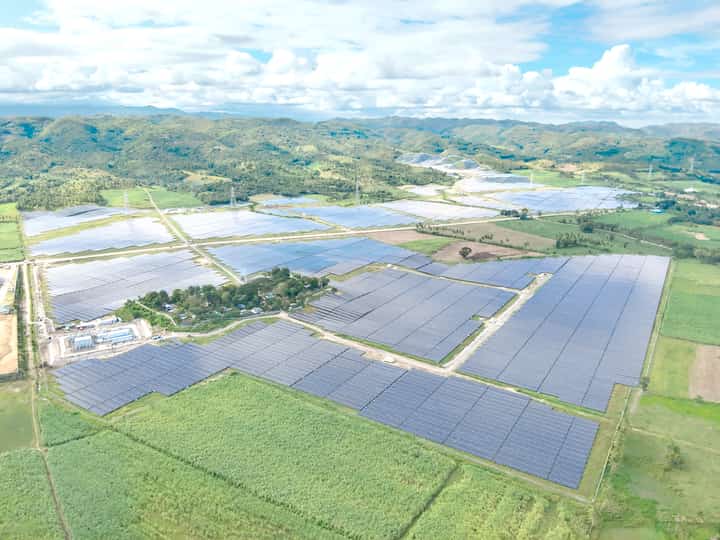
THE Olongapo Solar Power Plant of Aboitiz Power Corp. comes as the country’s energy regulators work to lessen one of its biggest economic vulnerabilities — its heavy reliance on imported fuel.
Photograph courtesy of Aboitiz Power
Behind every new factory that opens, every train that rolls out, every data center that comes online, and every investment that lands in the Philippines is one thing that often goes unnoticed: electricity.
Economic growth is impossible without it.
As the country pushes to industrialize, attract more investors and create jobs, the challenge is no longer simply generating enough power.
It is building an energy system that can keep up with an economy that refuses to stand still.
That makes the country’s power sector more than a utility business — it has become one of the foundations of national development. And increasingly, it is being built through a growing partnership between government and the private sector. Among the companies helping lead that effort is Aboitiz Power Corp.
The Department of Energy’s (DoE) recent endorsement of Aboitiz Renewables’ 221-megawatt-peak Olongapo Solar Power Plant highlights how closely the company’s expansion aligns with the government’s push to secure the country’s energy future.
Following a visit to the facility, Energy Secretary Sharon Garin identified the project as one of 22 renewable energy developments being prioritized by the government to accelerate the country’s transition toward cleaner, more reliable electricity.
The support comes as the Philippines works to lessen one of its biggest economic vulnerabilities — its heavy reliance on imported fuel.
For decades, global oil price shocks triggered by wars, supply disruptions and geopolitical tensions have rippled through the Philippine economy, pushing up electricity costs for households and businesses alike. Expanding indigenous energy sources such as solar, hydro wind and geothermal offers a way to reduce that dependence while making the country’s power supply more resilient.
The Olongapo Solar Power Plant, energized in December 2025, represents another step toward that goal.
It also reflects the speed of AboitizPower’s renewable expansion. In just five years, Aboitiz Renewables has increased its attributable dependable capacity to 2.3 gigawatts from roughly 900 MW, making it one of the country’s fastest-growing clean energy platforms.
But building power behind progress takes more than adding solar panels.
During the DoE visit, government officials and AboitizPower executives discussed a broader pipeline of renewable energy projects spanning solar, geothermal, hydroelectric, wind and battery energy storage — investments designed not only to generate more electricity but also to improve grid reliability as demand continues to rise.
The company has already strengthened its renewable portfolio by operating the 789-megawatt Caliraya-Botocan-Kalayaan Hydroelectric Power Plant Complex, one of the country’s largest renewable energy assets.
Even as renewables expand, AboitizPower is also looking beyond today’s technologies.
The company recently joined the DOE and the National Power Corp. in a government-led feasibility study that will examine potential nuclear power sites in the Philippines, including the possible revival of the long-idled Bataan Nuclear Power Plant.
The move does not signal an imminent nuclear project.
Instead, it reflects another example of government and industry working together to study how future technologies can strengthen the country’s long-term energy security.
AboitizPower emphasized that the memorandum of understanding is purely exploratory and carries no commitment to build a nuclear facility.
“At this stage, the Company is focused on preliminary evaluations and, consequently, no decisions or schedule around this have been defined,” AboitizPower said in a disclosure.
The DoE said the study will evaluate potential sites—including the BNPP—based on safety, security, infrastructure, site suitability, and regulatory readiness, in accordance with International Atomic Energy Agency standards.
It forms part of the Philippine Energy Plan, which targets 1,200 MW of nuclear capacity by 2032, increasing to 2,400 MW by 2035, and reaching 4,800 MW by 2050 as the country diversifies its energy mix.
For AboitizPower, whether the solution comes from solar panels, hydroelectric dams, battery storage, or eventually nuclear technology, the objective remains the same.
“AboitizPower remains focused on providing reliable and reasonably priced energy to its customers while minimizing environmental and community impact,” the company said.
That strategy has also become central to the broader Aboitiz Group.
Despite booking a P7.2-billion impairment related to the partial impairment of the GNPower Mariveles Energy Center, parent company Aboitiz Equity Ventures Inc. reported net income of P18.3 billion in 2025, while core earnings held steady at P25.5 billion.
Power remained its biggest earnings engine, with AboitizPower contributing 46 percent of the conglomerate’s total net income from strategic business units.
As the Philippines competes for manufacturing investments, digital infrastructure, and new industries, electricity is no longer simply another utility—it is economic infrastructure.
The DOE’s support for the Olongapo Solar Power Plant illustrates how public policy and private capital are increasingly moving in the same direction. Together, they are building more than power plants. They are building the foundation for the country’s next chapter of growth, ensuring that when opportunity arrives, the lights stay on.