




45 feather days
Replacement-cost pricing lets companies re-price against a hypothetical future invoice. The rocket’s engine would have a zero inventory lag on the way up.

Text size
Replacement-cost pricing lets companies re-price against a hypothetical future invoice. The rocket’s engine would have a zero inventory lag on the way up.
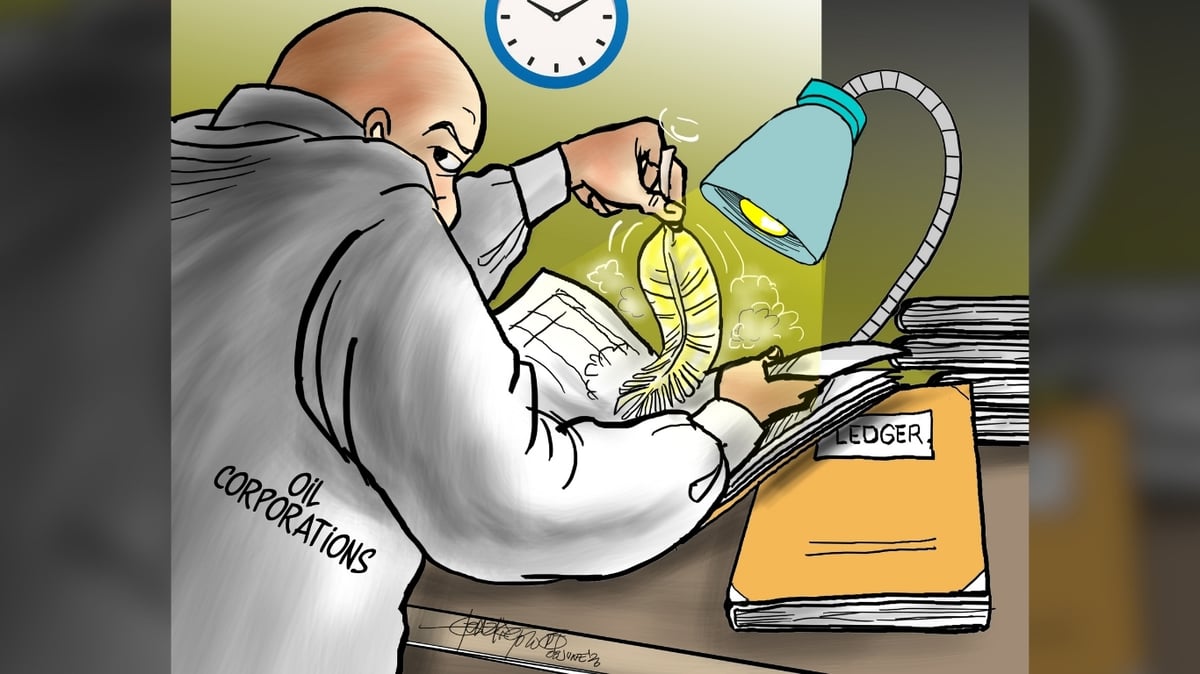
In the highly dubious pricing of fuel products, economists such as University of the Philippines School of Economics professor emeritus Solita Monsod invoke the rocket-and-feather metaphor. The hypothesis is tested against what oil companies were actually holding in their tanks as prices moved.
On 28 February, when the US and Israel bombed Iran, the Philippines had roughly 45 to 50 days of gasoline and diesel sitting in storage — fuel already paid for at the pre-war price. Within days, pump prices jumped — that is the rocket — and the inventory computation is what convicts it.
There was no justification for an instant upsurge since the gas in the storage tanks had been purchased weeks earlier at the old rate. The only thing that had changed was the cost of replacing that diesel once the tanks ran dry, a cost that hadn’t been incurred yet, given that the existing stock would last 45 days.
Replacement-cost pricing lets companies re-price against a hypothetical future invoice. The rocket’s engine would have a zero inventory lag on the way up.
A deceleration inverts the logic that makes for the feather. Consider the supply surplus in the Middle East and the increased production elsewhere after the US-Iran ceasefire held and tanker traffic resumed through Hormuz, with the steepest relief landing in May and June.
A retailer selling that inventory at a price reflecting the new, cheaper crude would be selling at a loss until the costly stock cleared. Here, unlike on the way up, the lag has a genuine justification.
The inventory cycle is about 45 days or roughly six and a half weeks. Dubai crude’s peak fell in early April; the rollbacks didn’t reach what the Department of Energy (DoE) called the “biggest since the crisis peaked” until 2 June, and a second round just as large followed on 23 June, closer to 11 or 12 weeks after the peak.
If purchase cost is considered, the descent should have tracked one inventory turn almost exactly, and prices should have fallen in lockstep with the crude for the first 45 days, as old high-cost stock still had to clear, then closed the remaining gap fast once fresh, cheap crude inventory dominated the tanks.
Instead, the gap narrowed gradually across nearly two turns, with the most aggressive single-week cuts arriving only after the ceasefire extension was already old news.
That second, slower stretch is no longer explainable by inventory at all since by the seventh or eighth week, the tanks should have been substantially restocked at post-ceasefire prices. Monsod referred to this as the precise asymmetry. Replacement cost makes the prices of old stocks disappear when crude rises, accelerating the March spike.
When crude falls, the adjustments take twice as long, a scheme oil companies employ to protect their obscene margins.
The simplest explanation is that pump prices rocket without a lag. In contrast, a slide in crude prices needs only one inventory cycle to reflect the lower cost, since companies must first discard the higher-cost inventory before passing on savings, but the actual adjustment takes twice as long.
The DoE had said as much in issuing a warning about the delay, but no agency dares challenge the pricing mechanism, since the industry is deregulated.
The political will is missing, as no one asks the oil companies to justify their fuel-costing methods.
Three decades after the Marcopper mining disaster devastated Marinduque’s waterways, the province is again pressing the…
Housing is probably the biggest issue affecting people the world over.
Malacañang on Monday called for a more thorough investigation into the questioned flood control projects in Taguig…
The defense on Monday backed the move by senator-judges to exclude a prosecution witness who testified on the firearms…
